
About This Book
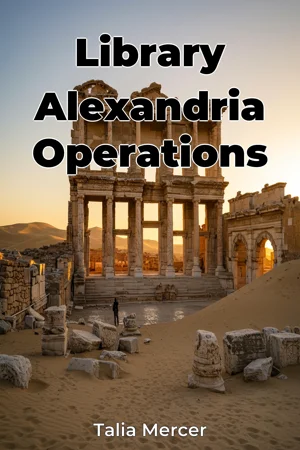
What if the accumulated wisdom of an entire civilization vanished, leaving behind only fragmented clues? This book, *Library Alexandria Operations*, undertakes a detailed reconstruction of the ancient Library of Alexandria, exploring its structure, goals, and scholarly output using available archaeological and historical evidence. Understanding the Library’s function and impact is crucial for comprehending the intellectual landscape of the Hellenistic world and its lasting influence on Western scholarship. This book delves into the core functions of the Library, focusing on two primary areas: the acquisition and organization of knowledge, and the facilitation of scholarly activity. The first section examines the Library's methods for amassing its vast collection, scrutinizing the processes of book acquisition, translation, and preservation. The second analyzes the activities of the scholars who worked within its walls, investigating their research, writing, and teaching endeavors. The historical context is pivotal. The Library emerged during the Ptolemaic dynasty in Egypt, a period marked by unprecedented cultural exchange and intellectual ferment. Its establishment reflected the Ptolemies' ambition to create a center of learning that rivaled Athens and other Greek intellectual hubs. A basic understanding of Hellenistic history and the development of Alexandria as a cosmopolitan city is beneficial for fully appreciating the Library’s role. The central argument of *Library Alexandria Operations* is that the Library of Alexandria was not simply a repository of texts, but a dynamic intellectual center that actively shaped the development of scholarship, science, and literature in the ancient world. This argument challenges traditional views that often portray the Library as a passive archive, emphasizing instead its proactive role in knowledge creation and dissemination. The book is structured in four parts. Part One introduces the historical context and explores the founding and physical structure of the Library. Part Two investigates the Library’s collection, detailing acquisition methods, cataloging practices, and the challenges of preserving ancient texts. Part Three analyzes the scholarly activities pursued within the Library, focusing on specific fields such as mathematics, astronomy, and literature. Part Four examines the Library's decline and eventual destruction, considering various theories and assessing its lasting legacy. The analysis relies heavily on primary source material, including fragments of papyri, inscriptions, and accounts from ancient authors such as Strabo, Plutarch, and Galen. Archaeological findings from Alexandria are also integrated to provide a more complete picture of the Library's physical environment. The book also employs secondary scholarship, critically evaluating existing interpretations and offering new perspectives based on meticulous analysis of the available evidence. The book intersects with several other fields of study. It connects to classical studies by examining the transmission of Greek literature and philosophy. It relates to the history of science by exploring the scientific advancements made by scholars associated with the Library. Finally, it links to library science by investigating the Library's organizational methods and their influence on modern library practices. *Library Alexandria Operations* distinguishes itself by adopting an operational perspective, focusing on the practical aspects of how the Library functioned on a day-to-day basis. This approach moves beyond romanticized notions of the Library, offering a grounded reconstruction based on the available evidence. The book is written in an academic style, maintaining a formal and objective tone while remaining accessible to a broad readership. The target audience includes historians, classicists, library scientists, and anyone interested in the history of knowledge and the intellectual achievements of the ancient world. This book provides a valuable resource for students, researchers, and general readers seeking a comprehensive and nuanced understanding of the Library of Alexandria. The scope of the book is limited to the Library's activities during its period of greatest influence, from the 3rd century BCE to the Roman period. It does not attempt to cover every aspect of Alexandrian history or culture, but focuses specifically on the Library and its role as a center of learning. The information presented in this book has real-world applications for modern librarians and information scientists, offering insights into the challenges of managing and preserving vast collections of knowledge. The book also provides valuable lessons about the importance of intellectual freedom, collaboration, and the pursuit of knowledge for its own sake. The historical accounts surrounding the Library of Alexandria are filled with debates. This book addresses the ongoing controversies surrounding the Library's destruction. By critically evaluating different theories and presenting the available evidence, the book aims to provide a balanced and informed perspective on this complex topic.
What if the accumulated wisdom of an entire civilization vanished, leaving behind only fragmented clues? This book, *Library Alexandria Operations*, undertakes a detailed reconstruction of the ancient Library of Alexandria, exploring its structure, goals, and scholarly output using available archaeological and historical evidence. Understanding the Library’s function and impact is crucial for comprehending the intellectual landscape of the Hellenistic world and its lasting influence on Western scholarship. This book delves into the core functions of the Library, focusing on two primary areas: the acquisition and organization of knowledge, and the facilitation of scholarly activity. The first section examines the Library's methods for amassing its vast collection, scrutinizing the processes of book acquisition, translation, and preservation. The second analyzes the activities of the scholars who worked within its walls, investigating their research, writing, and teaching endeavors. The historical context is pivotal. The Library emerged during the Ptolemaic dynasty in Egypt, a period marked by unprecedented cultural exchange and intellectual ferment. Its establishment reflected the Ptolemies' ambition to create a center of learning that rivaled Athens and other Greek intellectual hubs. A basic understanding of Hellenistic history and the development of Alexandria as a cosmopolitan city is beneficial for fully appreciating the Library’s role. The central argument of *Library Alexandria Operations* is that the Library of Alexandria was not simply a repository of texts, but a dynamic intellectual center that actively shaped the development of scholarship, science, and literature in the ancient world. This argument challenges traditional views that often portray the Library as a passive archive, emphasizing instead its proactive role in knowledge creation and dissemination. The book is structured in four parts. Part One introduces the historical context and explores the founding and physical structure of the Library. Part Two investigates the Library’s collection, detailing acquisition methods, cataloging practices, and the challenges of preserving ancient texts. Part Three analyzes the scholarly activities pursued within the Library, focusing on specific fields such as mathematics, astronomy, and literature. Part Four examines the Library's decline and eventual destruction, considering various theories and assessing its lasting legacy. The analysis relies heavily on primary source material, including fragments of papyri, inscriptions, and accounts from ancient authors such as Strabo, Plutarch, and Galen. Archaeological findings from Alexandria are also integrated to provide a more complete picture of the Library's physical environment. The book also employs secondary scholarship, critically evaluating existing interpretations and offering new perspectives based on meticulous analysis of the available evidence. The book intersects with several other fields of study. It connects to classical studies by examining the transmission of Greek literature and philosophy. It relates to the history of science by exploring the scientific advancements made by scholars associated with the Library. Finally, it links to library science by investigating the Library's organizational methods and their influence on modern library practices. *Library Alexandria Operations* distinguishes itself by adopting an operational perspective, focusing on the practical aspects of how the Library functioned on a day-to-day basis. This approach moves beyond romanticized notions of the Library, offering a grounded reconstruction based on the available evidence. The book is written in an academic style, maintaining a formal and objective tone while remaining accessible to a broad readership. The target audience includes historians, classicists, library scientists, and anyone interested in the history of knowledge and the intellectual achievements of the ancient world. This book provides a valuable resource for students, researchers, and general readers seeking a comprehensive and nuanced understanding of the Library of Alexandria. The scope of the book is limited to the Library's activities during its period of greatest influence, from the 3rd century BCE to the Roman period. It does not attempt to cover every aspect of Alexandrian history or culture, but focuses specifically on the Library and its role as a center of learning. The information presented in this book has real-world applications for modern librarians and information scientists, offering insights into the challenges of managing and preserving vast collections of knowledge. The book also provides valuable lessons about the importance of intellectual freedom, collaboration, and the pursuit of knowledge for its own sake. The historical accounts surrounding the Library of Alexandria are filled with debates. This book addresses the ongoing controversies surrounding the Library's destruction. By critically evaluating different theories and presenting the available evidence, the book aims to provide a balanced and informed perspective on this complex topic.
*Library Alexandria Operations* explores the renowned Library of Alexandria, a pivotal institution in the Hellenistic world. The book investigates its mission, organizational structure, and the intellectual achievements of its scholars. By examining how the Ptolemaic dynasty fostered an environment for learning, the narrative sheds light on the Library's significant role in shaping Western scholarship and intellectual history. Contrary to seeing it as merely a storehouse, the book posits the Library as a dynamic center for knowledge creation and dissemination. The study uniquely focuses on the Library’s operations, detailing book acquisition, translation, and preservation methods. It also examines the scholarly activities within its walls, including research in mathematics, astronomy, and literature, highlighting the Library’s influence on the history of science. The book progresses from introducing the historical context and physical structure, to analyzing the collection and scholarly activities. Finally, it addresses the Library's decline, considering various theories surrounding its destruction and assessing its lasting legacy in classical studies.
Book Details
ISBN
9788235262912
Publisher
Publifye AS
Your Licenses
You don't own any licenses for this book
Purchase a license below to unlock this book and download the EPUB.
Purchase License
Select a tier to unlock this book
Need bulk licensing?
Contact us for enterprise agreements.