
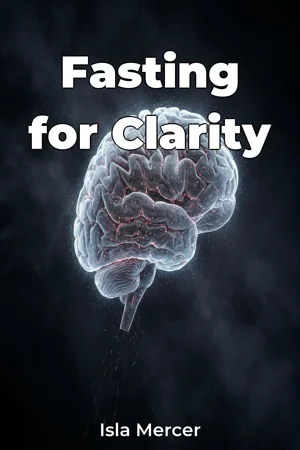
About This Book
Are you seeking a clearer mind and enhanced cognitive function? "Fasting for Clarity" explores the profound connection between periods of voluntary abstinence from food and improved brain function, offering a comprehensive guide to understanding and implementing fasting for cognitive enhancement. This book delves into the neurological mechanisms that underpin the cognitive benefits of fasting, providing readers with a science-backed approach to optimizing their mental performance. This exploration is important because of the growing need to optimize cognitive performance in an increasingly demanding world. Further, understanding the science behind practices like fasting empowers individuals to make informed choices about their health and lifestyle. This book does not offer a historical overview of fasting. Instead, it focuses on the modern scientific understanding of how fasting impacts the brain. While the practice of fasting has ancient roots, this book centers around contemporary research in neuroscience, nutrition, and physiology. Readers will benefit from a basic understanding of biological concepts, such as cellular energy production and hormonal regulation, but these concepts will be explained in accessible terms throughout the book. The central argument of "Fasting for Clarity" is that strategic fasting practices can significantly improve cognitive functions like focus, memory, and mental sharpness by triggering specific neurological processes. It is important to understand the mechanisms involved so that readers can implement the best strategies and dispel any misconceptions. The book begins by introducing the core concepts of fasting and its physiological effects, including ketogenesis and autophagy. The narrative progresses by examining how these processes directly impact brain function. Crucially, the book explores the effects of intermittent fasting, time-restricted eating, and extended fasting on various cognitive domains. It then culminates in a practical guide on how to safely and effectively incorporate fasting into one's lifestyle, outlining different fasting protocols and addressing potential risks and considerations. The evidence presented in "Fasting for Clarity" is based on a thorough review of scientific literature, including human clinical trials, animal studies, and meta-analyses. The book draws upon research from respected journals in neuroscience, nutrition, and metabolic health. Where applicable, quantitative data is presented to support claims, providing a rigorous, evidence-based foundation. This book also connects to other fields, most notably, dietetics – exploring optimal nutrition during and after fasting periods. It also connects to the area of preventative medicine – examining the long-term impacts of fasting on brain health and the prevention of neurodegenerative diseases. Finally, it links to exercise physiology to explain how combining fasting with physical activity can maximize cognitive and physical benefits. "Fasting for Clarity" offers a unique perspective by focusing specifically on the cognitive benefits of fasting, differentiating itself from general guides on weight loss or metabolic health. It emphasizes the neurological mechanisms involved, thereby providing a more profound understanding of how fasting impacts the brain. The tone throughout the book is informative and accessible, geared towards educated readers interested in optimizing their health and cognitive function. The target audience includes health-conscious individuals, biohackers, students, professionals, and anyone seeking to improve their mental performance. The book is valuable to them because it provides clear, science-backed guidance on a topic often surrounded by misinformation and hype. As a health and fitness book, "Fasting for Clarity" provides practical strategies and guidelines for incorporating fasting into one's lifestyle. As a psychology book, it delves into the cognitive and emotional effects of these strategies. As a health fitness book, it bridges that gap and creates relevant, actionable advice that considers short and long-term impacts to the reader. The scope of "Fasting for Clarity" is intentionally limited to the cognitive effects of fasting in healthy adults. It does not extensively cover the use of fasting for specific medical conditions, although it acknowledges potential therapeutic applications. The book also avoids making unsubstantiated claims or promoting extreme fasting practices. Readers will learn how to implement various fasting protocols, monitor their cognitive performance, and adjust their approach based on individual needs and responses. They will also gain insights into optimizing their diet and lifestyle to support the cognitive benefits of fasting. The book also addresses controversies and debates surrounding fasting, such as the safety and efficacy of different fasting protocols, potential risks for certain populations, and ethical considerations. It presents a balanced perspective, acknowledging both the potential benefits and risks of fasting.
Are you seeking a clearer mind and enhanced cognitive function? "Fasting for Clarity" explores the profound connection between periods of voluntary abstinence from food and improved brain function, offering a comprehensive guide to understanding and implementing fasting for cognitive enhancement. This book delves into the neurological mechanisms that underpin the cognitive benefits of fasting, providing readers with a science-backed approach to optimizing their mental performance. This exploration is important because of the growing need to optimize cognitive performance in an increasingly demanding world. Further, understanding the science behind practices like fasting empowers individuals to make informed choices about their health and lifestyle. This book does not offer a historical overview of fasting. Instead, it focuses on the modern scientific understanding of how fasting impacts the brain. While the practice of fasting has ancient roots, this book centers around contemporary research in neuroscience, nutrition, and physiology. Readers will benefit from a basic understanding of biological concepts, such as cellular energy production and hormonal regulation, but these concepts will be explained in accessible terms throughout the book. The central argument of "Fasting for Clarity" is that strategic fasting practices can significantly improve cognitive functions like focus, memory, and mental sharpness by triggering specific neurological processes. It is important to understand the mechanisms involved so that readers can implement the best strategies and dispel any misconceptions. The book begins by introducing the core concepts of fasting and its physiological effects, including ketogenesis and autophagy. The narrative progresses by examining how these processes directly impact brain function. Crucially, the book explores the effects of intermittent fasting, time-restricted eating, and extended fasting on various cognitive domains. It then culminates in a practical guide on how to safely and effectively incorporate fasting into one's lifestyle, outlining different fasting protocols and addressing potential risks and considerations. The evidence presented in "Fasting for Clarity" is based on a thorough review of scientific literature, including human clinical trials, animal studies, and meta-analyses. The book draws upon research from respected journals in neuroscience, nutrition, and metabolic health. Where applicable, quantitative data is presented to support claims, providing a rigorous, evidence-based foundation. This book also connects to other fields, most notably, dietetics – exploring optimal nutrition during and after fasting periods. It also connects to the area of preventative medicine – examining the long-term impacts of fasting on brain health and the prevention of neurodegenerative diseases. Finally, it links to exercise physiology to explain how combining fasting with physical activity can maximize cognitive and physical benefits. "Fasting for Clarity" offers a unique perspective by focusing specifically on the cognitive benefits of fasting, differentiating itself from general guides on weight loss or metabolic health. It emphasizes the neurological mechanisms involved, thereby providing a more profound understanding of how fasting impacts the brain. The tone throughout the book is informative and accessible, geared towards educated readers interested in optimizing their health and cognitive function. The target audience includes health-conscious individuals, biohackers, students, professionals, and anyone seeking to improve their mental performance. The book is valuable to them because it provides clear, science-backed guidance on a topic often surrounded by misinformation and hype. As a health and fitness book, "Fasting for Clarity" provides practical strategies and guidelines for incorporating fasting into one's lifestyle. As a psychology book, it delves into the cognitive and emotional effects of these strategies. As a health fitness book, it bridges that gap and creates relevant, actionable advice that considers short and long-term impacts to the reader. The scope of "Fasting for Clarity" is intentionally limited to the cognitive effects of fasting in healthy adults. It does not extensively cover the use of fasting for specific medical conditions, although it acknowledges potential therapeutic applications. The book also avoids making unsubstantiated claims or promoting extreme fasting practices. Readers will learn how to implement various fasting protocols, monitor their cognitive performance, and adjust their approach based on individual needs and responses. They will also gain insights into optimizing their diet and lifestyle to support the cognitive benefits of fasting. The book also addresses controversies and debates surrounding fasting, such as the safety and efficacy of different fasting protocols, potential risks for certain populations, and ethical considerations. It presents a balanced perspective, acknowledging both the potential benefits and risks of fasting.
"Fasting for Clarity" explores the powerful link between fasting and enhanced brain function, offering a science-backed guide to cognitive enhancement. Delving into neuroscience, the book reveals how practices like intermittent fasting and time-restricted eating can sharpen focus, improve memory, and boost overall mental sharpness. One intriguing fact is that fasting triggers ketogenesis, providing the brain with an alternative energy source. Another is that it activates autophagy, a cellular cleaning process beneficial for brain health. The book progresses logically by first introducing the core principles of fasting and its physiological effects, such as ketogenesis and autophagy. Second, it examines how these processes directly impact cognitive function. Finally, it culminates with practical guidelines for safely incorporating fasting into your lifestyle, including different protocols, potential risks, and considerations. Unlike general weight loss guides, this book uniquely focuses on the neurological mechanisms behind fasting's cognitive benefits, making it a valuable resource for anyone seeking to optimize their mental performance through dietetics and strategic health and fitness practices.
Book Details
ISBN
9788235262356
Publisher
Publifye AS
Your Licenses
You don't own any licenses for this book
Purchase a license below to unlock this book and download the EPUB.
Purchase License
Select a tier to unlock this book
Need bulk licensing?
Contact us for enterprise agreements.