
About This Book
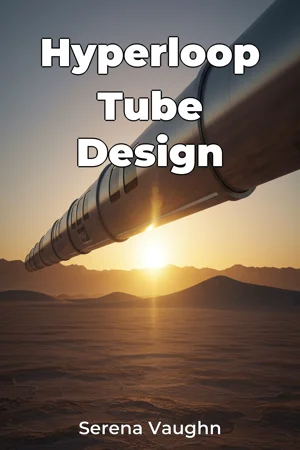
What if passenger transport could achieve speeds exceeding 700 miles per hour, traveling in near-vacuum conditions? "Hyperloop Tube Design" delves into this revolutionary concept, exploring the intricate engineering challenges and solutions surrounding the design, construction, and maintenance of the hyperloop tube infrastructure. This book focuses on three pivotal aspects: materials science in tube construction, the physics of reduced-pressure environments, and structural engineering for stability and safety, each vital for making hyperloop systems a viable mode of transportation. Hyperloop technology, while promising, demands a synergy of multiple engineering disciplines. This book addresses the pressing need for optimized tube designs capable of withstanding the stresses of both high-speed travel and low-pressure environments, while also being economically feasible and environmentally sustainable. We assert that a successful hyperloop implementation hinges on innovative tube designs that integrate advanced materials, precise pressure control, and robust structural integrity. Providing a comprehensive understanding of hyperloop tube design, the book begins by establishing the theoretical foundations of vacuum technology and high-speed aerodynamics within confined spaces. It then transitions to practical considerations, such as material selection criteria, encompassing factors like tensile strength, thermal expansion, and resistance to corrosion in reduced-pressure settings. Finite element analysis (FEA) simulations and real-world case studies are presented to illustrate the behavior of different tube designs under operational loads. The book is structured into three primary sections. The first introduces the fundamental principles of hyperloop technology, its history, and its potential impact on transportation. It also provides a detailed overview of the environmental conditions inside the tube, including pressure levels, temperature variations, and dynamic loads. The second section meticulously examines materials science, focusing on the selection of appropriate materials like high-strength steel alloys, composites, and concrete mixes, considering their cost, durability, and manufacturing feasibility. This section includes data from materials testing facilities and experimental studies on material fatigue under cyclic loading. The third section concentrates on structural engineering aspects, covering tube geometry optimization using computational fluid dynamics (CFD) and FEA. It also delves into methods for mitigating thermal stress, buckling, and vibrational resonance, along with strategies for ensuring tube alignment and stability across varied terrains. This involves data on ground settlement, seismic activity, and weather patterns. The evidence presented draws from academic research, industry reports, and data collected from ongoing hyperloop test facilities worldwide. We analyze publicly available data from companies involved in hyperloop development and incorporate findings from experimental studies on tube performance. The methodologies employed include a combination of theoretical analysis, computer simulations, and experimental validation. This book connects to several other fields, including transportation planning, urban development, and environmental science. It explores the potential of hyperloop systems to reduce travel times, alleviate traffic congestion, and decrease carbon emissions. It assesses the environmental impact of hyperloop construction and operation, considering factors such as land use, energy consumption, and noise pollution. Furthermore, it touches upon the socioeconomic implications of hyperloop technology, including job creation, regional development, and accessibility to transportation services. This book bridges the gap between theoretical concepts and practical implementation, offering a pragmatic approach to hyperloop tube design. It provides actionable insights and design guidelines applicable to real-world projects. Written in a formal style, the book targets engineers, scientists, researchers, and policymakers involved in hyperloop development. It also caters to university students studying civil engineering, mechanical engineering, and aerospace engineering. A reader with a background in engineering mathematics and physics will find the book particularly accessible. The scope of this book is limited to the design and engineering of hyperloop tubes. While it touches upon other aspects of hyperloop technology, such as propulsion systems and pod design, these topics are not covered in detail. The information presented here can be applied to the design of new hyperloop systems, the optimization of existing infrastructure, and the development of innovative materials and construction techniques. While hyperloop technology holds immense potential, debates persist regarding its economic viability, safety, and environmental impact, and this book offers a balanced perspective on these debates.
What if passenger transport could achieve speeds exceeding 700 miles per hour, traveling in near-vacuum conditions? "Hyperloop Tube Design" delves into this revolutionary concept, exploring the intricate engineering challenges and solutions surrounding the design, construction, and maintenance of the hyperloop tube infrastructure. This book focuses on three pivotal aspects: materials science in tube construction, the physics of reduced-pressure environments, and structural engineering for stability and safety, each vital for making hyperloop systems a viable mode of transportation. Hyperloop technology, while promising, demands a synergy of multiple engineering disciplines. This book addresses the pressing need for optimized tube designs capable of withstanding the stresses of both high-speed travel and low-pressure environments, while also being economically feasible and environmentally sustainable. We assert that a successful hyperloop implementation hinges on innovative tube designs that integrate advanced materials, precise pressure control, and robust structural integrity. Providing a comprehensive understanding of hyperloop tube design, the book begins by establishing the theoretical foundations of vacuum technology and high-speed aerodynamics within confined spaces. It then transitions to practical considerations, such as material selection criteria, encompassing factors like tensile strength, thermal expansion, and resistance to corrosion in reduced-pressure settings. Finite element analysis (FEA) simulations and real-world case studies are presented to illustrate the behavior of different tube designs under operational loads. The book is structured into three primary sections. The first introduces the fundamental principles of hyperloop technology, its history, and its potential impact on transportation. It also provides a detailed overview of the environmental conditions inside the tube, including pressure levels, temperature variations, and dynamic loads. The second section meticulously examines materials science, focusing on the selection of appropriate materials like high-strength steel alloys, composites, and concrete mixes, considering their cost, durability, and manufacturing feasibility. This section includes data from materials testing facilities and experimental studies on material fatigue under cyclic loading. The third section concentrates on structural engineering aspects, covering tube geometry optimization using computational fluid dynamics (CFD) and FEA. It also delves into methods for mitigating thermal stress, buckling, and vibrational resonance, along with strategies for ensuring tube alignment and stability across varied terrains. This involves data on ground settlement, seismic activity, and weather patterns. The evidence presented draws from academic research, industry reports, and data collected from ongoing hyperloop test facilities worldwide. We analyze publicly available data from companies involved in hyperloop development and incorporate findings from experimental studies on tube performance. The methodologies employed include a combination of theoretical analysis, computer simulations, and experimental validation. This book connects to several other fields, including transportation planning, urban development, and environmental science. It explores the potential of hyperloop systems to reduce travel times, alleviate traffic congestion, and decrease carbon emissions. It assesses the environmental impact of hyperloop construction and operation, considering factors such as land use, energy consumption, and noise pollution. Furthermore, it touches upon the socioeconomic implications of hyperloop technology, including job creation, regional development, and accessibility to transportation services. This book bridges the gap between theoretical concepts and practical implementation, offering a pragmatic approach to hyperloop tube design. It provides actionable insights and design guidelines applicable to real-world projects. Written in a formal style, the book targets engineers, scientists, researchers, and policymakers involved in hyperloop development. It also caters to university students studying civil engineering, mechanical engineering, and aerospace engineering. A reader with a background in engineering mathematics and physics will find the book particularly accessible. The scope of this book is limited to the design and engineering of hyperloop tubes. While it touches upon other aspects of hyperloop technology, such as propulsion systems and pod design, these topics are not covered in detail. The information presented here can be applied to the design of new hyperloop systems, the optimization of existing infrastructure, and the development of innovative materials and construction techniques. While hyperloop technology holds immense potential, debates persist regarding its economic viability, safety, and environmental impact, and this book offers a balanced perspective on these debates.
"Hyperloop Tube Design" explores the innovative engineering required for high-speed transportation systems exceeding 700 miles per hour in near-vacuum conditions. It emphasizes the critical role of tube infrastructure, highlighting how advanced materials, precise pressure control using vacuum technology, and robust structural integrity are essential for hyperloop viability. The book uniquely addresses the challenges of designing tubes capable of withstanding the combined stresses of high-speed travel and low-pressure environments, while promoting economic feasibility and environmental sustainability. The book begins with the theoretical underpinnings of vacuum technology and high-speed aerodynamics before moving into practical considerations like material selection, which involves balancing tensile strength with resistance to corrosion. Finite element analysis and case studies illustrate how different designs behave under operational loads. Divided into three sections, the book first introduces hyperloop technology and its potential impact, then examines materials science, and finally concentrates on structural engineering aspects, including tube geometry optimization. Drawing from academic research, industry reports, and data from global hyperloop test facilities, the book bridges the gap between theoretical concepts and real-world implementation. It offers design guidelines applicable to existing and future projects, targeting engineers, scientists, and policymakers involved in hyperloop development, as well as students in civil, mechanical, and aerospace engineering.
Book Details
ISBN
9788235260093
Publisher
Publifye AS
Your Licenses
You don't own any licenses for this book
Purchase a license below to unlock this book and download the EPUB.
Purchase License
Select a tier to unlock this book
Need bulk licensing?
Contact us for enterprise agreements.