
About This Book
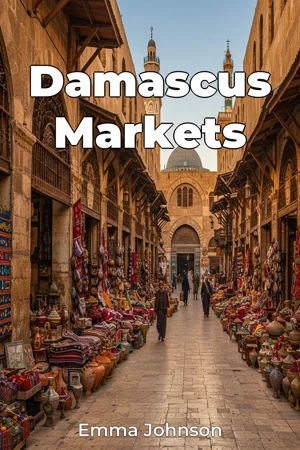
For centuries, have the bustling markets of Damascus served as mere trading posts, or vital engines driving global economies and shaping cultural landscapes? "Damascus Markets" delves into the complex history and lasting significance of these commercial hubs, exploring their foundational role in global trade networks and their profound impact on both cultural and commercial exchanges across continents and eras. This book examines three central themes, each crucial to understanding the markets' enduring relevance. First, it meticulously reconstructs the economic history of Damascus markets, tracing their evolution from regional trading centers to pivotal nodes in intercontinental exchange routes. Second, it analyzes the intricate web of global trade relationships fostered by these markets, highlighting their influence on the flow of goods, capital, and ideas between East and West. Third, it investigates the cultural dynamism generated by the interaction of diverse peoples and traditions within the marketplace, assessing how commercial activity shaped social customs, artistic expression, and intellectual discourse. To fully grasp the significance of Damascus markets, we must acknowledge the broader historical context of the Silk Road, the rise of Islamic empires, and the subsequent waves of European colonialism. These factors profoundly influenced the structure and operation of the markets, dictating the types of goods traded, the identities of the merchants involved, and the regulatory frameworks that governed commercial transactions. Readers will benefit from basic knowledge of Middle Eastern history and economic principles. The central argument of "Damascus Markets" is that these markets acted not merely as passive conduits for goods but as active agents in shaping global economic and cultural landscapes. By facilitating the exchange of commodities, technologies, and ideas, they fostered interconnectedness and spurred innovation. This argument is vital because it challenges simplistic narratives of globalization, emphasizing the agency of non-Western actors in shaping global processes. The book unfolds in three parts. Part One introduces the geographical, historical, and economic context of Damascus, establishing its strategic importance as a commercial center. Part Two examines the organizational structure of the markets, detailing the roles of merchants, artisans, and brokers, and analyzing the regulatory frameworks governing trade. Part Three explores the markets' impact on cultural exchange, examining how commercial interactions facilitated the diffusion of ideas, customs, and artistic styles across cultures. The conclusion synthesizes these findings, highlighting the enduring legacy of Damascus markets in shaping global trade and cultural exchange. The arguments presented are supported by a wealth of historical evidence, including archival documents, travelers' accounts, trade records, and archaeological findings. I use interdisciplinary methodologies, drawing from history, economics, and anthropology, to provide a comprehensive and nuanced understanding of the markets' significance. The book connects to broader fields of study such as economic history, postcolonial studies, and cultural studies, illustrating how commercial activities can both reflect and shape social, political, and cultural dynamics. It offers an innovative perspective by focusing on the markets as dynamic spaces of intercultural exchange, challenging Eurocentric views of globalization that often overlook the contributions of non-Western societies. The writing style is academic yet accessible, balancing rigorous analysis with engaging narratives to appeal to a broad audience. "Damascus Markets" is targeted toward students, scholars, and general readers interested in history, economics, and cultural studies. It offers valuable insights into the complexities of globalization and the enduring legacy of historical trade networks. In line with the conventions of historical writing, the book strives for objectivity and accuracy, presenting a balanced account based on available evidence. While the book covers a broad sweep of history, from the medieval period to the early modern era, it acknowledges limitations in fully capturing the experiences of all individuals and communities involved in the markets' operations. The book also provides insights relevant to contemporary issues, such as the challenges of global trade, the dynamics of cultural exchange, and the importance of understanding historical perspectives in addressing current global challenges. While this book aims to provide a comprehensive overview, it is crucial to acknowledge ongoing debates among historians regarding the precise scale and impact of Damascus markets. By engaging with these debates, the book offers a nuanced and critical perspective on the legacy of these important commercial hubs.
For centuries, have the bustling markets of Damascus served as mere trading posts, or vital engines driving global economies and shaping cultural landscapes? "Damascus Markets" delves into the complex history and lasting significance of these commercial hubs, exploring their foundational role in global trade networks and their profound impact on both cultural and commercial exchanges across continents and eras. This book examines three central themes, each crucial to understanding the markets' enduring relevance. First, it meticulously reconstructs the economic history of Damascus markets, tracing their evolution from regional trading centers to pivotal nodes in intercontinental exchange routes. Second, it analyzes the intricate web of global trade relationships fostered by these markets, highlighting their influence on the flow of goods, capital, and ideas between East and West. Third, it investigates the cultural dynamism generated by the interaction of diverse peoples and traditions within the marketplace, assessing how commercial activity shaped social customs, artistic expression, and intellectual discourse. To fully grasp the significance of Damascus markets, we must acknowledge the broader historical context of the Silk Road, the rise of Islamic empires, and the subsequent waves of European colonialism. These factors profoundly influenced the structure and operation of the markets, dictating the types of goods traded, the identities of the merchants involved, and the regulatory frameworks that governed commercial transactions. Readers will benefit from basic knowledge of Middle Eastern history and economic principles. The central argument of "Damascus Markets" is that these markets acted not merely as passive conduits for goods but as active agents in shaping global economic and cultural landscapes. By facilitating the exchange of commodities, technologies, and ideas, they fostered interconnectedness and spurred innovation. This argument is vital because it challenges simplistic narratives of globalization, emphasizing the agency of non-Western actors in shaping global processes. The book unfolds in three parts. Part One introduces the geographical, historical, and economic context of Damascus, establishing its strategic importance as a commercial center. Part Two examines the organizational structure of the markets, detailing the roles of merchants, artisans, and brokers, and analyzing the regulatory frameworks governing trade. Part Three explores the markets' impact on cultural exchange, examining how commercial interactions facilitated the diffusion of ideas, customs, and artistic styles across cultures. The conclusion synthesizes these findings, highlighting the enduring legacy of Damascus markets in shaping global trade and cultural exchange. The arguments presented are supported by a wealth of historical evidence, including archival documents, travelers' accounts, trade records, and archaeological findings. I use interdisciplinary methodologies, drawing from history, economics, and anthropology, to provide a comprehensive and nuanced understanding of the markets' significance. The book connects to broader fields of study such as economic history, postcolonial studies, and cultural studies, illustrating how commercial activities can both reflect and shape social, political, and cultural dynamics. It offers an innovative perspective by focusing on the markets as dynamic spaces of intercultural exchange, challenging Eurocentric views of globalization that often overlook the contributions of non-Western societies. The writing style is academic yet accessible, balancing rigorous analysis with engaging narratives to appeal to a broad audience. "Damascus Markets" is targeted toward students, scholars, and general readers interested in history, economics, and cultural studies. It offers valuable insights into the complexities of globalization and the enduring legacy of historical trade networks. In line with the conventions of historical writing, the book strives for objectivity and accuracy, presenting a balanced account based on available evidence. While the book covers a broad sweep of history, from the medieval period to the early modern era, it acknowledges limitations in fully capturing the experiences of all individuals and communities involved in the markets' operations. The book also provides insights relevant to contemporary issues, such as the challenges of global trade, the dynamics of cultural exchange, and the importance of understanding historical perspectives in addressing current global challenges. While this book aims to provide a comprehensive overview, it is crucial to acknowledge ongoing debates among historians regarding the precise scale and impact of Damascus markets. By engaging with these debates, the book offers a nuanced and critical perspective on the legacy of these important commercial hubs.
"Damascus Markets" explores the pivotal role of Damascus's commercial centers in shaping global trade and cultural exchange. For centuries, these markets acted as vital engines, influencing not only the flow of goods and capital but also the spread of ideas across continents. The book reconstructs the economic history of these markets, highlighting their evolution along the Silk Road and within Islamic empires, and examines their influence on the interaction of diverse cultures. The book argues that Damascus markets were active agents in shaping global landscapes. For example, the exchange of commodities spurred innovation and fostered interconnectedness. Part one introduces the geographical and economic context, part two details the roles within the markets, and part three explores the markets' impact on cultural exchange. By challenging Eurocentric views of globalization and using interdisciplinary methodologies, the book provides a comprehensive understanding of these markets' significance. It highlights how these hubs facilitated the diffusion of customs and artistic styles, leaving an enduring legacy on global trade and cultural exchange.
Book Details
ISBN
9788235259608
Publisher
Publifye AS
Your Licenses
You don't own any licenses for this book
Purchase a license below to unlock this book and download the EPUB.
Purchase License
Select a tier to unlock this book
Need bulk licensing?
Contact us for enterprise agreements.