
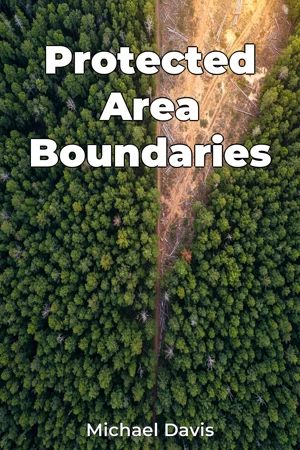
About This Book
Why do some lines on a map spark conflict while others ensure preservation? "Protected Area Boundaries" delves into the complex world of environmental law, exploring how these legal constructs define and enforce protected zones, including national parks, vital wildlife reserves, and restricted industrial regions. This book argues that the effectiveness of environmental protection hinges not just on the presence of laws, but on the clarity, enforceability, and social acceptance of the boundaries they establish. We begin by examining the critical role that clearly defined protected area boundaries play in mitigating environmental degradation. These boundaries serve as the legal lines in the sand, separating areas designated for conservation from those open to exploitation. Without precise and legally defensible borders, protected areas become vulnerable to encroachment, illegal resource extraction, and other threats that undermine their intended purpose. The book unfolds in three major parts. First, we introduce the fundamental legal concepts underpinning protected area designation, tracing the evolution of environmental legislation from its nascent stages to the sophisticated frameworks in place today. This section clarifies the legal basis for establishing protected areas and the different types of protection afforded under various national and international laws. The second part dissects the practical challenges of boundary demarcation and enforcement. We explore case studies from around the globe, analyzing how different countries grapple with issues such as conflicting land uses, indigenous rights, and the economic pressures that can lead to boundary violations. These examples illustrate the importance of community involvement, transparent governance, and effective monitoring in maintaining boundary integrity. The third portion of the book addresses the future of protected area boundaries in an era of climate change and increasing human population. It discusses innovative approaches to boundary design, such as buffer zones, corridors, and adaptive management strategies, that can enhance the resilience of protected areas in the face of environmental change. We also analyze the role of technology, including remote sensing and geographic information systems (GIS), in improving boundary monitoring and enforcement. Throughout the book, we draw upon a wide range of evidence, including legal documents, scientific research, and on-the-ground observations. We present statistical data on the effectiveness of different boundary management strategies, as well as qualitative analyses of the social and political factors that influence boundary compliance. A unique aspect of our research is the use of comparative legal analysis, examining how different legal systems approach the challenge of defining and enforcing protected area boundaries. "Protected Area Boundaries" also connects to several other fields, including geography, sociology, and economics. The geographical perspective helps us understand the spatial dynamics of protected areas and the surrounding landscapes. Sociology provides insights into the social and cultural factors that influence human behavior in relation to protected area boundaries. Economic analysis helps us assess the costs and benefits of different boundary management strategies. This book takes a nuanced approach, acknowledging that protected area boundaries are not simply lines on a map, but rather complex social, legal, and ecological constructs. It avoids simplistic solutions and instead seeks to provide a comprehensive understanding of the challenges and opportunities involved in defining and enforcing these critical environmental safeguards. Written in a clear and accessible style, "Protected Area Boundaries" is intended for a broad audience, including environmental lawyers, policymakers, conservation professionals, and students of environmental studies. It offers practical guidance for improving boundary management practices and contributing to the long-term sustainability of protected areas. While focusing on legal and practical aspects, the book acknowledges limitations in predicting future legal or policy shifts. The content’s real-world applications are extensive, from informing policy decisions to guiding conservation efforts on the ground. Finally, the book addresses ongoing debates surrounding protected area management, such as the balance between conservation and development, and the rights of indigenous communities.
Why do some lines on a map spark conflict while others ensure preservation? "Protected Area Boundaries" delves into the complex world of environmental law, exploring how these legal constructs define and enforce protected zones, including national parks, vital wildlife reserves, and restricted industrial regions. This book argues that the effectiveness of environmental protection hinges not just on the presence of laws, but on the clarity, enforceability, and social acceptance of the boundaries they establish. We begin by examining the critical role that clearly defined protected area boundaries play in mitigating environmental degradation. These boundaries serve as the legal lines in the sand, separating areas designated for conservation from those open to exploitation. Without precise and legally defensible borders, protected areas become vulnerable to encroachment, illegal resource extraction, and other threats that undermine their intended purpose. The book unfolds in three major parts. First, we introduce the fundamental legal concepts underpinning protected area designation, tracing the evolution of environmental legislation from its nascent stages to the sophisticated frameworks in place today. This section clarifies the legal basis for establishing protected areas and the different types of protection afforded under various national and international laws. The second part dissects the practical challenges of boundary demarcation and enforcement. We explore case studies from around the globe, analyzing how different countries grapple with issues such as conflicting land uses, indigenous rights, and the economic pressures that can lead to boundary violations. These examples illustrate the importance of community involvement, transparent governance, and effective monitoring in maintaining boundary integrity. The third portion of the book addresses the future of protected area boundaries in an era of climate change and increasing human population. It discusses innovative approaches to boundary design, such as buffer zones, corridors, and adaptive management strategies, that can enhance the resilience of protected areas in the face of environmental change. We also analyze the role of technology, including remote sensing and geographic information systems (GIS), in improving boundary monitoring and enforcement. Throughout the book, we draw upon a wide range of evidence, including legal documents, scientific research, and on-the-ground observations. We present statistical data on the effectiveness of different boundary management strategies, as well as qualitative analyses of the social and political factors that influence boundary compliance. A unique aspect of our research is the use of comparative legal analysis, examining how different legal systems approach the challenge of defining and enforcing protected area boundaries. "Protected Area Boundaries" also connects to several other fields, including geography, sociology, and economics. The geographical perspective helps us understand the spatial dynamics of protected areas and the surrounding landscapes. Sociology provides insights into the social and cultural factors that influence human behavior in relation to protected area boundaries. Economic analysis helps us assess the costs and benefits of different boundary management strategies. This book takes a nuanced approach, acknowledging that protected area boundaries are not simply lines on a map, but rather complex social, legal, and ecological constructs. It avoids simplistic solutions and instead seeks to provide a comprehensive understanding of the challenges and opportunities involved in defining and enforcing these critical environmental safeguards. Written in a clear and accessible style, "Protected Area Boundaries" is intended for a broad audience, including environmental lawyers, policymakers, conservation professionals, and students of environmental studies. It offers practical guidance for improving boundary management practices and contributing to the long-term sustainability of protected areas. While focusing on legal and practical aspects, the book acknowledges limitations in predicting future legal or policy shifts. The content’s real-world applications are extensive, from informing policy decisions to guiding conservation efforts on the ground. Finally, the book addresses ongoing debates surrounding protected area management, such as the balance between conservation and development, and the rights of indigenous communities.
"Protected Area Boundaries" explores the pivotal role of clearly defined and enforced boundaries in environmental protection, particularly for national parks and wildlife reserves. It argues that effective conservation depends not just on environmental law, but on the practical application and acceptance of these boundaries. A key insight is that precise boundaries mitigate environmental degradation by separating conservation areas from exploitation zones. The book examines how clarity in boundary demarcation directly reduces encroachment and illegal resource extraction, thereby safeguarding the integrity of protected areas. The book progresses from foundational legal concepts to practical enforcement challenges and future strategies. It dissects real-world case studies, highlighting the complexities of balancing land use, indigenous rights, and economic pressures. The book uniquely emphasizes the importance of community involvement and transparent governance. Furthermore, it addresses innovative approaches like buffer zones and the use of GIS technology for enhanced monitoring in an era defined by climate change and increasing population. This book offers significant value by providing a comprehensive understanding of the social, legal, and ecological constructs of protected area boundaries. It connects environmental law with geography, sociology, and economics, offering a nuanced perspective for environmental lawyers, policymakers, and conservation professionals. By using comparative legal analysis, the book examines different legal systems and their approaches to boundary enforcement, making it a practical guide for improving boundary management practices and ensuring the sustainability of natural resources.
Book Details
ISBN
9788235259592
Publisher
Publifye AS
Your Licenses
You don't own any licenses for this book
Purchase a license below to unlock this book and download the EPUB.
Purchase License
Select a tier to unlock this book
Need bulk licensing?
Contact us for enterprise agreements.