
About This Book
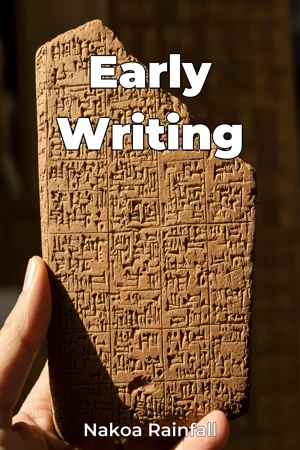
Have you ever considered how profoundly writing has shaped our world, transforming human communication from fleeting spoken words to enduring records of thought? "Early Writing" explores this pivotal development in human history, tracing the origins and evolution of writing systems from their earliest forms to the emergence of alphabets. This book delves into the fascinating journey of how humanity learned to externalize and preserve its collective knowledge. This book examines three core themes: the genesis of cuneiform in Mesopotamia, the development of hieroglyphic writing in ancient Egypt, and the subsequent emergence of early alphabets in the Levant. These topics are crucial because they represent independent inventions and evolutionary pathways of writing, each reflecting unique cultural, social, and administrative needs. Understanding these systems allows us to appreciate the diverse ways early civilizations organized their societies and transmitted information. To properly understand the development of these writing systems, we must consider the social and economic contexts in which they arose. Early writing was often closely tied to administrative functions, such as recording agricultural surpluses, tracking trade, and codifying laws. Early chapters provide background on the Bronze Age societies where writing emerged, detailing the political structures, economic systems, and religious beliefs that influenced their development. No prior knowledge is strictly required, but a general understanding of ancient history will enhance the reading experience. "Early Writing" argues that the invention of writing was not a singular event but a gradual process spurred by practical necessity and facilitated by increasing social complexity. The book will demonstrate that while the specific forms and functions of early writing systems varied significantly, they all served to extend human memory and enable more complex forms of social organization. The book is structured to guide the reader through the chronological development of writing. It begins with an introduction to the concept of writing and its pre-cursors, such as proto-writing and mnemonic devices. The book then moves onto cuneiform, exploring its origins in Sumerian pictographs, its evolution into a more abstract syllabic script, and its spread throughout Mesopotamia. It examines the role of cuneiform in administration, literature, and law, drawing on primary sources such as clay tablets and royal inscriptions. Following this is the rise of Egyptian hieroglyphs, investigating their complex combination of ideograms, phonograms, and determinatives. "Early Writing" analyzes the religious and monumental contexts of hieroglyphic inscriptions, as well as the development of more cursive scripts such as hieratic and demotic. The book then investigates the emergence of early alphabets in the Levant, tracing the transition from consonantal scripts to the Greek alphabet, which formed the basis for many modern writing systems. It will explore the social and economic factors that contributed to the alphabet's success, as well as its impact on literacy and communication. The book culminates by synthesizing the key themes and insights from each case study, drawing conclusions about the nature of writing, its impact on human societies, and its continuing evolution. The arguments presented are supported by archaeological evidence, deciphered inscriptions, and comparative analyses of different writing systems. The book draws on a wide range of primary and secondary sources, including scholarly articles, excavation reports, and museum collections. "Early Writing" connects to various fields, including archaeology, linguistics, and ancient history. By examining the material culture of early writing, the book provides insights into the daily lives of ancient peoples. By investigating the linguistic structures of ancient languages, it sheds light on the evolution of human language and thought. By situating writing within its historical context, it offers a broader understanding of ancient civilizations and their interactions. This book offers a comparative perspective, examining the similarities and differences between early writing systems and highlighting the diverse ways in which different cultures met the challenge of representing language in a durable form. The tone of "Early Writing" is academic yet accessible, aiming to engage both scholars and general readers with an interest in the history of writing. The writing style is clear and concise, avoiding jargon and technical terms where possible. The intended audience includes students and scholars of linguistics, ancient history, and archaeology, as well as general readers with an interest in the origins of writing and the history of human communication. As a work of non-fiction, "Early Writing" adheres to the principles of accuracy, objectivity, and evidence-based reasoning. It presents a balanced and nuanced account of the development of early writing systems, avoiding speculation and focusing on verifiable facts. The scope of "Early Writing" is limited to the earliest stages of writing, focusing on the invention and initial development of cuneiform, hieroglyphs, and early alphabets. It does not cover later developments in writing technology, such as the invention of the printing press or the rise of digital communication. Understanding the origins of writing is essential for appreciating the power and potential of this transformative technology. By tracing the evolution of writing from its earliest forms to the present day, we can gain a deeper understanding of ourselves and our place in the world. The book acknowledges the ongoing scholarly debates surrounding the decipherment and interpretation of ancient inscriptions, presenting different perspectives.
Have you ever considered how profoundly writing has shaped our world, transforming human communication from fleeting spoken words to enduring records of thought? "Early Writing" explores this pivotal development in human history, tracing the origins and evolution of writing systems from their earliest forms to the emergence of alphabets. This book delves into the fascinating journey of how humanity learned to externalize and preserve its collective knowledge. This book examines three core themes: the genesis of cuneiform in Mesopotamia, the development of hieroglyphic writing in ancient Egypt, and the subsequent emergence of early alphabets in the Levant. These topics are crucial because they represent independent inventions and evolutionary pathways of writing, each reflecting unique cultural, social, and administrative needs. Understanding these systems allows us to appreciate the diverse ways early civilizations organized their societies and transmitted information. To properly understand the development of these writing systems, we must consider the social and economic contexts in which they arose. Early writing was often closely tied to administrative functions, such as recording agricultural surpluses, tracking trade, and codifying laws. Early chapters provide background on the Bronze Age societies where writing emerged, detailing the political structures, economic systems, and religious beliefs that influenced their development. No prior knowledge is strictly required, but a general understanding of ancient history will enhance the reading experience. "Early Writing" argues that the invention of writing was not a singular event but a gradual process spurred by practical necessity and facilitated by increasing social complexity. The book will demonstrate that while the specific forms and functions of early writing systems varied significantly, they all served to extend human memory and enable more complex forms of social organization. The book is structured to guide the reader through the chronological development of writing. It begins with an introduction to the concept of writing and its pre-cursors, such as proto-writing and mnemonic devices. The book then moves onto cuneiform, exploring its origins in Sumerian pictographs, its evolution into a more abstract syllabic script, and its spread throughout Mesopotamia. It examines the role of cuneiform in administration, literature, and law, drawing on primary sources such as clay tablets and royal inscriptions. Following this is the rise of Egyptian hieroglyphs, investigating their complex combination of ideograms, phonograms, and determinatives. "Early Writing" analyzes the religious and monumental contexts of hieroglyphic inscriptions, as well as the development of more cursive scripts such as hieratic and demotic. The book then investigates the emergence of early alphabets in the Levant, tracing the transition from consonantal scripts to the Greek alphabet, which formed the basis for many modern writing systems. It will explore the social and economic factors that contributed to the alphabet's success, as well as its impact on literacy and communication. The book culminates by synthesizing the key themes and insights from each case study, drawing conclusions about the nature of writing, its impact on human societies, and its continuing evolution. The arguments presented are supported by archaeological evidence, deciphered inscriptions, and comparative analyses of different writing systems. The book draws on a wide range of primary and secondary sources, including scholarly articles, excavation reports, and museum collections. "Early Writing" connects to various fields, including archaeology, linguistics, and ancient history. By examining the material culture of early writing, the book provides insights into the daily lives of ancient peoples. By investigating the linguistic structures of ancient languages, it sheds light on the evolution of human language and thought. By situating writing within its historical context, it offers a broader understanding of ancient civilizations and their interactions. This book offers a comparative perspective, examining the similarities and differences between early writing systems and highlighting the diverse ways in which different cultures met the challenge of representing language in a durable form. The tone of "Early Writing" is academic yet accessible, aiming to engage both scholars and general readers with an interest in the history of writing. The writing style is clear and concise, avoiding jargon and technical terms where possible. The intended audience includes students and scholars of linguistics, ancient history, and archaeology, as well as general readers with an interest in the origins of writing and the history of human communication. As a work of non-fiction, "Early Writing" adheres to the principles of accuracy, objectivity, and evidence-based reasoning. It presents a balanced and nuanced account of the development of early writing systems, avoiding speculation and focusing on verifiable facts. The scope of "Early Writing" is limited to the earliest stages of writing, focusing on the invention and initial development of cuneiform, hieroglyphs, and early alphabets. It does not cover later developments in writing technology, such as the invention of the printing press or the rise of digital communication. Understanding the origins of writing is essential for appreciating the power and potential of this transformative technology. By tracing the evolution of writing from its earliest forms to the present day, we can gain a deeper understanding of ourselves and our place in the world. The book acknowledges the ongoing scholarly debates surrounding the decipherment and interpretation of ancient inscriptions, presenting different perspectives.
"Early Writing" explores the captivating origins and evolution of writing, a cornerstone of human civilization. Delving into ancient history, the book reveals how early societies transitioned from spoken language to lasting written records. It highlights that writing wasn't a singular invention but a gradual development driven by practical needs, such as managing agricultural surpluses. The book journeys through Mesopotamia, examining the genesis of cuneiform from Sumerian pictographs to a more abstract script. It then investigates Egyptian hieroglyphs, a complex system of ideograms and phonograms used in religious and monumental contexts. "Early Writing" further explores the emergence of early alphabets in the Levant and their transformative impact on literacy and communication. Each chapter builds upon the last, tracing the chronological development and providing a comparative perspective. Supported by archaeological evidence and deciphered inscriptions, the book presents a balanced account of these early writing systems. It connects to fields like archaeology and linguistics, providing broader insights into ancient civilizations. The book argues that understanding these systems allows us to appreciate the diverse ways early civilizations organized their societies and transmitted information.
Book Details
ISBN
9788235259219
Publisher
Publifye AS
Your Licenses
You don't own any licenses for this book
Purchase a license below to unlock this book and download the EPUB.
Purchase License
Select a tier to unlock this book
Need bulk licensing?
Contact us for enterprise agreements.