
About This Book
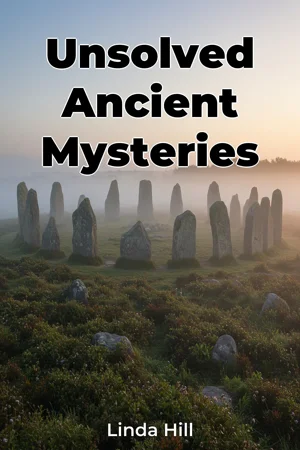
What if the stones of ancient ruins held secrets far beyond our current understanding? "Unsolved Ancient Mysteries" invites you on an in-depth exploration of the most perplexing enigmas from our past, spanning the globe and challenging conventional historical narratives. We will examine evidence-based investigations into sites whose true purpose remains shrouded in obscurity and artifacts that defy easy interpretation. These are not fanciful speculations but rather meticulous analyses of physical and textual evidence. This book focuses on three critical areas: undeciphered languages and scripts, the origins and purposes of megalithic structures, and the abrupt abandonment of major ancient settlements. The importance of these topics lies in their potential to reshape our understanding of ancient civilizations' technological capabilities, societal structures, and intellectual achievements. By confronting these mysteries, we gain insights into the diverse nature of human ingenuity and the complex factors that shaped the course of history. To fully appreciate these mysteries, it's necessary to understand the methodologies employed by archaeologists, linguists, and historians. This book will provide a grounding in these disciplines, discussing radiocarbon dating, linguistic analysis techniques, and comparative mythology. No prior expertise is required, as clear explanations are woven throughout. The central argument of "Unsolved Ancient Mysteries" is that many established historical narratives are incomplete, and these unsolved mysteries represent critical gaps in our knowledge. By rigorously examining these areas, we can move beyond speculation and towards a more nuanced and accurate reconstruction of the past. This argument matters because it encourages a critical reevaluation of accepted truths. The book will proceed systematically. First, we will introduce the concept of an “unsolved mystery” within the context of ancient history, outlining the criteria used to classify a site or artifact as such. Next, we delve into specific examples, with major sections devoted to: * The Voynich Manuscript: Its baffling script, illustrations, and potential origins. * Göbekli Tepe: A prehistoric temple complex and what it suggests about early human society. * The disappearance of the Maya civilization: Investigating the various environmental, political, and social elements. The culmination of the book will synthesize the findings from these case studies, arguing that a multidisciplinary approach is essential for making progress in understanding these mysteries. We propose specific avenues for future research. The evidence presented will be drawn from archaeological reports, scientific analyses (such as material composition studies), and translations of ancient texts. We avoid sensationalism and rely on primary sources whenever possible. This book intersects with several other fields. Firstly, anthropology provides a framework for understanding ancient cultures. Secondly, geology offers insights into environmental changes and their impact on human settlements. Finally, computer science can be applied to decipher complex codes and patterns in artifacts. These interdisciplinary connections will be used to construct more holistic understandings of the mysteries. "Unsolved Ancient Mysteries" takes a fresh approach by focusing on the methodological challenges inherent in studying ancient sites and artifacts. Rather than offering definitive answers, the book will explore the limitations of current research and propose new avenues for investigation. The tone is inquisitive and analytical, aiming to stimulate critical thinking. The target audience includes history enthusiasts, archaeology buffs, and anyone intrigued by the unknown. This book offers valuable insights and accessible information for those seeking an understanding of unexplained phenomena of the ancient world. As a work of history, it adheres to standards of accuracy, objectivity, and source citation. While covering a broad geographical range, the book will focus primarily on sites and artifacts with substantial existing scholarly literature, ensuring a foundation of established research. We acknowledge that many other mysteries exist but limit our scope to facilitate in-depth analysis. The critical thinking skills developed while reading this book can be applied to evaluating information in everyday situations. Also, readers will gain a better understanding of the scientific method and the process of historical inquiry. The interpretation of ancient texts and the reconstruction of past events are not without debate. Where relevant, the book will acknowledge these controversies, presenting various viewpoints and the evidence supporting them. We aim to foster a balanced and critical understanding of these complex issues.
What if the stones of ancient ruins held secrets far beyond our current understanding? "Unsolved Ancient Mysteries" invites you on an in-depth exploration of the most perplexing enigmas from our past, spanning the globe and challenging conventional historical narratives. We will examine evidence-based investigations into sites whose true purpose remains shrouded in obscurity and artifacts that defy easy interpretation. These are not fanciful speculations but rather meticulous analyses of physical and textual evidence. This book focuses on three critical areas: undeciphered languages and scripts, the origins and purposes of megalithic structures, and the abrupt abandonment of major ancient settlements. The importance of these topics lies in their potential to reshape our understanding of ancient civilizations' technological capabilities, societal structures, and intellectual achievements. By confronting these mysteries, we gain insights into the diverse nature of human ingenuity and the complex factors that shaped the course of history. To fully appreciate these mysteries, it's necessary to understand the methodologies employed by archaeologists, linguists, and historians. This book will provide a grounding in these disciplines, discussing radiocarbon dating, linguistic analysis techniques, and comparative mythology. No prior expertise is required, as clear explanations are woven throughout. The central argument of "Unsolved Ancient Mysteries" is that many established historical narratives are incomplete, and these unsolved mysteries represent critical gaps in our knowledge. By rigorously examining these areas, we can move beyond speculation and towards a more nuanced and accurate reconstruction of the past. This argument matters because it encourages a critical reevaluation of accepted truths. The book will proceed systematically. First, we will introduce the concept of an “unsolved mystery” within the context of ancient history, outlining the criteria used to classify a site or artifact as such. Next, we delve into specific examples, with major sections devoted to: * The Voynich Manuscript: Its baffling script, illustrations, and potential origins. * Göbekli Tepe: A prehistoric temple complex and what it suggests about early human society. * The disappearance of the Maya civilization: Investigating the various environmental, political, and social elements. The culmination of the book will synthesize the findings from these case studies, arguing that a multidisciplinary approach is essential for making progress in understanding these mysteries. We propose specific avenues for future research. The evidence presented will be drawn from archaeological reports, scientific analyses (such as material composition studies), and translations of ancient texts. We avoid sensationalism and rely on primary sources whenever possible. This book intersects with several other fields. Firstly, anthropology provides a framework for understanding ancient cultures. Secondly, geology offers insights into environmental changes and their impact on human settlements. Finally, computer science can be applied to decipher complex codes and patterns in artifacts. These interdisciplinary connections will be used to construct more holistic understandings of the mysteries. "Unsolved Ancient Mysteries" takes a fresh approach by focusing on the methodological challenges inherent in studying ancient sites and artifacts. Rather than offering definitive answers, the book will explore the limitations of current research and propose new avenues for investigation. The tone is inquisitive and analytical, aiming to stimulate critical thinking. The target audience includes history enthusiasts, archaeology buffs, and anyone intrigued by the unknown. This book offers valuable insights and accessible information for those seeking an understanding of unexplained phenomena of the ancient world. As a work of history, it adheres to standards of accuracy, objectivity, and source citation. While covering a broad geographical range, the book will focus primarily on sites and artifacts with substantial existing scholarly literature, ensuring a foundation of established research. We acknowledge that many other mysteries exist but limit our scope to facilitate in-depth analysis. The critical thinking skills developed while reading this book can be applied to evaluating information in everyday situations. Also, readers will gain a better understanding of the scientific method and the process of historical inquiry. The interpretation of ancient texts and the reconstruction of past events are not without debate. Where relevant, the book will acknowledge these controversies, presenting various viewpoints and the evidence supporting them. We aim to foster a balanced and critical understanding of these complex issues.
"Unsolved Ancient Mysteries" delves into the captivating world of historical enigmas, exploring perplexing sites and artifacts that challenge conventional historical narratives. It examines undeciphered languages like the Voynich Manuscript, the origins of megalithic structures such as Göbekli Tepe, and the abrupt abandonment of ancient settlements, like those of the Maya Civilization. The book emphasizes that many accepted historical narratives are incomplete and that these mysteries represent critical gaps in our knowledge. The book takes a systematic approach, first introducing the concept of "unsolved mysteries" and then delving into specific examples. It explores how archaeologists and linguists use methods like radiocarbon dating and linguistic analysis to try and understand these mysteries. Rather than offering definitive answers, "Unsolved Ancient Mysteries" focuses on the methodological challenges inherent in studying these ancient sites, making it a valuable resource for those interested in archaeology, ancient civilizations, and the ongoing quest to understand our past. The culmination of the book synthesizes findings from case studies, looking at how a multidisciplinary approach is essential for understanding these mysteries. The book progresses across chapters in a systematic fashion, providing a fresh perspective, exploring the limitations of current research, and stimulating critical thinking about the unsolved mysteries of our past.
Book Details
ISBN
9788235258762
Publisher
Publifye AS
Your Licenses
You don't own any licenses for this book
Purchase a license below to unlock this book and download the EPUB.
Purchase License
Select a tier to unlock this book
Need bulk licensing?
Contact us for enterprise agreements.