
About This Book
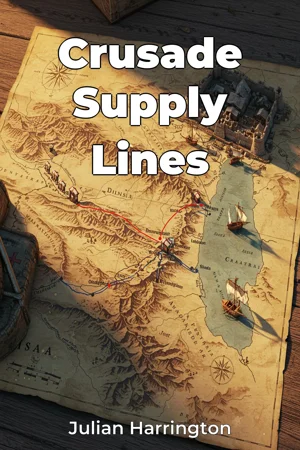
How did medieval armies, thousands of miles from home, sustain themselves for years while engaged in relentless warfare? "Crusade Supply Lines" delves into the complex and often overlooked logistical networks that fueled the crusades, exploring how these ambitious military expeditions managed to operate far from their European power bases. This book examines the vital role of sea routes, caravan paths, and supply outposts in enabling the crusader states to survive and wage war in the Levant. Understanding these logistical systems is crucial to comprehending the crusades not just as religious wars but as sophisticated exercises in military organization and resource management. This book argues that the success and failures of the crusades were directly linked to the effectiveness of their supply lines. It analyzes how the crusaders, facing considerable geographical and political challenges, adapted and innovated to maintain a constant flow of resources. Without these elaborate supply networks, the crusader states would have quickly collapsed. The book begins by establishing the historical context of the crusades, outlining the political landscape of Europe and the Levant in the 11th to 13th centuries. It then introduces the key elements of crusader logistics. This includes a detailed analysis of maritime support, focusing on the Italian city-states like Venice and Genoa, which provided crucial naval transport and supply services. The book also explores the overland caravan routes that stretched from Europe through Anatolia and into the Levant, examining the challenges of traversing these routes, including banditry, taxation, and the sheer distances involved. Furthermore, it investigates the role of strategically located supply outposts, such as Cyprus, which served as vital hubs for storing and distributing goods. "Crusade Supply Lines" devotes considerable attention to the practical aspects of maintaining these supply chains. It examines the types of goods transported, including food, weapons, and equipment, as well as the methods used to preserve and transport them. It further analyzes the financial mechanisms that supported these operations, including taxation, loans, and the role of merchant communities. The book also explores the impact of these logistical demands on the local populations, both Christian and Muslim, in the areas through which the supply lines passed. To support its arguments, the book draws on a wide range of primary sources, including chronicles, letters, financial records, and archaeological evidence. It also incorporates insights from secondary scholarship in history, military science, and economic history. A unique aspect of the book is its use of spatial analysis, employing maps and geographical data to illustrate the extent and complexity of the crusader supply networks. This book connects to broader fields such as economic history, examining the development of trade networks and financial systems in the medieval period; environmental history, considering the impact of large-scale military operations on the environment; and social history, exploring the interaction between crusaders and local populations. "Crusade Supply Lines" offers a fresh perspective by focusing on the nuts and bolts of crusader logistics, moving beyond traditional narratives of battles and religious fervor. The book adopts an analytical and fact-based approach, presenting information in a clear and accessible manner. The target audience includes students and scholars of medieval history, military history, and the crusades, as well as general readers interested in learning more about the logistical challenges of medieval warfare. This book is valuable because it provides a comprehensive and nuanced understanding of a critical but often neglected aspect of the crusades. While the book provides extensive coverage of the major supply lines, it acknowledges that limitations exist in the available historical data, particularly concerning the precise quantities of goods transported and the financial transactions involved. It focuses primarily on the Latin crusades in the Levant, with less emphasis on other crusades in different regions. The strategies discussed in "Crusade Supply Lines" have relevance far beyond the medieval period. The challenges of maintaining long-distance supply lines remain a critical factor in modern military operations, and the lessons learned from the crusades can offer valuable insights into the importance of logistics in warfare.
How did medieval armies, thousands of miles from home, sustain themselves for years while engaged in relentless warfare? "Crusade Supply Lines" delves into the complex and often overlooked logistical networks that fueled the crusades, exploring how these ambitious military expeditions managed to operate far from their European power bases. This book examines the vital role of sea routes, caravan paths, and supply outposts in enabling the crusader states to survive and wage war in the Levant. Understanding these logistical systems is crucial to comprehending the crusades not just as religious wars but as sophisticated exercises in military organization and resource management. This book argues that the success and failures of the crusades were directly linked to the effectiveness of their supply lines. It analyzes how the crusaders, facing considerable geographical and political challenges, adapted and innovated to maintain a constant flow of resources. Without these elaborate supply networks, the crusader states would have quickly collapsed. The book begins by establishing the historical context of the crusades, outlining the political landscape of Europe and the Levant in the 11th to 13th centuries. It then introduces the key elements of crusader logistics. This includes a detailed analysis of maritime support, focusing on the Italian city-states like Venice and Genoa, which provided crucial naval transport and supply services. The book also explores the overland caravan routes that stretched from Europe through Anatolia and into the Levant, examining the challenges of traversing these routes, including banditry, taxation, and the sheer distances involved. Furthermore, it investigates the role of strategically located supply outposts, such as Cyprus, which served as vital hubs for storing and distributing goods. "Crusade Supply Lines" devotes considerable attention to the practical aspects of maintaining these supply chains. It examines the types of goods transported, including food, weapons, and equipment, as well as the methods used to preserve and transport them. It further analyzes the financial mechanisms that supported these operations, including taxation, loans, and the role of merchant communities. The book also explores the impact of these logistical demands on the local populations, both Christian and Muslim, in the areas through which the supply lines passed. To support its arguments, the book draws on a wide range of primary sources, including chronicles, letters, financial records, and archaeological evidence. It also incorporates insights from secondary scholarship in history, military science, and economic history. A unique aspect of the book is its use of spatial analysis, employing maps and geographical data to illustrate the extent and complexity of the crusader supply networks. This book connects to broader fields such as economic history, examining the development of trade networks and financial systems in the medieval period; environmental history, considering the impact of large-scale military operations on the environment; and social history, exploring the interaction between crusaders and local populations. "Crusade Supply Lines" offers a fresh perspective by focusing on the nuts and bolts of crusader logistics, moving beyond traditional narratives of battles and religious fervor. The book adopts an analytical and fact-based approach, presenting information in a clear and accessible manner. The target audience includes students and scholars of medieval history, military history, and the crusades, as well as general readers interested in learning more about the logistical challenges of medieval warfare. This book is valuable because it provides a comprehensive and nuanced understanding of a critical but often neglected aspect of the crusades. While the book provides extensive coverage of the major supply lines, it acknowledges that limitations exist in the available historical data, particularly concerning the precise quantities of goods transported and the financial transactions involved. It focuses primarily on the Latin crusades in the Levant, with less emphasis on other crusades in different regions. The strategies discussed in "Crusade Supply Lines" have relevance far beyond the medieval period. The challenges of maintaining long-distance supply lines remain a critical factor in modern military operations, and the lessons learned from the crusades can offer valuable insights into the importance of logistics in warfare.
"Crusade Supply Lines" explores the crucial, yet often overlooked, logistical networks that sustained the crusades in the Levant. This book shifts the focus from battles and religious fervor to the practical challenges of maintaining armies thousands of miles from home. It reveals how vital sea routes, like those dominated by Italian city-states, and overland caravan paths ensured the crusader states' survival. Without these intricate systems of resource management and military organization, the crusades would have faltered. The book details the types of goods transported, such as food and weaponry, and the financial mechanisms that supported these operations, including taxation and loans. It also uses spatial analysis, incorporating maps and geographical data, to illustrate the vastness and complexity of these medieval supply lines. By examining chronicles, letters, and archaeological evidence, "Crusade Supply Lines" offers a fresh perspective on the crusades, emphasizing the critical role of logistics in military history. Beginning with the historical context of the crusades, the book progresses through an analysis of maritime support, overland routes, and strategic supply outposts. It concludes by connecting these logistical demands to broader themes in economic, environmental, and social history. This approach provides a comprehensive understanding of how logistics shaped the crusades and their impact on both the crusaders and the local populations.
Book Details
ISBN
9788235257697
Publisher
Publifye AS
Your Licenses
You don't own any licenses for this book
Purchase a license below to unlock this book and download the EPUB.
Purchase License
Select a tier to unlock this book
Need bulk licensing?
Contact us for enterprise agreements.