
About This Book
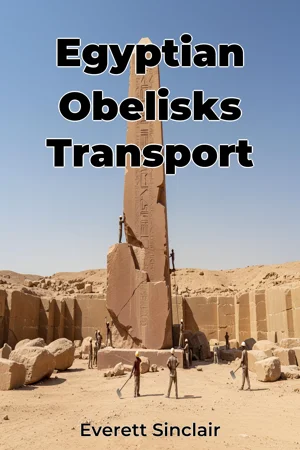
How did the ancient Egyptians, without modern machinery, manage to quarry, transport, and erect colossal obelisks, some weighing hundreds of tons? "Egyptian Obelisks Transport" delves into the monumental engineering feats and cultural significance of these iconic structures, revealing the ingenuity and meticulous planning that underpinned their creation. This inquiry is vital because understanding obelisk construction provides insight into ancient Egyptian society's technical capabilities, religious beliefs, and organizational prowess. This book explores three primary areas: quarrying techniques, transportation methods, and the symbolic meaning imbued within these monolithic monuments. We examine the geological composition of the quarries, the tools employed to extract the stone, and the labor force responsible for this demanding task. We then analyze the diverse strategies used to move these immense stones across land and water, focusing on the logistical challenges overcome and the infrastructure developed to support these endeavors. Finally, the book investigates the religious and political significance of obelisks, examining their role in temple complexes, their inscription details, and their connection to the sun god Ra. Our investigation is grounded in the historical context of ancient Egypt, spanning from the Old Kingdom through the Roman period. Familiarity with basic Egyptian history is helpful but not required, as relevant background information will be provided. The argument presented is that the successful creation and erection of obelisks demonstrate a sophisticated understanding of engineering principles, resource management, and social coordination, reflecting the advanced nature of ancient Egyptian civilization. The book unfolds in a structured manner. First, it introduces the concept of the obelisk within the broader context of ancient Egyptian architecture and religion. The second section details quarrying operations. This section will explore the specific quarries from which obelisks originated, the methods of stone extraction using dolerite tools and other techniques, and the organization of the workforce. The third section analyzes transportation logistics. This part will discuss the construction of specialized sleds and barges, the management of manpower needed for overland and riverine transport, and the routes used to move obelisks to their final destinations. The fourth section discusses erection techniques, looking at the foundations, the methods used to raise the obelisks, and the tools and calculations involved. Finally, the book culminates with an examination of the symbolism of obelisks, their relationship to pharaonic power, and their lasting impact on the Egyptian landscape. The book relies on archaeological evidence, including inscriptions, architectural remains, and surviving tools. It draws on historical texts, such as those found on the obelisks themselves and records from ancient writers, and incorporates recent experimental archaeology findings that simulate ancient construction techniques. The evidence includes detailed surveys of existing obelisks and quarry sites, providing firsthand accounts of the scale and complexity of these endeavors. Interdisciplinary connections enhance the book's argument. Firstly, geology informs our understanding of the stone's properties and the challenges of quarrying. Secondly, engineering principles help us analyze the structural integrity of obelisks and the mechanics of their transport and erection. Thirdly, art history provides insights into the symbolic representation of royal power and religious beliefs conveyed through obelisk design. This book adopts a fact-based, analytical approach, presenting information in a clear and accessible manner. The intended audience includes students of ancient history, Egyptology enthusiasts, and readers interested in engineering history and ancient technologies. The book aims to provide a comprehensive and up-to-date overview of obelisk construction and significance, offering a valuable resource for those seeking a deeper understanding of ancient Egyptian achievements. The scope of the book encompasses obelisks erected throughout ancient Egyptian history, from the Old Kingdom to the Roman Period. While focusing primarily on the engineering aspects of their creation and transport, the book also acknowledges the religious and political context that shaped their purpose. It is not intended as a biographical study of individual pharaohs but rather as a focused analysis of obelisk construction as a technological and cultural phenomenon. The information in this book provides a detailed examination applicable to understanding the technological prowess of ancient civilizations, offering insights into project management, resource allocation, and the integration of technology, art, and religious belief. While the precise methods used for obelisk erection remain subject to academic debate, this book presents a balanced overview of current theories, drawing on both historical evidence and experimental reconstructions. By exploring the controversies and challenges surrounding obelisk construction, this book offers a nuanced and informed perspective on this remarkable aspect of ancient Egyptian civilization.
How did the ancient Egyptians, without modern machinery, manage to quarry, transport, and erect colossal obelisks, some weighing hundreds of tons? "Egyptian Obelisks Transport" delves into the monumental engineering feats and cultural significance of these iconic structures, revealing the ingenuity and meticulous planning that underpinned their creation. This inquiry is vital because understanding obelisk construction provides insight into ancient Egyptian society's technical capabilities, religious beliefs, and organizational prowess. This book explores three primary areas: quarrying techniques, transportation methods, and the symbolic meaning imbued within these monolithic monuments. We examine the geological composition of the quarries, the tools employed to extract the stone, and the labor force responsible for this demanding task. We then analyze the diverse strategies used to move these immense stones across land and water, focusing on the logistical challenges overcome and the infrastructure developed to support these endeavors. Finally, the book investigates the religious and political significance of obelisks, examining their role in temple complexes, their inscription details, and their connection to the sun god Ra. Our investigation is grounded in the historical context of ancient Egypt, spanning from the Old Kingdom through the Roman period. Familiarity with basic Egyptian history is helpful but not required, as relevant background information will be provided. The argument presented is that the successful creation and erection of obelisks demonstrate a sophisticated understanding of engineering principles, resource management, and social coordination, reflecting the advanced nature of ancient Egyptian civilization. The book unfolds in a structured manner. First, it introduces the concept of the obelisk within the broader context of ancient Egyptian architecture and religion. The second section details quarrying operations. This section will explore the specific quarries from which obelisks originated, the methods of stone extraction using dolerite tools and other techniques, and the organization of the workforce. The third section analyzes transportation logistics. This part will discuss the construction of specialized sleds and barges, the management of manpower needed for overland and riverine transport, and the routes used to move obelisks to their final destinations. The fourth section discusses erection techniques, looking at the foundations, the methods used to raise the obelisks, and the tools and calculations involved. Finally, the book culminates with an examination of the symbolism of obelisks, their relationship to pharaonic power, and their lasting impact on the Egyptian landscape. The book relies on archaeological evidence, including inscriptions, architectural remains, and surviving tools. It draws on historical texts, such as those found on the obelisks themselves and records from ancient writers, and incorporates recent experimental archaeology findings that simulate ancient construction techniques. The evidence includes detailed surveys of existing obelisks and quarry sites, providing firsthand accounts of the scale and complexity of these endeavors. Interdisciplinary connections enhance the book's argument. Firstly, geology informs our understanding of the stone's properties and the challenges of quarrying. Secondly, engineering principles help us analyze the structural integrity of obelisks and the mechanics of their transport and erection. Thirdly, art history provides insights into the symbolic representation of royal power and religious beliefs conveyed through obelisk design. This book adopts a fact-based, analytical approach, presenting information in a clear and accessible manner. The intended audience includes students of ancient history, Egyptology enthusiasts, and readers interested in engineering history and ancient technologies. The book aims to provide a comprehensive and up-to-date overview of obelisk construction and significance, offering a valuable resource for those seeking a deeper understanding of ancient Egyptian achievements. The scope of the book encompasses obelisks erected throughout ancient Egyptian history, from the Old Kingdom to the Roman Period. While focusing primarily on the engineering aspects of their creation and transport, the book also acknowledges the religious and political context that shaped their purpose. It is not intended as a biographical study of individual pharaohs but rather as a focused analysis of obelisk construction as a technological and cultural phenomenon. The information in this book provides a detailed examination applicable to understanding the technological prowess of ancient civilizations, offering insights into project management, resource allocation, and the integration of technology, art, and religious belief. While the precise methods used for obelisk erection remain subject to academic debate, this book presents a balanced overview of current theories, drawing on both historical evidence and experimental reconstructions. By exploring the controversies and challenges surrounding obelisk construction, this book offers a nuanced and informed perspective on this remarkable aspect of ancient Egyptian civilization.
"Egyptian Obelisks Transport" explores the remarkable engineering feats behind the creation of ancient Egyptian obelisks. These monolithic monuments, some weighing hundreds of tons, were quarried, transported, and erected using techniques that continue to fascinate historians and engineers alike. The book uncovers how the ancient Egyptians mastered quarrying techniques without modern machinery, including the use of dolerite tools to extract stone. It further investigates the sophisticated transportation methods employed to move these colossal structures across land and water, revealing the organizational prowess required for such massive undertakings. The book’s approach is structured, beginning with an introduction to obelisks within Egyptian architecture and religion. It then details quarrying operations, followed by an analysis of transportation logistics, erection techniques, and finally, an examination of the symbolism of obelisks. By examining archaeological evidence, historical texts, and recent experimental findings, the book highlights the religious and political significance of obelisks, emphasizing their connection to pharaonic power and their lasting impact on the Egyptian landscape. The successful construction of obelisks reflects the advanced nature of ancient Egyptian civilization and their sophisticated understanding of engineering principles.
Book Details
ISBN
9788235257680
Publisher
Publifye AS
Your Licenses
You don't own any licenses for this book
Purchase a license below to unlock this book and download the EPUB.
Purchase License
Select a tier to unlock this book
Need bulk licensing?
Contact us for enterprise agreements.