
About This Book
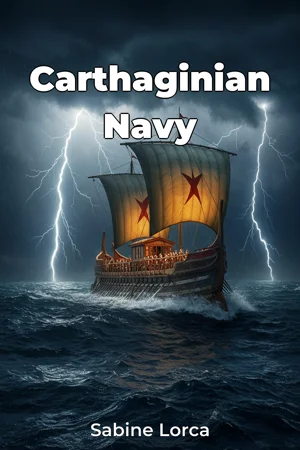
How did a civilization, initially a small trading outpost, rise to challenge the Roman Republic for dominance of the Mediterranean? The answer lies, in large part, with its navy. "Carthaginian Navy" delves into the maritime power of Carthage, exploring how its fleet was not merely a collection of ships, but a key instrument in the city's economic prosperity, territorial expansion, and its centuries-long struggle against Rome. Crucial aspects of Carthaginian naval power were the sophisticated ship designs, and the innovative tactics employed by their admirals. These elements allowed Carthage to control trade routes, project power across vast distances, and repeatedly threaten Rome itself. Understanding the Carthaginian navy offers critical insights into the balance of power in the ancient world and the factors contributing to Carthage's eventual defeat. This book argues that the Carthaginian navy was a highly organized, technologically advanced, and strategically deployed force essential to the state's survival and expansion. We explore the evolution of Carthaginian naval architecture, tracing developments from early, less sophisticated vessels to the formidable quinqueremes that dominated the seas during the Punic Wars. This examination includes evidence from archaeological finds, Punic inscriptions, and accounts from Greek and Roman historians, offering a comprehensive picture of Carthaginian shipbuilding techniques. We delve into the logistical challenges of maintaining a large fleet, including sourcing timber, manning the ships, and providing supplies for extended campaigns. The book examines the social and economic implications of naval service in Carthaginian society, exploring the recruitment processes, the lives of sailors and officers, and the impact of naval expenditure on the Carthaginian economy. The book is structured to provide a comprehensive understanding of the Carthaginian navy. It begins by establishing the historical context of Carthage, examining its origins as a Phoenician colony and its subsequent rise to dominance in the western Mediterranean. It then moves into the specifics of the fleet, detailing ship construction, armament, and crew composition. Subsequent chapters analyze key naval battles, such as those at Ecnomus and the Aegates Islands, dissecting the tactics employed by both sides and evaluating their outcomes. The book emphasizes the critical role of individuals, examining the careers of notable Carthaginian admirals such as Hamilcar Barca and Hannibal, and analyzing their contributions to Carthaginian naval strategy. Finally, the book evaluates the reasons for Carthaginian naval decline in the face of Roman expansion, exploring the impact of political instability, economic strain, and strategic miscalculations. "Carthaginian Navy" draws upon a range of primary and secondary sources. It integrates archaeological data from Punic shipwrecks and harbors with literary accounts from classical authors like Polybius, Livy, and Diodorus Siculus. The book also incorporates insights from modern scholarship in maritime history, naval archaeology, and Punic studies. This interdisciplinary approach allows for a nuanced and comprehensive reconstruction of Carthaginian naval power. This book is aimed at anyone with an interest in ancient history, naval warfare, or the Punic Wars. It will appeal to both academic scholars and general readers seeking a detailed and accessible account of a pivotal aspect of Carthaginian civilization. The book adds to the existing body of literature by providing a focused study on the Carthaginian navy, an area that is often overshadowed by accounts of the Punic land campaigns. While the book focuses primarily on military and naval aspects, it also touches on economic, social, and political dimensions, thus offering a holistic understanding of Carthaginian society. The book acknowledges the inherent limitations in the available evidence, particularly the bias present in Roman sources. Despite these challenges, "Carthaginian Navy" offers a compelling and well-supported assessment of Carthage's maritime strength and its role in shaping the ancient Mediterranean world.
How did a civilization, initially a small trading outpost, rise to challenge the Roman Republic for dominance of the Mediterranean? The answer lies, in large part, with its navy. "Carthaginian Navy" delves into the maritime power of Carthage, exploring how its fleet was not merely a collection of ships, but a key instrument in the city's economic prosperity, territorial expansion, and its centuries-long struggle against Rome. Crucial aspects of Carthaginian naval power were the sophisticated ship designs, and the innovative tactics employed by their admirals. These elements allowed Carthage to control trade routes, project power across vast distances, and repeatedly threaten Rome itself. Understanding the Carthaginian navy offers critical insights into the balance of power in the ancient world and the factors contributing to Carthage's eventual defeat. This book argues that the Carthaginian navy was a highly organized, technologically advanced, and strategically deployed force essential to the state's survival and expansion. We explore the evolution of Carthaginian naval architecture, tracing developments from early, less sophisticated vessels to the formidable quinqueremes that dominated the seas during the Punic Wars. This examination includes evidence from archaeological finds, Punic inscriptions, and accounts from Greek and Roman historians, offering a comprehensive picture of Carthaginian shipbuilding techniques. We delve into the logistical challenges of maintaining a large fleet, including sourcing timber, manning the ships, and providing supplies for extended campaigns. The book examines the social and economic implications of naval service in Carthaginian society, exploring the recruitment processes, the lives of sailors and officers, and the impact of naval expenditure on the Carthaginian economy. The book is structured to provide a comprehensive understanding of the Carthaginian navy. It begins by establishing the historical context of Carthage, examining its origins as a Phoenician colony and its subsequent rise to dominance in the western Mediterranean. It then moves into the specifics of the fleet, detailing ship construction, armament, and crew composition. Subsequent chapters analyze key naval battles, such as those at Ecnomus and the Aegates Islands, dissecting the tactics employed by both sides and evaluating their outcomes. The book emphasizes the critical role of individuals, examining the careers of notable Carthaginian admirals such as Hamilcar Barca and Hannibal, and analyzing their contributions to Carthaginian naval strategy. Finally, the book evaluates the reasons for Carthaginian naval decline in the face of Roman expansion, exploring the impact of political instability, economic strain, and strategic miscalculations. "Carthaginian Navy" draws upon a range of primary and secondary sources. It integrates archaeological data from Punic shipwrecks and harbors with literary accounts from classical authors like Polybius, Livy, and Diodorus Siculus. The book also incorporates insights from modern scholarship in maritime history, naval archaeology, and Punic studies. This interdisciplinary approach allows for a nuanced and comprehensive reconstruction of Carthaginian naval power. This book is aimed at anyone with an interest in ancient history, naval warfare, or the Punic Wars. It will appeal to both academic scholars and general readers seeking a detailed and accessible account of a pivotal aspect of Carthaginian civilization. The book adds to the existing body of literature by providing a focused study on the Carthaginian navy, an area that is often overshadowed by accounts of the Punic land campaigns. While the book focuses primarily on military and naval aspects, it also touches on economic, social, and political dimensions, thus offering a holistic understanding of Carthaginian society. The book acknowledges the inherent limitations in the available evidence, particularly the bias present in Roman sources. Despite these challenges, "Carthaginian Navy" offers a compelling and well-supported assessment of Carthage's maritime strength and its role in shaping the ancient Mediterranean world.
"Carthaginian Navy" explores how Carthage, initially a small outpost, rose to challenge Rome through its formidable naval power. The book details how the Carthaginian fleet was integral to the city's economic strength and expansion, playing a vital role in the Punic Wars. It examines the evolution of ship design, from early vessels to the advanced quinqueremes, which allowed Carthage to control vital trade routes. Carthaginian naval tactics were so effective that they posed a direct and ongoing threat to Rome. The book provides a comprehensive look at Carthage's maritime strength, drawing upon archaeological evidence, Punic inscriptions, and accounts from Greek and Roman historians. It investigates the logistical challenges of maintaining a large fleet, including timber sourcing and crew management, and explores the social and economic impacts of naval service. The book progresses chronologically, beginning with Carthage's origins and moving through key naval battles, examining the strategies of Carthaginian admirals, and ultimately analyzing the reasons for Carthage's naval decline against the expanding Roman Republic. This approach offers a nuanced understanding of Carthaginian society and maritime power.
Book Details
ISBN
9788235257666
Publisher
Publifye AS
Your Licenses
You don't own any licenses for this book
Purchase a license below to unlock this book and download the EPUB.
Purchase License
Select a tier to unlock this book
Need bulk licensing?
Contact us for enterprise agreements.