
About This Book
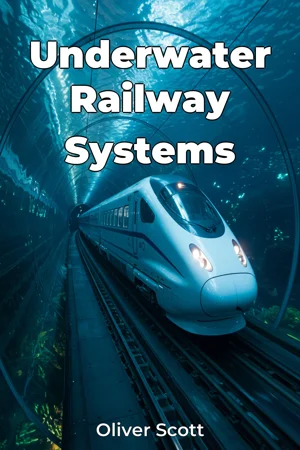
Imagine travelling from London to New York in under three hours, not by air, but by train, seamlessly gliding beneath the Atlantic Ocean. "Underwater Railway Systems" explores the ambitious, yet increasingly plausible, future of submerged rail networks designed to redefine global travel. This book focuses on the technological advancements, engineering feats, and economic factors that are converging to make underwater rail transport a viable alternative to air and sea travel. Considering the increasing demand for faster and more sustainable transportation solutions, the concepts explored within this book offer a pathway for future infrastructure development. The core of this book revolves around three central themes: first, the design and construction of submerged floating tunnels (SFTs), which form the essential structure of these underwater railways; second, the advanced materials and engineering techniques required to withstand immense water pressure and ensure passenger safety; and third, the socio-economic impact of such systems on global trade, tourism, and regional development. These themes are presented in a manner accessible to readers with varied backgrounds, building from fundamental engineering principles to complex economic models. Before delving into the specifics, "Underwater Railway Systems" provides essential background information on current transportation infrastructure, including high-speed rail networks and existing subsea tunnels, outlining their limitations and the driving forces behind the need for innovative solutions. We also examine the history of visionary, yet unrealized, underwater transport proposals, providing context for the current resurgence of interest in this field. The central argument presented is that, while significant challenges remain, the combination of technological progress and the growing demand for efficient, low-emission transportation makes underwater rail systems a potentially transformative infrastructure project of the 21st century. The book is structured in three parts. Part one introduces the fundamental concepts of SFT design, focusing on buoyancy, stability, and hydrodynamic forces. Part two explores materials science and engineering, detailing the properties of advanced concrete, composite materials, and tunnel-boring technologies used in constructing these submerged structures. We analyze the environmental impacts of underwater construction, the safety protocols involved, and the necessary emergency response systems. Part three examines the economic feasibility of underwater rail projects, considering construction costs, operational expenses, and potential revenue streams. This section also evaluates the geopolitical implications of connecting continents via underwater infrastructure, looking at the impact on international trade and tourism. Case studies of proposed routes around the globe, including the Atlantic crossing, Scandinavian linkages, and Asian connections, illustrate the complex challenges and potential benefits. The evidence presented throughout the book draws from engineering simulations, material testing data, economic feasibility studies, and environmental impact assessments. We utilize data from existing tunnel projects, offshore oil and gas platforms, and bridge construction to support the proposed engineering solutions. The research methodologies include finite element analysis, computational fluid dynamics, and life cycle cost analysis. This book connects to several fields of study, including civil engineering, materials science, economics, and environmental science. The integration of these disciplines is crucial for assessing the overall viability and sustainability of underwater rail systems. The unique approach of "Underwater Railway Systems" lies in its comprehensive consideration of all aspects of submerged rail transport, from the initial design phase to the long-term socio-economic impacts. The material is presented in a professional and approachable style, avoiding overly technical jargon while maintaining scientific rigor. The target audience includes engineers, urban planners, policymakers, investors, and anyone interested in the future of transportation and infrastructure. The book is valuable to those seeking a comprehensive overview of the challenges and opportunities associated with this emerging technology. In line with the conventions of the technology and travel genres, "Underwater Railway Systems" presents factual information, technical specifications, and real-world case studies to support its arguments. The scope of the book is intentionally broad, covering a wide range of topics related to underwater rail systems, while acknowledging the limitations imposed by the theoretical nature of many of the proposed designs. The book does not delve into the specific political challenges of international cooperation beyond a broad overview. The information presented in this book can be applied to policy decisions related to infrastructure investment, engineering design choices for future transportation projects, and economic modeling to assess the feasibility of large-scale underwater construction. "Underwater Railway Systems" addresses ongoing debates concerning the environmental impact of large-scale construction projects and the equitable distribution of benefits associated with new transportation infrastructure. The book offers a balanced perspective, acknowledging both the potential benefits and the inherent risks of pursuing this ambitious technology.
Imagine travelling from London to New York in under three hours, not by air, but by train, seamlessly gliding beneath the Atlantic Ocean. "Underwater Railway Systems" explores the ambitious, yet increasingly plausible, future of submerged rail networks designed to redefine global travel. This book focuses on the technological advancements, engineering feats, and economic factors that are converging to make underwater rail transport a viable alternative to air and sea travel. Considering the increasing demand for faster and more sustainable transportation solutions, the concepts explored within this book offer a pathway for future infrastructure development. The core of this book revolves around three central themes: first, the design and construction of submerged floating tunnels (SFTs), which form the essential structure of these underwater railways; second, the advanced materials and engineering techniques required to withstand immense water pressure and ensure passenger safety; and third, the socio-economic impact of such systems on global trade, tourism, and regional development. These themes are presented in a manner accessible to readers with varied backgrounds, building from fundamental engineering principles to complex economic models. Before delving into the specifics, "Underwater Railway Systems" provides essential background information on current transportation infrastructure, including high-speed rail networks and existing subsea tunnels, outlining their limitations and the driving forces behind the need for innovative solutions. We also examine the history of visionary, yet unrealized, underwater transport proposals, providing context for the current resurgence of interest in this field. The central argument presented is that, while significant challenges remain, the combination of technological progress and the growing demand for efficient, low-emission transportation makes underwater rail systems a potentially transformative infrastructure project of the 21st century. The book is structured in three parts. Part one introduces the fundamental concepts of SFT design, focusing on buoyancy, stability, and hydrodynamic forces. Part two explores materials science and engineering, detailing the properties of advanced concrete, composite materials, and tunnel-boring technologies used in constructing these submerged structures. We analyze the environmental impacts of underwater construction, the safety protocols involved, and the necessary emergency response systems. Part three examines the economic feasibility of underwater rail projects, considering construction costs, operational expenses, and potential revenue streams. This section also evaluates the geopolitical implications of connecting continents via underwater infrastructure, looking at the impact on international trade and tourism. Case studies of proposed routes around the globe, including the Atlantic crossing, Scandinavian linkages, and Asian connections, illustrate the complex challenges and potential benefits. The evidence presented throughout the book draws from engineering simulations, material testing data, economic feasibility studies, and environmental impact assessments. We utilize data from existing tunnel projects, offshore oil and gas platforms, and bridge construction to support the proposed engineering solutions. The research methodologies include finite element analysis, computational fluid dynamics, and life cycle cost analysis. This book connects to several fields of study, including civil engineering, materials science, economics, and environmental science. The integration of these disciplines is crucial for assessing the overall viability and sustainability of underwater rail systems. The unique approach of "Underwater Railway Systems" lies in its comprehensive consideration of all aspects of submerged rail transport, from the initial design phase to the long-term socio-economic impacts. The material is presented in a professional and approachable style, avoiding overly technical jargon while maintaining scientific rigor. The target audience includes engineers, urban planners, policymakers, investors, and anyone interested in the future of transportation and infrastructure. The book is valuable to those seeking a comprehensive overview of the challenges and opportunities associated with this emerging technology. In line with the conventions of the technology and travel genres, "Underwater Railway Systems" presents factual information, technical specifications, and real-world case studies to support its arguments. The scope of the book is intentionally broad, covering a wide range of topics related to underwater rail systems, while acknowledging the limitations imposed by the theoretical nature of many of the proposed designs. The book does not delve into the specific political challenges of international cooperation beyond a broad overview. The information presented in this book can be applied to policy decisions related to infrastructure investment, engineering design choices for future transportation projects, and economic modeling to assess the feasibility of large-scale underwater construction. "Underwater Railway Systems" addresses ongoing debates concerning the environmental impact of large-scale construction projects and the equitable distribution of benefits associated with new transportation infrastructure. The book offers a balanced perspective, acknowledging both the potential benefits and the inherent risks of pursuing this ambitious technology.
"Underwater Railway Systems" explores the groundbreaking concept of submerged rail networks, envisioning a future where high-speed rail travel occurs beneath the ocean's surface. It delves into the possibility of traveling from London to New York in under three hours via underwater tunnels. The book highlights the convergence of technological advancements, engineering innovations, and economic factors that could make this vision a reality, offering a solution to the growing demand for sustainable transportation. The book examines the design and construction of submerged floating tunnels (SFTs), the advanced materials required to withstand immense water pressure, and the potential socio-economic impacts on global trade and tourism. It presents a balanced perspective on the challenges and opportunities of underwater rail systems using engineering simulations, material testing data, and economic feasibility studies. Case studies of proposed routes, such as transatlantic crossings and Scandinavian linkages, illustrate the potential benefits and complex challenges. Structured in three parts, the book progresses from fundamental design concepts to materials science, engineering, and economic feasibility. It offers a comprehensive overview of the topic, making it valuable to engineers, urban planners, and anyone interested in the future of transportation technology and infrastructure development.
Book Details
ISBN
9788235257376
Publisher
Publifye AS
Your Licenses
You don't own any licenses for this book
Purchase a license below to unlock this book and download the EPUB.
Purchase License
Select a tier to unlock this book
Need bulk licensing?
Contact us for enterprise agreements.