
About This Book
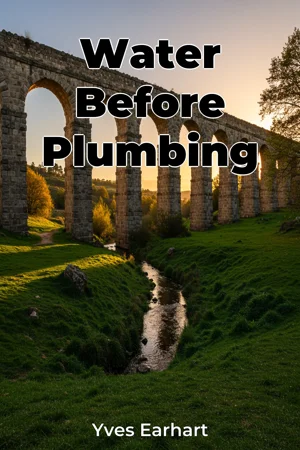
How did civilizations flourish long before the advent of taps, sewers, and water treatment plants? "Water Before Plumbing" explores the ingenuity and resourcefulness of early societies in accessing, storing, and transporting water, revealing the intricate relationship between water management and societal development. This book delves into the critical role water played in shaping ancient civilizations, examining the techniques they employed and the challenges they overcame to secure this essential resource. We will explore three key areas: ancient water sources and collection, the engineering of early water transport systems, and the social and cultural impact of water management. Understanding these topics is crucial because it provides insights into how societies adapted to their environments, organized themselves, and developed complex technologies in response to the fundamental need for water. It also offers a valuable perspective on the long-term sustainability of water resources, a pressing issue today. The context for our exploration lies in the pre-industrial era, spanning from the dawn of agriculture to the early modern period. We will consider the geographical variations that influenced different approaches to water management, from arid regions where water scarcity was a constant concern to areas with abundant surface water. A basic understanding of hydrological principles and historical timelines will aid the reader, but the book is written to be accessible to a broad audience. The central argument of "Water Before Plumbing" is that the ability to effectively manage water resources was a determining factor in the success and longevity of early societies. By examining case studies from around the world, we demonstrate that sophisticated water management techniques were not merely technological achievements but also reflections of a society's social, political, and economic structures. The book begins by introducing various sources of water utilized by ancient peoples, including springs, wells, rainwater harvesting, and river diversions. We then investigate the development of early water transport systems, such as canals, aqueducts, and underground conduits, highlighting the engineering principles and labor involved in their construction. The core of the book consists of detailed analyses of specific civilizations—Mesopotamia, ancient Egypt, the Roman Empire, and the Inca civilization—showcasing their unique approaches to water management. Each case study examines the challenges these societies faced, the solutions they implemented, and the consequences of their water management practices. The book culminates by drawing parallels between ancient water management strategies and contemporary challenges, exploring lessons that can be applied to address current water scarcity and sustainability issues. Our evidence will be drawn from archaeological records, historical texts, and geological surveys. We will analyze the physical remains of ancient water systems, interpret historical accounts of water management practices, and utilize geological data to understand the environmental contexts in which these systems operated. Unique data sources include previously untranslated cuneiform tablets detailing irrigation practices in Mesopotamia and newly discovered sections of Roman aqueducts. The book's interdisciplinary nature connects Earth Sciences, Geography, and History. Earth Sciences provide the geological and hydrological context for understanding water availability. Geography illustrates how different environments shaped water management strategies. History provides the narrative framework for understanding the evolution of these practices over time. "Water Before Plumbing" adopts a narrative non-fiction style, blending factual information with engaging storytelling to bring the past to life. Technical details are explained in a clear and accessible manner, avoiding jargon and unnecessary complexity. The target audience includes students of history, archaeology, and environmental studies, as well as general readers interested in ancient civilizations and the history of technology. The book will appeal to anyone seeking a deeper understanding of humanity's enduring relationship with water. As a work of non-fiction in the Earth Sciences Geography and History genres, this book adheres to rigorous standards of scholarship, with all claims supported by credible evidence and properly cited sources. The scope of the book is global, encompassing a wide range of civilizations and geographical regions, but it does not delve into the specific details of modern water treatment technologies. The information in this book can inform contemporary water management practices, offering insights into sustainable strategies for water conservation, distribution, and governance. While the evidence overwhelmingly supports the importance of water management in early societal development, debates persist among historians regarding the relative influence of water management compared to other factors such as agriculture, trade, and warfare. This book acknowledges and addresses these debates, presenting a balanced and nuanced perspective on the complex interplay of factors that shaped ancient civilizations.
How did civilizations flourish long before the advent of taps, sewers, and water treatment plants? "Water Before Plumbing" explores the ingenuity and resourcefulness of early societies in accessing, storing, and transporting water, revealing the intricate relationship between water management and societal development. This book delves into the critical role water played in shaping ancient civilizations, examining the techniques they employed and the challenges they overcame to secure this essential resource. We will explore three key areas: ancient water sources and collection, the engineering of early water transport systems, and the social and cultural impact of water management. Understanding these topics is crucial because it provides insights into how societies adapted to their environments, organized themselves, and developed complex technologies in response to the fundamental need for water. It also offers a valuable perspective on the long-term sustainability of water resources, a pressing issue today. The context for our exploration lies in the pre-industrial era, spanning from the dawn of agriculture to the early modern period. We will consider the geographical variations that influenced different approaches to water management, from arid regions where water scarcity was a constant concern to areas with abundant surface water. A basic understanding of hydrological principles and historical timelines will aid the reader, but the book is written to be accessible to a broad audience. The central argument of "Water Before Plumbing" is that the ability to effectively manage water resources was a determining factor in the success and longevity of early societies. By examining case studies from around the world, we demonstrate that sophisticated water management techniques were not merely technological achievements but also reflections of a society's social, political, and economic structures. The book begins by introducing various sources of water utilized by ancient peoples, including springs, wells, rainwater harvesting, and river diversions. We then investigate the development of early water transport systems, such as canals, aqueducts, and underground conduits, highlighting the engineering principles and labor involved in their construction. The core of the book consists of detailed analyses of specific civilizations—Mesopotamia, ancient Egypt, the Roman Empire, and the Inca civilization—showcasing their unique approaches to water management. Each case study examines the challenges these societies faced, the solutions they implemented, and the consequences of their water management practices. The book culminates by drawing parallels between ancient water management strategies and contemporary challenges, exploring lessons that can be applied to address current water scarcity and sustainability issues. Our evidence will be drawn from archaeological records, historical texts, and geological surveys. We will analyze the physical remains of ancient water systems, interpret historical accounts of water management practices, and utilize geological data to understand the environmental contexts in which these systems operated. Unique data sources include previously untranslated cuneiform tablets detailing irrigation practices in Mesopotamia and newly discovered sections of Roman aqueducts. The book's interdisciplinary nature connects Earth Sciences, Geography, and History. Earth Sciences provide the geological and hydrological context for understanding water availability. Geography illustrates how different environments shaped water management strategies. History provides the narrative framework for understanding the evolution of these practices over time. "Water Before Plumbing" adopts a narrative non-fiction style, blending factual information with engaging storytelling to bring the past to life. Technical details are explained in a clear and accessible manner, avoiding jargon and unnecessary complexity. The target audience includes students of history, archaeology, and environmental studies, as well as general readers interested in ancient civilizations and the history of technology. The book will appeal to anyone seeking a deeper understanding of humanity's enduring relationship with water. As a work of non-fiction in the Earth Sciences Geography and History genres, this book adheres to rigorous standards of scholarship, with all claims supported by credible evidence and properly cited sources. The scope of the book is global, encompassing a wide range of civilizations and geographical regions, but it does not delve into the specific details of modern water treatment technologies. The information in this book can inform contemporary water management practices, offering insights into sustainable strategies for water conservation, distribution, and governance. While the evidence overwhelmingly supports the importance of water management in early societal development, debates persist among historians regarding the relative influence of water management compared to other factors such as agriculture, trade, and warfare. This book acknowledges and addresses these debates, presenting a balanced and nuanced perspective on the complex interplay of factors that shaped ancient civilizations.
"Water Before Plumbing" explores how ancient civilizations thrived by mastering water management long before modern plumbing. Investigating early water systems, the book reveals ingenious techniques for accessing, storing, and transporting water. From rainwater harvesting to complex aqueducts, these methods were crucial for societal development, demonstrating that effective water management played a key role in the success and longevity of early societies. The book highlights the intricate relationship between Earth Sciences, Geography, and History by examining how different environments influenced water strategies. The book progresses across chapters, starting with ancient water sources and early transport systems, then delving into case studies of Mesopotamia, ancient Egypt, the Roman Empire, and the Inca civilization. These civilizations illustrate how water scarcity and abundance shaped their societies, revealing the social, political, and economic impact of water management. This approach allows readers to appreciate the resourcefulness of ancient engineering and the importance of water sustainability. Drawing from archaeological records, historical texts, and geological surveys, "Water Before Plumbing" adopts a narrative non-fiction style to present complex information in an accessible manner. It offers a valuable perspective on pre-industrial water techniques and their relevance to contemporary water challenges, making it a compelling read for anyone interested in Earth Sciences, Geography, History, and the enduring relationship between humanity and water.
Book Details
ISBN
9788235256485
Publisher
Publifye AS
Your Licenses
You don't own any licenses for this book
Purchase a license below to unlock this book and download the EPUB.
Purchase License
Select a tier to unlock this book
Need bulk licensing?
Contact us for enterprise agreements.