
About This Book
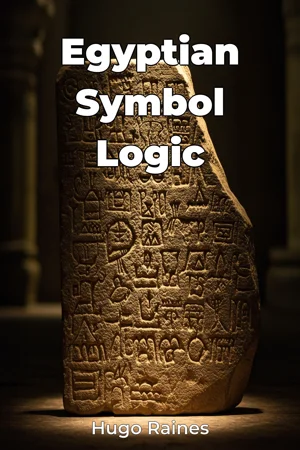
Can a lost language unlock the secrets of an ancient civilization's power? "Egyptian Symbol Logic" delves into the rational systems underpinning Egyptian hieroglyphs, revealing how this intricate writing system communicated power, religion, and daily affairs across vast distances and millennia. This book argues that hieroglyphs were not merely decorative or mystical symbols but a sophisticated form of communication rooted in structured logic and conveying complex information. Understanding this logic provides insight into the core of Egyptian society, its governance, and its worldview. This book explores three core elements: the grammatical and syntactical structures within hieroglyphic texts, the symbolic weight carried by individual glyphs in conveying concepts of power and authority, and the use of hieroglyphs to transmit religious and philosophical beliefs across generations. We examine how these elements intersect to create a cohesive system capable of expressing abstract ideas and concrete realities. To fully appreciate the logic inherent in hieroglyphs, a basic understanding of ancient Egyptian society and its historical timeline is helpful. This book provides sufficient context, including an overview of key pharaohs, dynasties, and significant periods in Egyptian history. No prior knowledge of linguistics or ancient languages is required. The central thesis asserts that Egyptian hieroglyphs represent a deliberate and rationally constructed system of communication designed to reinforce societal hierarchies and religious doctrines. This system facilitated the consolidation of power by the ruling elite and ensured the perpetuation of specific belief systems. This argument challenges more romanticized interpretations of hieroglyphs, positioning them instead as a powerful tool of social and political control. The book is structured in three parts. First, it introduces the basic principles of hieroglyphic grammar and syntax, explaining how glyphs combine to form words, phrases, and sentences. Second, it analyzes the symbolism encoded within individual glyphs, focusing on those related to kingship, divinity, and social order. Third, it examines specific texts, such as royal decrees, temple inscriptions, and funerary documents, demonstrating how the principles of logic and symbolism were applied in practice. The book culminates by exploring how an understanding of Egyptian symbol logic can enhance our appreciation of Egyptian art, architecture, and literature. The analysis presented relies on a combination of primary source analysis (direct examination of hieroglyphic texts and artifacts) and secondary scholarship in Egyptology and linguistics. The methodology employs a combination of philological analysis, iconographic interpretation, and comparative linguistics. "Egyptian Symbol Logic" connects to several other fields, including semiotics (the study of signs and symbols), political science (through the examination of power dynamics), and religious studies (through the analysis of ancient Egyptian beliefs). These interdisciplinary connections enrich the understanding of hieroglyphs and their role in shaping Egyptian civilization. This book offers a unique perspective by treating hieroglyphs not as simple pictures but as elements within an elaborate, rational system. It emphasizes the importance of understanding the underlying structure of the language in order to fully appreciate its meaning and purpose. The tone is academic but accessible, employing clear language and avoiding technical jargon whenever possible. Complex ideas are explained in a straightforward manner, making the information digestible for a broad audience. The target audience includes students of history, Egyptology, linguistics, and anyone interested in ancient civilizations and the power of language. It offers valuable insights to those seeking a deeper understanding of Egyptian culture and its lasting legacy. As a work of non-fiction in the field of history and language arts, this book adheres to the principles of factual accuracy, evidence-based argumentation, and scholarly rigor. It makes a clear distinction between verifiable facts and speculative interpretations. The scope of the book is limited to the analysis of hieroglyphs as a system of communication. It does not delve into other aspects of Egyptian culture, such as art, architecture, or social customs, except where they directly relate to the interpretation of hieroglyphic texts. The principles of Egyptian symbol logic can be applied to the study of other ancient writing systems and to the analysis of visual communication in contemporary society. It offers a framework for understanding how symbols can be used to convey complex ideas and reinforce social structures. While there is general agreement among Egyptologists regarding the basic principles of hieroglyphic writing, debates persist regarding the precise meaning of certain glyphs and the nuances of their usage. This book acknowledges these debates and presents alternative interpretations where appropriate.
Can a lost language unlock the secrets of an ancient civilization's power? "Egyptian Symbol Logic" delves into the rational systems underpinning Egyptian hieroglyphs, revealing how this intricate writing system communicated power, religion, and daily affairs across vast distances and millennia. This book argues that hieroglyphs were not merely decorative or mystical symbols but a sophisticated form of communication rooted in structured logic and conveying complex information. Understanding this logic provides insight into the core of Egyptian society, its governance, and its worldview. This book explores three core elements: the grammatical and syntactical structures within hieroglyphic texts, the symbolic weight carried by individual glyphs in conveying concepts of power and authority, and the use of hieroglyphs to transmit religious and philosophical beliefs across generations. We examine how these elements intersect to create a cohesive system capable of expressing abstract ideas and concrete realities. To fully appreciate the logic inherent in hieroglyphs, a basic understanding of ancient Egyptian society and its historical timeline is helpful. This book provides sufficient context, including an overview of key pharaohs, dynasties, and significant periods in Egyptian history. No prior knowledge of linguistics or ancient languages is required. The central thesis asserts that Egyptian hieroglyphs represent a deliberate and rationally constructed system of communication designed to reinforce societal hierarchies and religious doctrines. This system facilitated the consolidation of power by the ruling elite and ensured the perpetuation of specific belief systems. This argument challenges more romanticized interpretations of hieroglyphs, positioning them instead as a powerful tool of social and political control. The book is structured in three parts. First, it introduces the basic principles of hieroglyphic grammar and syntax, explaining how glyphs combine to form words, phrases, and sentences. Second, it analyzes the symbolism encoded within individual glyphs, focusing on those related to kingship, divinity, and social order. Third, it examines specific texts, such as royal decrees, temple inscriptions, and funerary documents, demonstrating how the principles of logic and symbolism were applied in practice. The book culminates by exploring how an understanding of Egyptian symbol logic can enhance our appreciation of Egyptian art, architecture, and literature. The analysis presented relies on a combination of primary source analysis (direct examination of hieroglyphic texts and artifacts) and secondary scholarship in Egyptology and linguistics. The methodology employs a combination of philological analysis, iconographic interpretation, and comparative linguistics. "Egyptian Symbol Logic" connects to several other fields, including semiotics (the study of signs and symbols), political science (through the examination of power dynamics), and religious studies (through the analysis of ancient Egyptian beliefs). These interdisciplinary connections enrich the understanding of hieroglyphs and their role in shaping Egyptian civilization. This book offers a unique perspective by treating hieroglyphs not as simple pictures but as elements within an elaborate, rational system. It emphasizes the importance of understanding the underlying structure of the language in order to fully appreciate its meaning and purpose. The tone is academic but accessible, employing clear language and avoiding technical jargon whenever possible. Complex ideas are explained in a straightforward manner, making the information digestible for a broad audience. The target audience includes students of history, Egyptology, linguistics, and anyone interested in ancient civilizations and the power of language. It offers valuable insights to those seeking a deeper understanding of Egyptian culture and its lasting legacy. As a work of non-fiction in the field of history and language arts, this book adheres to the principles of factual accuracy, evidence-based argumentation, and scholarly rigor. It makes a clear distinction between verifiable facts and speculative interpretations. The scope of the book is limited to the analysis of hieroglyphs as a system of communication. It does not delve into other aspects of Egyptian culture, such as art, architecture, or social customs, except where they directly relate to the interpretation of hieroglyphic texts. The principles of Egyptian symbol logic can be applied to the study of other ancient writing systems and to the analysis of visual communication in contemporary society. It offers a framework for understanding how symbols can be used to convey complex ideas and reinforce social structures. While there is general agreement among Egyptologists regarding the basic principles of hieroglyphic writing, debates persist regarding the precise meaning of certain glyphs and the nuances of their usage. This book acknowledges these debates and presents alternative interpretations where appropriate.
"Egyptian Symbol Logic" unveils the sophisticated rational system behind Egyptian hieroglyphs, revealing how they served as more than mere decoration. This book argues that hieroglyphs were a structured form of communication, crucial for conveying power, religious beliefs, and everyday information throughout ancient Egypt. By understanding the logic inherent in these symbols, readers gain insight into the core of Egyptian society, its governance, and its unique worldview. The book explores the grammatical structure and symbolic weight of hieroglyphs, demonstrating their role in reinforcing societal hierarchies and religious doctrines. For instance, glyphs associated with kingship and divinity served to legitimize the pharaoh's authority and maintain social order. Structured in three parts, it begins with hieroglyphic grammar, progresses to the symbolism within individual glyphs, and concludes with the analysis of specific texts like royal decrees and temple inscriptions, illustrating the practical application of this ancient writing system. This unique approach treats hieroglyphs not as isolated images but as interconnected elements within a carefully crafted system, emphasizing the importance of understanding their underlying structure. By examining royal decrees and religious texts, the book reveals how hieroglyphs facilitated political control and perpetuated specific belief systems. Ultimately, "Egyptian Symbol Logic" enhances appreciation for Egyptian art, architecture, and literature through a deeper understanding of its language.
Book Details
ISBN
9788235256409
Publisher
Publifye AS
Your Licenses
You don't own any licenses for this book
Purchase a license below to unlock this book and download the EPUB.
Purchase License
Select a tier to unlock this book
Need bulk licensing?
Contact us for enterprise agreements.