
About This Book
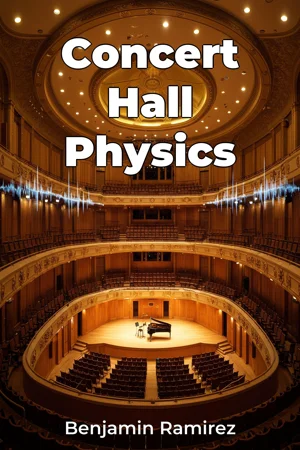
Have you ever wondered why some concert halls seem to breathe life into music, while others leave it sounding flat and lifeless? "Concert Hall Physics" delves into the intricate science behind creating exceptional acoustic spaces, revealing the architectural and material choices that determine a venue's sonic character. This book explores the fundamental principles of sound reflection, absorption, and diffusion, crucial elements in achieving optimal listening experiences. Why are these principles so important? Because a concert hall's acoustics directly impact the clarity, richness, and emotional impact of musical performances for both performers and audience members. This book provides a comprehensive examination of concert hall acoustics, integrating knowledge from physics and architecture. It offers a deep dive into the historical context, tracing the evolution of concert hall design from early amphitheaters to contemporary marvels. While a basic understanding of wave mechanics is helpful, the book doesn't assume prior expertise. The central argument is that exceptional concert hall acoustics stem from a deliberate and informed application of physical principles, allowing architects and acousticians to shape the sound field within a space to create the desired effect. Good design improves the listening experience, which in turn provides greater access and enjoyment of cultural events. "Concert Hall Physics" is structured to guide readers through this complex subject. The first section introduces the fundamental concepts of sound propagation, reflection, absorption, and diffusion. Core chapters then delve into the specific architectural and material characteristics that influence these acoustic phenomena, explaining how factors like room shape, wall materials, and surface textures contribute to a hall's overall sound quality. The book culminates by examining several case studies of renowned concert halls, analyzing their acoustic designs and demonstrating how the principles discussed are applied in practice. The content builds to explore the practical implications of acoustic design for musicians, audiences, and architects. The book draws upon a wealth of scientific data, including acoustic measurements, computer simulations, and subjective evaluations from musicians and listeners. Original acoustic data and analyses of specific concert halls are presented, alongside established research in architectural acoustics. "Concert Hall Physics" uniquely bridges the gap between scientific theory and architectural practice, offering insights valuable to both fields. The interdisciplinary nature extends into the realm of musicology, where the influence of acoustic design on musical performance and interpretation is considered. Furthermore, connections to materials science are explored, examining how different materials interact with sound waves. What sets "Concert Hall Physics" apart is its holistic approach to understanding concert hall acoustics, emphasizing the interplay between architectural design, material properties, and subjective perception of sound. The tone remains academic, yet accessible, using clear explanations and illustrative examples to convey complex concepts. This book targets a broad audience, including architecture students, practicing architects, acousticians, musicians, and anyone with a keen interest in the science of sound and its impact on the built environment. The insights provided will enable readers to appreciate and evaluate concert hall design critically and also to inform their own design decisions. As a work of non-fiction, "Concert Hall Physics" adheres to the conventions of scientific accuracy and evidence-based reasoning. The book's scope encompasses a wide range of acoustic principles and architectural designs but focuses primarily on concert halls designed for classical music performance, acknowledging the unique acoustic requirements of other performance spaces. The information presented can be applied in the design and renovation of concert halls, recording studios, and other spaces where acoustic quality is paramount. While the book addresses some of the ongoing debates surrounding subjective vs. objective measures of acoustic quality, it primarily focuses on the scientific principles that underpin effective concert hall design. It is a practical guide to understanding and applying the science of sound in architectural spaces.
Have you ever wondered why some concert halls seem to breathe life into music, while others leave it sounding flat and lifeless? "Concert Hall Physics" delves into the intricate science behind creating exceptional acoustic spaces, revealing the architectural and material choices that determine a venue's sonic character. This book explores the fundamental principles of sound reflection, absorption, and diffusion, crucial elements in achieving optimal listening experiences. Why are these principles so important? Because a concert hall's acoustics directly impact the clarity, richness, and emotional impact of musical performances for both performers and audience members. This book provides a comprehensive examination of concert hall acoustics, integrating knowledge from physics and architecture. It offers a deep dive into the historical context, tracing the evolution of concert hall design from early amphitheaters to contemporary marvels. While a basic understanding of wave mechanics is helpful, the book doesn't assume prior expertise. The central argument is that exceptional concert hall acoustics stem from a deliberate and informed application of physical principles, allowing architects and acousticians to shape the sound field within a space to create the desired effect. Good design improves the listening experience, which in turn provides greater access and enjoyment of cultural events. "Concert Hall Physics" is structured to guide readers through this complex subject. The first section introduces the fundamental concepts of sound propagation, reflection, absorption, and diffusion. Core chapters then delve into the specific architectural and material characteristics that influence these acoustic phenomena, explaining how factors like room shape, wall materials, and surface textures contribute to a hall's overall sound quality. The book culminates by examining several case studies of renowned concert halls, analyzing their acoustic designs and demonstrating how the principles discussed are applied in practice. The content builds to explore the practical implications of acoustic design for musicians, audiences, and architects. The book draws upon a wealth of scientific data, including acoustic measurements, computer simulations, and subjective evaluations from musicians and listeners. Original acoustic data and analyses of specific concert halls are presented, alongside established research in architectural acoustics. "Concert Hall Physics" uniquely bridges the gap between scientific theory and architectural practice, offering insights valuable to both fields. The interdisciplinary nature extends into the realm of musicology, where the influence of acoustic design on musical performance and interpretation is considered. Furthermore, connections to materials science are explored, examining how different materials interact with sound waves. What sets "Concert Hall Physics" apart is its holistic approach to understanding concert hall acoustics, emphasizing the interplay between architectural design, material properties, and subjective perception of sound. The tone remains academic, yet accessible, using clear explanations and illustrative examples to convey complex concepts. This book targets a broad audience, including architecture students, practicing architects, acousticians, musicians, and anyone with a keen interest in the science of sound and its impact on the built environment. The insights provided will enable readers to appreciate and evaluate concert hall design critically and also to inform their own design decisions. As a work of non-fiction, "Concert Hall Physics" adheres to the conventions of scientific accuracy and evidence-based reasoning. The book's scope encompasses a wide range of acoustic principles and architectural designs but focuses primarily on concert halls designed for classical music performance, acknowledging the unique acoustic requirements of other performance spaces. The information presented can be applied in the design and renovation of concert halls, recording studios, and other spaces where acoustic quality is paramount. While the book addresses some of the ongoing debates surrounding subjective vs. objective measures of acoustic quality, it primarily focuses on the scientific principles that underpin effective concert hall design. It is a practical guide to understanding and applying the science of sound in architectural spaces.
"Concert Hall Physics" explores the intricate relationship between physics and architecture in creating exceptional acoustic spaces. It examines how architectural and material choices, such as room shape and wall textures, affect sound reflection, absorption, and diffusion, which are vital for optimal listening experiences. The acoustics of a concert hall directly influence the clarity and emotional impact of musical performances. The book traces the evolution of concert hall design, integrating historical context with scientific data from acoustic measurements and computer simulations. It uniquely bridges the gap between scientific theory and architectural practice, offering insights into how architects and acousticians can shape sound fields to achieve desired effects. Readers will discover how deliberate application of physics principles can transform a venue's sonic character. Structured to guide readers, the book begins with fundamental concepts of sound propagation and then explores architectural characteristics influencing acoustics. Case studies of renowned concert halls demonstrate the practical application of these principles. This approach allows readers to appreciate and critically evaluate concert hall design, making it valuable for architects, acousticians, musicians, and anyone interested in the science of sound.
Book Details
ISBN
9788235254955
Publisher
Publifye AS
Your Licenses
You don't own any licenses for this book
Purchase a license below to unlock this book and download the EPUB.
Purchase License
Select a tier to unlock this book
Need bulk licensing?
Contact us for enterprise agreements.