
About This Book
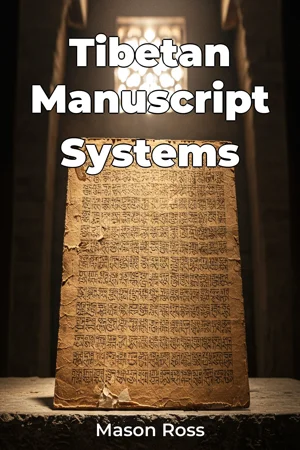
How did a civilization nestled in the Himalayas, often isolated and facing harsh environmental conditions, develop and maintain a sophisticated system for preserving its spiritual and administrative heritage? "Tibetan Manuscript Systems" delves into the intricate world of ancient Tibetan scribal culture, examining the methods employed to safeguard texts, educate scribes, and organize the vast collection of manuscripts crucial to both religious and secular life. This book reveals the mechanics behind the preservation of Tibetan knowledge, the training regimes that produced skilled scribes, and the organizational schema that managed sprawling archives. Understanding these systems provides invaluable insight into the cultural resilience, intellectual pursuits, and bureaucratic structures of ancient Tibet. This book fundamentally argues that the preservation and organization of manuscripts in ancient Tibet was not merely a clerical task but a cornerstone of societal stability and cultural continuity. The meticulousness of scribal training, the sophistication of preservation techniques, and the strategic organization of texts were integral to the transmission of religious doctrine, legal codes, and administrative records. Without these systems, the sustained influence and widespread dissemination of Tibetan Buddhism and statecraft would have been impossible. "Tibetan Manuscript Systems" opens by setting the stage with an overview of the historical and cultural context of ancient Tibet, emphasizing the unique challenges and opportunities presented by its geographical location and sociopolitical landscape. The book then proceeds in three major sections. The first section explores the materials and methods utilized in manuscript production and preservation, from the selection and preparation of paper to the creation of inks and the application of protective measures against deterioration and damage. It examines the processes that enabled texts to endure for centuries, often in challenging climates. The second section delves into the training and social roles of scribes. It analyzes the rigorous educational programs, the apprenticeship systems, and the social hierarchies that governed scribal communities. This section also considers the role of scribes not only as transcribers but also as editors, commentators, and creators of new works. The third section analyzes the organizational structures employed to manage and access textual materials. This includes the classification systems used in monasteries and administrative centers, the cataloging practices that facilitated retrieval, and the protocols that governed access to sensitive or restricted documents. The book culminates by exploring the legacy of these manuscript systems. The evidence presented throughout "Tibetan Manuscript Systems" draws upon a range of primary sources, including surviving manuscripts, monastic records, administrative documents, and archaeological findings. It incorporates recent scholarship in Tibetan studies, paleography, and archival science. This book connects to broader fields such as history of the book, religious studies, and comparative administration. It provides a case study in knowledge management within a pre-modern society, offering insights applicable to understanding similar systems in other cultures and eras. "Tibetan Manuscript Systems" addresses ongoing debates concerning the dating of certain Tibetan texts and competing theories regarding the origins of specific scribal practices. While primarily focused on the period from the Tibetan Empire (7th-9th centuries) through the early modern era (17th century), the book acknowledges the limitations of its scope and the ongoing nature of scholarly inquiry in this field. The book aims to provide a comprehensive overview of the established knowledge while also highlighting areas for further research and investigation, adopting an academic approach while maintaining clarity and accessibility. The target audience for "Tibetan Manuscript Systems" includes scholars and students of Tibetan studies, history, religious studies, and archival science, as well as anyone interested in the history of books and the transmission of knowledge. This book will be valuable to those seeking a comprehensive understanding of the material culture of ancient Tibet and the intellectual infrastructure that supported its rich spiritual and administrative traditions. As an academic work, the book upholds rigorous standards of scholarship and documentation, while aiming to present complex information in an accessible manner.
How did a civilization nestled in the Himalayas, often isolated and facing harsh environmental conditions, develop and maintain a sophisticated system for preserving its spiritual and administrative heritage? "Tibetan Manuscript Systems" delves into the intricate world of ancient Tibetan scribal culture, examining the methods employed to safeguard texts, educate scribes, and organize the vast collection of manuscripts crucial to both religious and secular life. This book reveals the mechanics behind the preservation of Tibetan knowledge, the training regimes that produced skilled scribes, and the organizational schema that managed sprawling archives. Understanding these systems provides invaluable insight into the cultural resilience, intellectual pursuits, and bureaucratic structures of ancient Tibet. This book fundamentally argues that the preservation and organization of manuscripts in ancient Tibet was not merely a clerical task but a cornerstone of societal stability and cultural continuity. The meticulousness of scribal training, the sophistication of preservation techniques, and the strategic organization of texts were integral to the transmission of religious doctrine, legal codes, and administrative records. Without these systems, the sustained influence and widespread dissemination of Tibetan Buddhism and statecraft would have been impossible. "Tibetan Manuscript Systems" opens by setting the stage with an overview of the historical and cultural context of ancient Tibet, emphasizing the unique challenges and opportunities presented by its geographical location and sociopolitical landscape. The book then proceeds in three major sections. The first section explores the materials and methods utilized in manuscript production and preservation, from the selection and preparation of paper to the creation of inks and the application of protective measures against deterioration and damage. It examines the processes that enabled texts to endure for centuries, often in challenging climates. The second section delves into the training and social roles of scribes. It analyzes the rigorous educational programs, the apprenticeship systems, and the social hierarchies that governed scribal communities. This section also considers the role of scribes not only as transcribers but also as editors, commentators, and creators of new works. The third section analyzes the organizational structures employed to manage and access textual materials. This includes the classification systems used in monasteries and administrative centers, the cataloging practices that facilitated retrieval, and the protocols that governed access to sensitive or restricted documents. The book culminates by exploring the legacy of these manuscript systems. The evidence presented throughout "Tibetan Manuscript Systems" draws upon a range of primary sources, including surviving manuscripts, monastic records, administrative documents, and archaeological findings. It incorporates recent scholarship in Tibetan studies, paleography, and archival science. This book connects to broader fields such as history of the book, religious studies, and comparative administration. It provides a case study in knowledge management within a pre-modern society, offering insights applicable to understanding similar systems in other cultures and eras. "Tibetan Manuscript Systems" addresses ongoing debates concerning the dating of certain Tibetan texts and competing theories regarding the origins of specific scribal practices. While primarily focused on the period from the Tibetan Empire (7th-9th centuries) through the early modern era (17th century), the book acknowledges the limitations of its scope and the ongoing nature of scholarly inquiry in this field. The book aims to provide a comprehensive overview of the established knowledge while also highlighting areas for further research and investigation, adopting an academic approach while maintaining clarity and accessibility. The target audience for "Tibetan Manuscript Systems" includes scholars and students of Tibetan studies, history, religious studies, and archival science, as well as anyone interested in the history of books and the transmission of knowledge. This book will be valuable to those seeking a comprehensive understanding of the material culture of ancient Tibet and the intellectual infrastructure that supported its rich spiritual and administrative traditions. As an academic work, the book upholds rigorous standards of scholarship and documentation, while aiming to present complex information in an accessible manner.
"Tibetan Manuscript Systems" explores the sophisticated methods used in ancient Tibet to preserve and organize their vast collection of manuscripts. This academic work illuminates how Tibetans, despite their geographic isolation, developed a complex scribal culture to safeguard religious doctrines, legal codes, and administrative records. The book highlights intriguing facts, such as the meticulous training regimes for scribes and the elaborate preservation techniques used to protect texts from deterioration, crucial for maintaining cultural continuity and societal stability. The book approaches this topic by first providing historical and cultural context of ancient Tibet. It then delves into the materials and methods used in manuscript production, the training and social roles of scribes, and the organizational structures employed to manage textual materials. By examining monastic records and administrative documents, the book reveals how these systems were integral to the transmission of Tibetan Buddhism and statecraft, offering a unique case study in knowledge management within a pre-modern society and connecting to broader fields like history of the book and archival science.
Book Details
ISBN
9788235254504
Publisher
Publifye AS
Your Licenses
You don't own any licenses for this book
Purchase a license below to unlock this book and download the EPUB.
Purchase License
Select a tier to unlock this book
Need bulk licensing?
Contact us for enterprise agreements.