
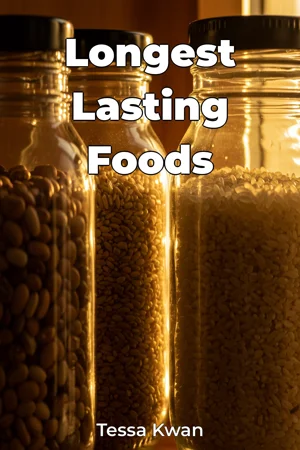
About This Book
Imagine holding a pantry stocked with ingredients that outlive you. How is this possible? *Longest Lasting Foods* delves into the science and art of food preservation, revealing which foods possess remarkable longevity and the methods that secure their extended shelf life. This book explores three pivotal areas: the inherent properties of certain foods that contribute to their durability, the scientifically proven preservation techniques that enhance their lifespan, and the historical significance of these foods in human civilization. Understanding these topics is crucial in an era of food waste, supply chain vulnerabilities, and a growing interest in sustainable living. It provides readers with knowledge applicable to emergency preparedness, resource management, and a deeper appreciation for culinary history. Throughout history, humans have relied on specific foods for survival during lean times. Grains, legumes, and certain fats have sustained populations through famines and long voyages. Understanding the scientific basis for why these foods resist spoilage – low moisture content, high acidity, or natural antibacterial properties – provides a foundation for optimizing preservation efforts. No specialized knowledge is required to understand this book, as it explains scientific concepts in an accessible manner. The central argument is that while all foods eventually degrade, specific intrinsic qualities and deliberate preservation strategies can dramatically extend their usability, enabling us to reduce waste and ensure long-term resource availability. This argument is important because it challenges the conventional wisdom of constantly replenishing food supplies, offering a more sustainable and resilient approach to food management. The book unfolds in four major parts. First, it introduces the core concepts of food spoilage – microbial growth, enzymatic reactions, and chemical degradation – and the factors that influence them. Second, it examines individual foods known for their longevity, such as honey, salt, dried beans, rice, and hard liquors, detailing their composition and the reasons for their resistance to decay. Third, it investigates various preservation methods, including drying, salting, fermenting, canning, and vacuum sealing, explaining the science behind each technique and its impact on food quality and safety. The final section explores practical applications, offering guidelines for creating a long-term food storage plan, troubleshooting common preservation challenges, and understanding the legal and safety regulations surrounding food preservation. The evidence presented is drawn from scientific studies in food chemistry and microbiology, historical accounts of food preservation practices, and data from food manufacturers and government agencies. The book incorporates experimental data on food storage conditions and microbial growth rates, providing a fact-based analysis of preservation effectiveness. This book also connects to fields such as archaeology (understanding ancient diets and food storage), public health (addressing foodborne illnesses and nutritional security), and environmental science (reducing food waste and promoting sustainable agriculture). These interdisciplinary connections enrich the book's argument by demonstrating the multifaceted impact of food preservation on society and the environment. *Longest Lasting Foods* presents a unique perspective by combining scientific rigor with practical advice, empowering readers to take control of their food supply and adopt more sustainable practices. The tone is informative and practical, aiming to educate and inspire readers to explore the world of food preservation. This book is geared toward home cooks, preppers, homesteaders, and anyone interested in food science and sustainability. It will be valuable to individuals who want to reduce food waste, prepare for emergencies, or simply learn more about the science and history of food. As a work in the cooking and science genres, the book explains the science behind cooking techniques, delves into the chemical reactions and biological processes involved in food preservation and draws on research in food science, microbiology, and nutrition to provide a comprehensive understanding of the subject matter. It steers away from recipes that require immediate consumption, focusing instead on the underlying principles that enable long-term food storage. The book's scope is limited to foods that, with proper preservation, can last for several years or even decades. It does not cover perishable foods that require refrigeration or freezing for short-term storage. The information in this book can be applied to create a well-stocked pantry for emergencies, reduce food waste in the home, and develop a deeper understanding of the food we eat. While most food preservation techniques are well-established, debates exist regarding the optimal methods for maintaining nutritional value and flavor during long-term storage. The book addresses these concerns by presenting a balanced view of different approaches and highlighting areas where further research is needed.
Imagine holding a pantry stocked with ingredients that outlive you. How is this possible? *Longest Lasting Foods* delves into the science and art of food preservation, revealing which foods possess remarkable longevity and the methods that secure their extended shelf life. This book explores three pivotal areas: the inherent properties of certain foods that contribute to their durability, the scientifically proven preservation techniques that enhance their lifespan, and the historical significance of these foods in human civilization. Understanding these topics is crucial in an era of food waste, supply chain vulnerabilities, and a growing interest in sustainable living. It provides readers with knowledge applicable to emergency preparedness, resource management, and a deeper appreciation for culinary history. Throughout history, humans have relied on specific foods for survival during lean times. Grains, legumes, and certain fats have sustained populations through famines and long voyages. Understanding the scientific basis for why these foods resist spoilage – low moisture content, high acidity, or natural antibacterial properties – provides a foundation for optimizing preservation efforts. No specialized knowledge is required to understand this book, as it explains scientific concepts in an accessible manner. The central argument is that while all foods eventually degrade, specific intrinsic qualities and deliberate preservation strategies can dramatically extend their usability, enabling us to reduce waste and ensure long-term resource availability. This argument is important because it challenges the conventional wisdom of constantly replenishing food supplies, offering a more sustainable and resilient approach to food management. The book unfolds in four major parts. First, it introduces the core concepts of food spoilage – microbial growth, enzymatic reactions, and chemical degradation – and the factors that influence them. Second, it examines individual foods known for their longevity, such as honey, salt, dried beans, rice, and hard liquors, detailing their composition and the reasons for their resistance to decay. Third, it investigates various preservation methods, including drying, salting, fermenting, canning, and vacuum sealing, explaining the science behind each technique and its impact on food quality and safety. The final section explores practical applications, offering guidelines for creating a long-term food storage plan, troubleshooting common preservation challenges, and understanding the legal and safety regulations surrounding food preservation. The evidence presented is drawn from scientific studies in food chemistry and microbiology, historical accounts of food preservation practices, and data from food manufacturers and government agencies. The book incorporates experimental data on food storage conditions and microbial growth rates, providing a fact-based analysis of preservation effectiveness. This book also connects to fields such as archaeology (understanding ancient diets and food storage), public health (addressing foodborne illnesses and nutritional security), and environmental science (reducing food waste and promoting sustainable agriculture). These interdisciplinary connections enrich the book's argument by demonstrating the multifaceted impact of food preservation on society and the environment. *Longest Lasting Foods* presents a unique perspective by combining scientific rigor with practical advice, empowering readers to take control of their food supply and adopt more sustainable practices. The tone is informative and practical, aiming to educate and inspire readers to explore the world of food preservation. This book is geared toward home cooks, preppers, homesteaders, and anyone interested in food science and sustainability. It will be valuable to individuals who want to reduce food waste, prepare for emergencies, or simply learn more about the science and history of food. As a work in the cooking and science genres, the book explains the science behind cooking techniques, delves into the chemical reactions and biological processes involved in food preservation and draws on research in food science, microbiology, and nutrition to provide a comprehensive understanding of the subject matter. It steers away from recipes that require immediate consumption, focusing instead on the underlying principles that enable long-term food storage. The book's scope is limited to foods that, with proper preservation, can last for several years or even decades. It does not cover perishable foods that require refrigeration or freezing for short-term storage. The information in this book can be applied to create a well-stocked pantry for emergencies, reduce food waste in the home, and develop a deeper understanding of the food we eat. While most food preservation techniques are well-established, debates exist regarding the optimal methods for maintaining nutritional value and flavor during long-term storage. The book addresses these concerns by presenting a balanced view of different approaches and highlighting areas where further research is needed.
"Longest Lasting Foods" explores the fascinating intersection of food science and culinary history, focusing on the art and science of food preservation. The book reveals how certain foods, due to their inherent properties like low moisture content as seen in dried beans, can last for extended periods. It also highlights diverse preservation techniques, like canning and fermenting, that significantly extend shelf life. Understanding these methods is crucial for reducing food waste and promoting sustainable living. The book takes a comprehensive approach, starting with the core concepts of food spoilage, examining foods known for their longevity, and then investigating various preservation methods. It emphasizes the importance of intrinsic qualities and preservation strategies in extending food usability. Did you know, for example, that honey's low water content and acidity contribute to its remarkable shelf life? Or that salting inhibits microbial growth, a key factor in food spoilage? The book progresses systematically, guiding readers through the science behind each technique and its impact on food quality, offering practical guidelines for long-term food storage and addressing common challenges, empowering readers to take control of their food supply.
Book Details
ISBN
9788235254450
Publisher
Publifye AS
Your Licenses
You don't own any licenses for this book
Purchase a license below to unlock this book and download the EPUB.
Purchase License
Select a tier to unlock this book
Need bulk licensing?
Contact us for enterprise agreements.