
About This Book
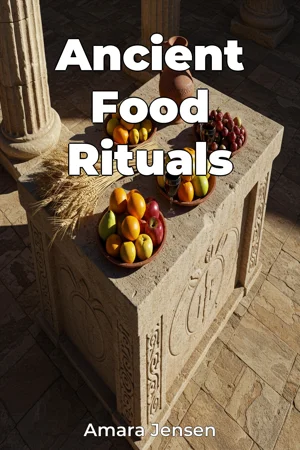
Have you ever considered that the meals we consume are more than just sustenance; that they are, in fact, echoes of ancient spiritual practices? "Ancient Food Rituals" invites you on a journey through time, exploring the profound connections between food, spirituality, and religious ceremonies across diverse cultures. This book delves into the historical and anthropological significance of food rituals, revealing how they have shaped human societies and belief systems. The primary focus will be to explore how food serves as a conduit for spiritual expression. We will examine both the symbolic meanings embedded in specific foods and the ritualistic preparation and consumption practices. A second key area of investigation will involve tracing the evolution of these practices from prehistoric times to the present day, illustrating how they have adapted and transformed over centuries while retaining core spiritual elements. Finally, we will analyze the role of food rituals in fostering social cohesion and reinforcing community identities within diverse religious frameworks. These topics are crucial because they offer insights into the fundamental human need for connection—to the divine, to nature, and to one another—through the seemingly simple act of eating. It will become clear that food rituals are not relics of the past but remain vital expressions of cultural and religious identity. To understand these connections, we must first acknowledge the historical context in which these rituals arise. Early societies were deeply dependent on agriculture and hunting, and their relationship with the natural world was imbued with spiritual significance. The success of a harvest or a hunt was seen as a direct reflection of divine favor. This book doesn't require a background in religious studies and anthropology; it is written to be accessible to any reader with an interest in history, culture, and the intersection of food and spirituality. At its heart, "Ancient Food Rituals" argues that food rituals serve as a tangible link between the earthly and the divine, and that understanding these rituals provides valuable insights into the core beliefs and values of different cultures. This argument is significant because it challenges the modern tendency to view food solely as a commodity, stripping it of its deeper cultural and spiritual meanings. The book will begin by laying the groundwork, introducing fundamental concepts such as the symbolic meanings associated with various foods (e.g., bread as a symbol of life, wine as a symbol of transformation) and the different types of food rituals (e.g., sacrifices, feasts, fasts). The subsequent sections will explore specific examples of food rituals from various cultures, including ancient Egypt, Greece, Rome, Mesoamerica, and early Judaism and Christianity. Each chapter will focus on a particular civilization or religious tradition, examining the foods that were considered sacred, the rituals surrounding their preparation and consumption, and the spiritual beliefs that underpinned these practices. The book will culminate in a discussion of the enduring legacy of ancient food rituals in contemporary society. It will explore how modern dietary practices, religious celebrations, and even culinary trends reflect the echoes of these ancient traditions. The evidence presented will be drawn from a variety of sources, including archaeological records, ancient texts, ethnographic studies, and comparative religious analyses. Particular attention will be paid to identifying patterns and commonalities across different cultures, as well as acknowledging the unique variations and adaptations that have occurred over time. "Ancient Food Rituals" draws connections between history, religion, and anthropology. Understanding the historical context is crucial for interpreting the meanings of food rituals. Religious studies provide the framework for understanding the spiritual beliefs that underpin these practices, while anthropology offers insights into the cultural and social functions of food rituals within different societies. Further relevant cross-disciplinary connections stem from archaeology and nutrition. This book offers a unique perspective by exploring the interconnectedness of food, spirituality, and ritual across multiple cultures and time periods. Rather than focusing on a single tradition or region, it provides a broad comparative analysis that highlights both the common threads and the distinctive features of different food rituals. The tone of "Ancient Food Rituals" will be scholarly yet accessible, aiming to engage a wide audience of readers. The writing style will be clear, concise, and engaging, avoiding jargon and technical terms whenever possible. The target audience includes anyone with an interest in history, religion, anthropology, food studies, or cultural traditions. The book will be of particular value to students, researchers, and anyone seeking a deeper understanding of the role of food in shaping human societies and belief systems. As a work of non-fiction, "Ancient Food Rituals" adheres to the conventions of scholarly writing. It will be thoroughly researched, meticulously documented, and objectively presented, relying on credible sources and sound reasoning to support its claims. While the book aims to provide a comprehensive overview of ancient food rituals, its scope is necessarily limited. It will focus primarily on major civilizations and religious traditions, acknowledging that many smaller or less well-documented cultures may also have rich and complex food rituals. The information presented in "Ancient Food Rituals" has several real-world applications. It can inform our understanding of contemporary food practices, promote cultural sensitivity, and encourage a deeper appreciation for the spiritual dimensions of eating. One area of ongoing debate in the field concerns the extent to which ancient food rituals have been influenced by ecological factors versus cultural beliefs. "Ancient Food Rituals" will address these debates by presenting a balanced and nuanced perspective, considering both the environmental and cultural forces that have shaped food practices throughout history.
Have you ever considered that the meals we consume are more than just sustenance; that they are, in fact, echoes of ancient spiritual practices? "Ancient Food Rituals" invites you on a journey through time, exploring the profound connections between food, spirituality, and religious ceremonies across diverse cultures. This book delves into the historical and anthropological significance of food rituals, revealing how they have shaped human societies and belief systems. The primary focus will be to explore how food serves as a conduit for spiritual expression. We will examine both the symbolic meanings embedded in specific foods and the ritualistic preparation and consumption practices. A second key area of investigation will involve tracing the evolution of these practices from prehistoric times to the present day, illustrating how they have adapted and transformed over centuries while retaining core spiritual elements. Finally, we will analyze the role of food rituals in fostering social cohesion and reinforcing community identities within diverse religious frameworks. These topics are crucial because they offer insights into the fundamental human need for connection—to the divine, to nature, and to one another—through the seemingly simple act of eating. It will become clear that food rituals are not relics of the past but remain vital expressions of cultural and religious identity. To understand these connections, we must first acknowledge the historical context in which these rituals arise. Early societies were deeply dependent on agriculture and hunting, and their relationship with the natural world was imbued with spiritual significance. The success of a harvest or a hunt was seen as a direct reflection of divine favor. This book doesn't require a background in religious studies and anthropology; it is written to be accessible to any reader with an interest in history, culture, and the intersection of food and spirituality. At its heart, "Ancient Food Rituals" argues that food rituals serve as a tangible link between the earthly and the divine, and that understanding these rituals provides valuable insights into the core beliefs and values of different cultures. This argument is significant because it challenges the modern tendency to view food solely as a commodity, stripping it of its deeper cultural and spiritual meanings. The book will begin by laying the groundwork, introducing fundamental concepts such as the symbolic meanings associated with various foods (e.g., bread as a symbol of life, wine as a symbol of transformation) and the different types of food rituals (e.g., sacrifices, feasts, fasts). The subsequent sections will explore specific examples of food rituals from various cultures, including ancient Egypt, Greece, Rome, Mesoamerica, and early Judaism and Christianity. Each chapter will focus on a particular civilization or religious tradition, examining the foods that were considered sacred, the rituals surrounding their preparation and consumption, and the spiritual beliefs that underpinned these practices. The book will culminate in a discussion of the enduring legacy of ancient food rituals in contemporary society. It will explore how modern dietary practices, religious celebrations, and even culinary trends reflect the echoes of these ancient traditions. The evidence presented will be drawn from a variety of sources, including archaeological records, ancient texts, ethnographic studies, and comparative religious analyses. Particular attention will be paid to identifying patterns and commonalities across different cultures, as well as acknowledging the unique variations and adaptations that have occurred over time. "Ancient Food Rituals" draws connections between history, religion, and anthropology. Understanding the historical context is crucial for interpreting the meanings of food rituals. Religious studies provide the framework for understanding the spiritual beliefs that underpin these practices, while anthropology offers insights into the cultural and social functions of food rituals within different societies. Further relevant cross-disciplinary connections stem from archaeology and nutrition. This book offers a unique perspective by exploring the interconnectedness of food, spirituality, and ritual across multiple cultures and time periods. Rather than focusing on a single tradition or region, it provides a broad comparative analysis that highlights both the common threads and the distinctive features of different food rituals. The tone of "Ancient Food Rituals" will be scholarly yet accessible, aiming to engage a wide audience of readers. The writing style will be clear, concise, and engaging, avoiding jargon and technical terms whenever possible. The target audience includes anyone with an interest in history, religion, anthropology, food studies, or cultural traditions. The book will be of particular value to students, researchers, and anyone seeking a deeper understanding of the role of food in shaping human societies and belief systems. As a work of non-fiction, "Ancient Food Rituals" adheres to the conventions of scholarly writing. It will be thoroughly researched, meticulously documented, and objectively presented, relying on credible sources and sound reasoning to support its claims. While the book aims to provide a comprehensive overview of ancient food rituals, its scope is necessarily limited. It will focus primarily on major civilizations and religious traditions, acknowledging that many smaller or less well-documented cultures may also have rich and complex food rituals. The information presented in "Ancient Food Rituals" has several real-world applications. It can inform our understanding of contemporary food practices, promote cultural sensitivity, and encourage a deeper appreciation for the spiritual dimensions of eating. One area of ongoing debate in the field concerns the extent to which ancient food rituals have been influenced by ecological factors versus cultural beliefs. "Ancient Food Rituals" will address these debates by presenting a balanced and nuanced perspective, considering both the environmental and cultural forces that have shaped food practices throughout history.
"Ancient Food Rituals" explores the deep connections between food, spirituality, and religious ceremonies throughout history. It examines how these practices have shaped human societies and belief systems. Early societies saw success in agriculture and hunting as divine favor, imbuing food with spiritual significance. The book argues these rituals provide insights into cultural values, revealing food as more than just sustenance. The book starts with fundamental concepts like the symbolic meanings of foods, such as bread representing life and wine symbolizing transformation. It then delves into specific food rituals from ancient Egypt, Greece, Rome, Mesoamerica, and early Judaism and Christianity. Each chapter focuses on a particular civilization or religious tradition, examining the foods that were considered sacred and the rituals surrounding their preparation and consumption. Drawing from archaeological records, ancient texts, and ethnographic studies, the book highlights common threads and unique adaptations across different cultures. It culminates in a discussion of the enduring legacy of ancient food rituals in contemporary society, showing how modern dietary practices and religious celebrations echo these ancient traditions. This approach offers a broad comparative analysis of food and spirituality.
Book Details
ISBN
9788235254214
Publisher
Publifye AS
Your Licenses
You don't own any licenses for this book
Purchase a license below to unlock this book and download the EPUB.
Purchase License
Select a tier to unlock this book
Need bulk licensing?
Contact us for enterprise agreements.