
About This Book
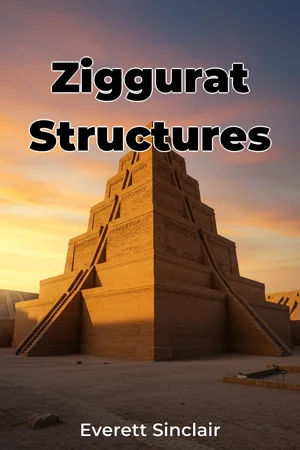
What drove ancient Mesopotamians to construct towering artificial mountains across their relatively flat landscape? "Ziggurat Structures" delves into these imposing monuments, exploring their architectural intricacies, profound religious significance, and crucial role in the development of early urban centers. This book presents an in-depth analysis of ziggurats, examining them not merely as physical structures, but as pivotal elements in the socio-political and religious fabric of Mesopotamian civilization. This book meticulously examines three core aspects of ziggurats. First, it details the architectural evolution of these structures, from their earliest iterations to the more complex and monumental forms seen in cities like Ur and Babylon. Second, it investigates the religious beliefs and rituals associated with ziggurats, exploring their function as sacred spaces connecting the earthly and divine realms. Finally, it analyzes the impact of ziggurats on early urban development, considering their influence on urban planning, resource management, and the consolidation of political power. Understanding the significance of ziggurats requires a grasp of Mesopotamian history, religious practices, and engineering capabilities. The book provides this context, offering a concise overview of the region's major periods, key deities, and technological advancements. Familiarity with basic architectural principles will further enhance the reader's understanding, though all concepts are clearly explained. The central argument of "Ziggurat Structures" is that ziggurats were not simply temples, but multifaceted structures that acted as focal points for religious expression, economic organization, and the legitimization of royal authority. They served as tangible symbols of a city's power and its connection to the gods, playing an indispensable role in shaping the identity and development of Mesopotamian urban centers. This argument challenges simplistic interpretations of ziggurats as mere places of worship, revealing their complex and integrated function within Mesopotamian society. The book begins by introducing the concept of the ziggurat and its historical context, tracing its origins and evolution. Subsequent chapters delve into specific case studies of prominent ziggurats, analyzing their architectural features, inscriptions, and associated artifacts. The book then explores the religious beliefs and rituals associated with these structures, drawing on textual sources and archaeological evidence to reconstruct ancient Mesopotamian religious practices. The final chapters examine the ziggurat's role in urban planning and political power, demonstrating how these monuments influenced the layout of cities and the consolidation of royal authority. The book culminates by examining the lasting legacy of ziggurats, considering their influence on later architectural traditions and their continuing significance as symbols of Mesopotamian civilization. The book relies on a variety of evidence, including archaeological excavations, cuneiform texts, and architectural analyses. It draws on data from sites across Mesopotamia, including Ur, Uruk, and Babylon, integrating textual evidence from royal inscriptions, religious hymns, and administrative documents to provide a comprehensive picture of ziggurat construction and function. Interdisciplinary connections are crucial to understanding ziggurats. The book draws on insights from archaeology, religious studies, and urban planning to offer a holistic perspective. By integrating these diverse fields, the book provides a richer and more nuanced understanding of the ziggurat's significance. "Ziggurat Structures" adopts a balanced and objective tone, presenting evidence and arguments in a clear and accessible manner. While grounded in rigorous scholarship, the book is written to appeal to a broad audience with an interest in history, archaeology, and architecture. The target audience includes students and scholars of ancient history, archaeology, and architecture, as well as general readers with an enthusiasm for ancient civilizations. The book offers valuable insights for anyone seeking a deeper understanding of Mesopotamia. As a work of non-fiction history and architecture, "Ziggurat Structures" emphasizes factual accuracy, clear presentation, and rigorous analysis. It conforms to the conventions of academic writing, providing detailed citations and a comprehensive bibliography. The scope of the book is limited to the ziggurats of Mesopotamia, focusing primarily on the period from the Early Dynastic period to the Neo-Babylonian Empire. While acknowledging the influence of Mesopotamian architecture on other cultures, the book does not delve into the architecture of other regions in detail. While studying ziggurats might seem confined to historical analysis, understanding their role in urban planning and resource management offers insights applicable to contemporary urban design and sustainable development. The centralized organization around these structures provides a historical case study of how monumental architecture can shape social and economic systems, offering valuable lessons for modern planners. The book will also address ongoing debates surrounding the interpretation of ziggurats, such as the precise nature of the rituals performed on their summits and the extent to which they were accessible to the general public. By presenting different perspectives and evaluating the evidence, the book provides a balanced and nuanced account of these controversies.
What drove ancient Mesopotamians to construct towering artificial mountains across their relatively flat landscape? "Ziggurat Structures" delves into these imposing monuments, exploring their architectural intricacies, profound religious significance, and crucial role in the development of early urban centers. This book presents an in-depth analysis of ziggurats, examining them not merely as physical structures, but as pivotal elements in the socio-political and religious fabric of Mesopotamian civilization. This book meticulously examines three core aspects of ziggurats. First, it details the architectural evolution of these structures, from their earliest iterations to the more complex and monumental forms seen in cities like Ur and Babylon. Second, it investigates the religious beliefs and rituals associated with ziggurats, exploring their function as sacred spaces connecting the earthly and divine realms. Finally, it analyzes the impact of ziggurats on early urban development, considering their influence on urban planning, resource management, and the consolidation of political power. Understanding the significance of ziggurats requires a grasp of Mesopotamian history, religious practices, and engineering capabilities. The book provides this context, offering a concise overview of the region's major periods, key deities, and technological advancements. Familiarity with basic architectural principles will further enhance the reader's understanding, though all concepts are clearly explained. The central argument of "Ziggurat Structures" is that ziggurats were not simply temples, but multifaceted structures that acted as focal points for religious expression, economic organization, and the legitimization of royal authority. They served as tangible symbols of a city's power and its connection to the gods, playing an indispensable role in shaping the identity and development of Mesopotamian urban centers. This argument challenges simplistic interpretations of ziggurats as mere places of worship, revealing their complex and integrated function within Mesopotamian society. The book begins by introducing the concept of the ziggurat and its historical context, tracing its origins and evolution. Subsequent chapters delve into specific case studies of prominent ziggurats, analyzing their architectural features, inscriptions, and associated artifacts. The book then explores the religious beliefs and rituals associated with these structures, drawing on textual sources and archaeological evidence to reconstruct ancient Mesopotamian religious practices. The final chapters examine the ziggurat's role in urban planning and political power, demonstrating how these monuments influenced the layout of cities and the consolidation of royal authority. The book culminates by examining the lasting legacy of ziggurats, considering their influence on later architectural traditions and their continuing significance as symbols of Mesopotamian civilization. The book relies on a variety of evidence, including archaeological excavations, cuneiform texts, and architectural analyses. It draws on data from sites across Mesopotamia, including Ur, Uruk, and Babylon, integrating textual evidence from royal inscriptions, religious hymns, and administrative documents to provide a comprehensive picture of ziggurat construction and function. Interdisciplinary connections are crucial to understanding ziggurats. The book draws on insights from archaeology, religious studies, and urban planning to offer a holistic perspective. By integrating these diverse fields, the book provides a richer and more nuanced understanding of the ziggurat's significance. "Ziggurat Structures" adopts a balanced and objective tone, presenting evidence and arguments in a clear and accessible manner. While grounded in rigorous scholarship, the book is written to appeal to a broad audience with an interest in history, archaeology, and architecture. The target audience includes students and scholars of ancient history, archaeology, and architecture, as well as general readers with an enthusiasm for ancient civilizations. The book offers valuable insights for anyone seeking a deeper understanding of Mesopotamia. As a work of non-fiction history and architecture, "Ziggurat Structures" emphasizes factual accuracy, clear presentation, and rigorous analysis. It conforms to the conventions of academic writing, providing detailed citations and a comprehensive bibliography. The scope of the book is limited to the ziggurats of Mesopotamia, focusing primarily on the period from the Early Dynastic period to the Neo-Babylonian Empire. While acknowledging the influence of Mesopotamian architecture on other cultures, the book does not delve into the architecture of other regions in detail. While studying ziggurats might seem confined to historical analysis, understanding their role in urban planning and resource management offers insights applicable to contemporary urban design and sustainable development. The centralized organization around these structures provides a historical case study of how monumental architecture can shape social and economic systems, offering valuable lessons for modern planners. The book will also address ongoing debates surrounding the interpretation of ziggurats, such as the precise nature of the rituals performed on their summits and the extent to which they were accessible to the general public. By presenting different perspectives and evaluating the evidence, the book provides a balanced and nuanced account of these controversies.
"Ziggurat Structures" explores the towering monuments of ancient Mesopotamia, examining their architectural evolution, religious significance, and pivotal role in early urban centers. These structures were not merely temples; they were integral to the socio-political and religious fabric of Mesopotamian civilization. Intriguingly, ziggurats served as tangible symbols of a city's power and connection to the gods, influencing urban planning and legitimizing royal authority. The book meticulously examines the architectural development of ziggurats, tracing their evolution from early iterations to monumental forms in cities like Ur and Babylon. It also delves into the religious beliefs and rituals associated with these sacred spaces, connecting the earthly and divine realms. Drawing on archaeological excavations and cuneiform texts, the book reconstructs ancient Mesopotamian practices and demonstrates how these structures influenced the layout of cities and the consolidation of power. Each chapter builds upon the previous, starting with an introduction to the ziggurat concept and culminating in an examination of their lasting legacy.
Book Details
ISBN
9788235253255
Publisher
Publifye AS
Your Licenses
You don't own any licenses for this book
Purchase a license below to unlock this book and download the EPUB.
Purchase License
Select a tier to unlock this book
Need bulk licensing?
Contact us for enterprise agreements.