
About This Book
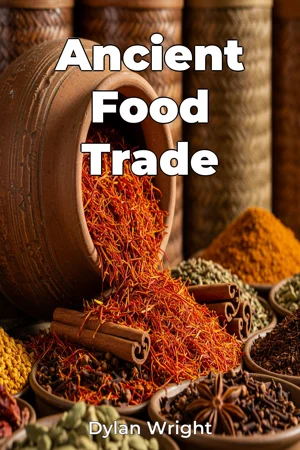
How did the simple act of exchanging food transform the ancient world and lay the foundation for the cuisines we know today? "Ancient Food Trade" delves into the intricate web of commerce that connected early civilizations through the exchange of spices, grains, and ingredients, fundamentally shaping global culinary traditions. This book explores three central, interwoven topics: the origins and routes of ancient food trade, the profound impact of these exchanges on the development of regional cuisines, and the social and economic consequences of controlling vital food resources. Understanding these facets is crucial because they reveal how deeply intertwined food systems are with cultural identity, economic power, and the course of history itself. Set against the backdrop of the Bronze Age through the early medieval period, the book examines the environmental factors, technological innovations, and shifting power dynamics that underpinned the burgeoning food trade. No specialized knowledge beyond a general understanding of ancient history is required, as the book provides context for each civilization and its key contributions. The central argument of "Ancient Food Trade" is that the exchange of foodstuffs was not merely a superficial economic activity, but a catalyst for cultural exchange, social stratification, and the creation of inter-dependent global networks. This argument is vital because it challenges the traditional view of ancient societies as isolated entities and highlights the interconnectedness that shaped their development. The book unfolds in a structured manner. First, it introduces the foundational concepts of ancient trade routes and agricultural practices, providing a baseline understanding of the available resources and technologies. It then examines the development of trade networks in three major regions: Mesopotamia and the Levant, the Mediterranean, and East Asia, detailing the specific goods exchanged and the cultural influences they carried. Finally, the book culminates by analyzing the long-term effects of this trade on culinary diversity, social hierarchies, and the establishment of global trade systems. To support its arguments, "Ancient Food Trade" draws on a wide range of evidence, including archaeological findings, ancient texts, trade records, and archaeobotanical studies. Particular attention is given to analyzing the spread of specific crops and spices, tracing their origins and documenting their adoption in different regions. Interdisciplinary connections are crucial to understanding the breadth of the topic. Firstly, archaeology provides physical evidence of trade through the discovery of foreign goods at excavation sites. Secondly, linguistics reveals the spread of words and concepts related to food and agriculture. Thirdly, genetics helps trace the origins and diversification of crops and livestock. These interdisciplinary approaches enrich the historical narrative and give a more complete picture of food trade's impact. "Ancient Food Trade" distinguishes itself by taking a holistic approach, integrating archaeological, textual, and scientific data to offer a nuanced understanding of ancient food systems. It moves beyond simply listing traded goods to examine the underlying social, economic, and cultural forces driving these exchanges. The book adopts a fact-based and analytical tone, presenting information in a clear and accessible manner. While grounded in academic research, it strives to engage a broad audience with compelling stories and vivid details. The intended audience includes anyone interested in history, food studies, or cultural exchange, from students and academics to foodies and general readers. The book's value lies in its ability to provide a comprehensive overview of a crucial aspect of human history, revealing the deep roots of our interconnected world. As a work of non-fiction, "Ancient Food Trade" adheres to the principles of accuracy, objectivity, and thorough research. It presents multiple perspectives and acknowledges areas of uncertainty or debate. The scope of the book is intentionally broad, covering a wide range of regions and time periods. However, it focuses primarily on long-distance trade and does not delve into the details of local or regional exchange networks. The information presented in "Ancient Food Trade" has practical applications for understanding contemporary food systems and global trade. By examining the historical precedents of food exchange, we can gain insights into the challenges and opportunities facing our modern food networks. While ancient food trade is not typically a field of heated debate, the interpretation of archaeological evidence and the reconstruction of trade routes are subject to ongoing scholarly discussion. "Ancient Food Trade" acknowledges these debates and presents different viewpoints where applicable.
How did the simple act of exchanging food transform the ancient world and lay the foundation for the cuisines we know today? "Ancient Food Trade" delves into the intricate web of commerce that connected early civilizations through the exchange of spices, grains, and ingredients, fundamentally shaping global culinary traditions. This book explores three central, interwoven topics: the origins and routes of ancient food trade, the profound impact of these exchanges on the development of regional cuisines, and the social and economic consequences of controlling vital food resources. Understanding these facets is crucial because they reveal how deeply intertwined food systems are with cultural identity, economic power, and the course of history itself. Set against the backdrop of the Bronze Age through the early medieval period, the book examines the environmental factors, technological innovations, and shifting power dynamics that underpinned the burgeoning food trade. No specialized knowledge beyond a general understanding of ancient history is required, as the book provides context for each civilization and its key contributions. The central argument of "Ancient Food Trade" is that the exchange of foodstuffs was not merely a superficial economic activity, but a catalyst for cultural exchange, social stratification, and the creation of inter-dependent global networks. This argument is vital because it challenges the traditional view of ancient societies as isolated entities and highlights the interconnectedness that shaped their development. The book unfolds in a structured manner. First, it introduces the foundational concepts of ancient trade routes and agricultural practices, providing a baseline understanding of the available resources and technologies. It then examines the development of trade networks in three major regions: Mesopotamia and the Levant, the Mediterranean, and East Asia, detailing the specific goods exchanged and the cultural influences they carried. Finally, the book culminates by analyzing the long-term effects of this trade on culinary diversity, social hierarchies, and the establishment of global trade systems. To support its arguments, "Ancient Food Trade" draws on a wide range of evidence, including archaeological findings, ancient texts, trade records, and archaeobotanical studies. Particular attention is given to analyzing the spread of specific crops and spices, tracing their origins and documenting their adoption in different regions. Interdisciplinary connections are crucial to understanding the breadth of the topic. Firstly, archaeology provides physical evidence of trade through the discovery of foreign goods at excavation sites. Secondly, linguistics reveals the spread of words and concepts related to food and agriculture. Thirdly, genetics helps trace the origins and diversification of crops and livestock. These interdisciplinary approaches enrich the historical narrative and give a more complete picture of food trade's impact. "Ancient Food Trade" distinguishes itself by taking a holistic approach, integrating archaeological, textual, and scientific data to offer a nuanced understanding of ancient food systems. It moves beyond simply listing traded goods to examine the underlying social, economic, and cultural forces driving these exchanges. The book adopts a fact-based and analytical tone, presenting information in a clear and accessible manner. While grounded in academic research, it strives to engage a broad audience with compelling stories and vivid details. The intended audience includes anyone interested in history, food studies, or cultural exchange, from students and academics to foodies and general readers. The book's value lies in its ability to provide a comprehensive overview of a crucial aspect of human history, revealing the deep roots of our interconnected world. As a work of non-fiction, "Ancient Food Trade" adheres to the principles of accuracy, objectivity, and thorough research. It presents multiple perspectives and acknowledges areas of uncertainty or debate. The scope of the book is intentionally broad, covering a wide range of regions and time periods. However, it focuses primarily on long-distance trade and does not delve into the details of local or regional exchange networks. The information presented in "Ancient Food Trade" has practical applications for understanding contemporary food systems and global trade. By examining the historical precedents of food exchange, we can gain insights into the challenges and opportunities facing our modern food networks. While ancient food trade is not typically a field of heated debate, the interpretation of archaeological evidence and the reconstruction of trade routes are subject to ongoing scholarly discussion. "Ancient Food Trade" acknowledges these debates and presents different viewpoints where applicable.
"Ancient Food Trade" explores how the exchange of food transformed ancient civilizations, shaping culinary traditions and laying the groundwork for today's global cuisines. It examines the origins and routes of ancient food trade, the impact on regional cuisines, and the social and economic effects of controlling essential food resources. Intriguingly, the book highlights how food systems are deeply intertwined with cultural identity and economic power. For example, the spice trade wasn't just about flavor; it often dictated political alliances and economic dominance. The book progresses by first establishing the fundamentals of ancient trade routes and agricultural practices. It then investigates the growth of trade networks in Mesopotamia, the Mediterranean, and East Asia, detailing the specific goods traded and their cultural impacts. It draws upon archaeological findings, ancient texts, and archaeobotanical studies to support its arguments. The book differentiates itself by integrating archaeological, textual, and scientific data to provide a comprehensive understanding of ancient food systems, offering a nuanced view beyond a simple list of traded goods.
Book Details
ISBN
9788235252197
Publisher
Publifye AS
Your Licenses
You don't own any licenses for this book
Purchase a license below to unlock this book and download the EPUB.
Purchase License
Select a tier to unlock this book
Need bulk licensing?
Contact us for enterprise agreements.