
About This Book
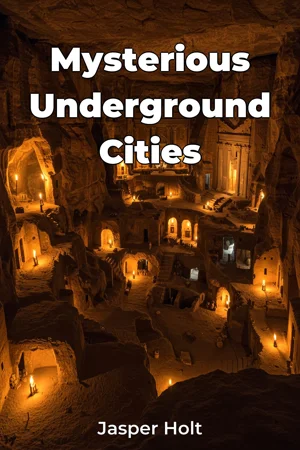
Have you ever wondered what lies beneath our feet, hidden from the sun and the casual observer? *Mysterious Underground Cities* delves into the fascinating world of subterranean metropolises, exploring the historical, architectural, and societal factors that led to their creation and, in many cases, their abandonment. This book will explore the construction, purpose, and enduring mysteries of these subterranean structures. This investigation is crucial because underground cities provide a unique perspective on human ingenuity, resilience, and adaptability. They reveal how societies throughout history have responded to threats, sought refuge, or pursued unique visions of community. Moreover, the largely unexplored nature of some of these sites presents ongoing opportunities for archaeological discovery and historical reinterpretation. Understanding the reasons behind the construction of these cities requires a multidisciplinary approach. We will examine the geological conditions that made their construction possible, the engineering techniques employed, and the social and political climates that necessitated their creation. The book will also address the psychological impact of living in confined, subterranean environments, exploring the potential challenges and adaptations of underground communities. Our central argument is that underground cities are not merely historical anomalies but rather reflections of fundamental human needs and aspirations. They demonstrate our capacity to modify our environment in response to perceived threats and to create unique social structures in unconventional settings. They also suggest a future where subterranean construction may offer solutions to overcrowding, climate change, and other challenges. The book is structured to provide a comprehensive overview of this subject. First, we introduce the concept of underground urbanism, exploring its diverse manifestations across different cultures and time periods. Second, we will delve into specific examples of underground cities, like Derinkuyu and Kaymakli in Turkey, or the tunnels of Moose Jaw, Canada, examining their architecture, history, and cultural significance. Finally, we analyze the common threads that link these disparate sites, identifying recurring themes of survival, secrecy, and social organization. The information presented in this book is based on a wide range of sources, including archaeological reports, historical documents, geological surveys, and architectural analyses. We draw on firsthand accounts from explorers, historians, and residents of these underground cities to provide a multifaceted perspective. We also incorporate data from recent scientific studies that shed light on the construction techniques, environmental conditions, and social dynamics of these subterranean communities. This book connects to several related fields, including archaeology, sociology, and urban planning. By examining the archaeological evidence, we can reconstruct the daily lives of the people who inhabited these cities. By applying sociological theories, we can understand the social structures and power dynamics that shaped their communities. By drawing on urban planning principles, we can evaluate the effectiveness of these subterranean environments as living spaces. A unique aspect of this book is its focus on the psychological impact of living underground. We explore the effects of limited sunlight, confined spaces, and constant proximity to others on the mental and emotional well-being of underground residents. We also consider the ways in which these communities developed unique cultural practices and social norms to adapt to their unusual environment. This book is intended for a broad audience, including history enthusiasts, architecture buffs, and anyone interested in exploring the hidden dimensions of human civilization. It offers a fascinating glimpse into a largely unknown world, revealing the ingenuity, resilience, and adaptability of the human spirit. This book respects the conventions of non-fiction, presenting well-researched information in an accessible and engaging manner. While the book aims to provide a comprehensive overview of underground cities, it is limited by the availability of information. Many of these sites are difficult to access or have not been fully explored. Moreover, some of the historical records are incomplete or unreliable. Therefore, the book focuses on the best-documented examples and acknowledges the limitations of our current knowledge. The information presented in this book has practical applications for contemporary urban planning and architecture. As cities around the world face increasing population density and environmental challenges, the principles of underground construction may offer viable solutions. By studying the successes and failures of past underground cities, we can learn valuable lessons about creating sustainable and livable subterranean environments. The study of underground cities is not without its controversies. There are ongoing debates about the origins, purposes, and dating of some of these sites. This book addresses these controversies head-on, presenting different perspectives and encouraging readers to draw their own conclusions.
Have you ever wondered what lies beneath our feet, hidden from the sun and the casual observer? *Mysterious Underground Cities* delves into the fascinating world of subterranean metropolises, exploring the historical, architectural, and societal factors that led to their creation and, in many cases, their abandonment. This book will explore the construction, purpose, and enduring mysteries of these subterranean structures. This investigation is crucial because underground cities provide a unique perspective on human ingenuity, resilience, and adaptability. They reveal how societies throughout history have responded to threats, sought refuge, or pursued unique visions of community. Moreover, the largely unexplored nature of some of these sites presents ongoing opportunities for archaeological discovery and historical reinterpretation. Understanding the reasons behind the construction of these cities requires a multidisciplinary approach. We will examine the geological conditions that made their construction possible, the engineering techniques employed, and the social and political climates that necessitated their creation. The book will also address the psychological impact of living in confined, subterranean environments, exploring the potential challenges and adaptations of underground communities. Our central argument is that underground cities are not merely historical anomalies but rather reflections of fundamental human needs and aspirations. They demonstrate our capacity to modify our environment in response to perceived threats and to create unique social structures in unconventional settings. They also suggest a future where subterranean construction may offer solutions to overcrowding, climate change, and other challenges. The book is structured to provide a comprehensive overview of this subject. First, we introduce the concept of underground urbanism, exploring its diverse manifestations across different cultures and time periods. Second, we will delve into specific examples of underground cities, like Derinkuyu and Kaymakli in Turkey, or the tunnels of Moose Jaw, Canada, examining their architecture, history, and cultural significance. Finally, we analyze the common threads that link these disparate sites, identifying recurring themes of survival, secrecy, and social organization. The information presented in this book is based on a wide range of sources, including archaeological reports, historical documents, geological surveys, and architectural analyses. We draw on firsthand accounts from explorers, historians, and residents of these underground cities to provide a multifaceted perspective. We also incorporate data from recent scientific studies that shed light on the construction techniques, environmental conditions, and social dynamics of these subterranean communities. This book connects to several related fields, including archaeology, sociology, and urban planning. By examining the archaeological evidence, we can reconstruct the daily lives of the people who inhabited these cities. By applying sociological theories, we can understand the social structures and power dynamics that shaped their communities. By drawing on urban planning principles, we can evaluate the effectiveness of these subterranean environments as living spaces. A unique aspect of this book is its focus on the psychological impact of living underground. We explore the effects of limited sunlight, confined spaces, and constant proximity to others on the mental and emotional well-being of underground residents. We also consider the ways in which these communities developed unique cultural practices and social norms to adapt to their unusual environment. This book is intended for a broad audience, including history enthusiasts, architecture buffs, and anyone interested in exploring the hidden dimensions of human civilization. It offers a fascinating glimpse into a largely unknown world, revealing the ingenuity, resilience, and adaptability of the human spirit. This book respects the conventions of non-fiction, presenting well-researched information in an accessible and engaging manner. While the book aims to provide a comprehensive overview of underground cities, it is limited by the availability of information. Many of these sites are difficult to access or have not been fully explored. Moreover, some of the historical records are incomplete or unreliable. Therefore, the book focuses on the best-documented examples and acknowledges the limitations of our current knowledge. The information presented in this book has practical applications for contemporary urban planning and architecture. As cities around the world face increasing population density and environmental challenges, the principles of underground construction may offer viable solutions. By studying the successes and failures of past underground cities, we can learn valuable lessons about creating sustainable and livable subterranean environments. The study of underground cities is not without its controversies. There are ongoing debates about the origins, purposes, and dating of some of these sites. This book addresses these controversies head-on, presenting different perspectives and encouraging readers to draw their own conclusions.
*Mysterious Underground Cities* explores the captivating world beneath our feet, revealing subterranean metropolises built throughout history. These hidden cities, such as Derinkuyu and Kaymakli in Turkey, demonstrate remarkable human ingenuity and adaptability in response to threats, environmental conditions, or unique social visions. The book examines the architectural designs, historical contexts, and enduring mysteries surrounding these subterranean structures, highlighting how they reflect fundamental human needs and aspirations. The book takes a multidisciplinary approach, delving into geological factors, engineering techniques, and socio-political climates that enabled the creation of these underground havens. It also addresses the psychological impact of subterranean living, exploring the challenges and adaptations of these unique communities. Through archaeological reports, historical documents, and firsthand accounts, the book provides a comprehensive overview of underground urbanism across different cultures and time periods, connecting it to fields like archaeology, sociology, and urban planning. The narrative progresses from introducing the concept of underground urbanism to examining specific examples and analyzing common themes of survival, secrecy, and social organization. By focusing on well-documented sites and acknowledging the limitations of current knowledge, *Mysterious Underground Cities* offers a unique and valuable perspective on the hidden dimensions of human civilization, showcasing the resilience and adaptability of the human spirit.
Book Details
ISBN
9788235252012
Publisher
Publifye AS
Your Licenses
You don't own any licenses for this book
Purchase a license below to unlock this book and download the EPUB.
Purchase License
Select a tier to unlock this book
Need bulk licensing?
Contact us for enterprise agreements.