
About This Book
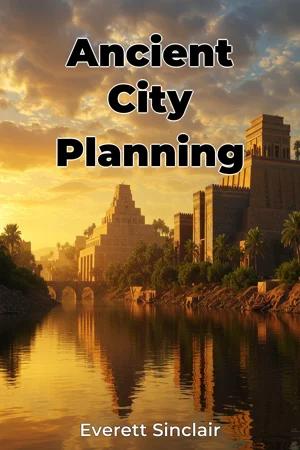
How did the ancients envision and build their cities, and how do those foundational principles continue to shape our urban landscapes today? "Ancient City Planning" delves into the sophisticated urban designs of early civilizations, revealing how their innovations in grid systems, public spaces, and infrastructure laid the cornerstone for modern urban living. This book explores the key elements of ancient city planning, particularly focusing on the Roman Empire and Babylonian societies. The aim is to understand the evolution of urban design and its lasting impact on contemporary urban environments. This book argues that the principles of urban planning established in ancient Rome and Babylon were not merely rudimentary attempts at organization but rather sophisticated systems designed to facilitate social, economic, and political life. By examining the layout, infrastructure, and public spaces of these cities, we can gain insights into the values, priorities, and social structures of these societies. This argument is crucial because it challenges the common perception of ancient urbanism as primitive, highlighting instead the ingenuity and foresight of these early urban planners. "Ancient City Planning" begins by introducing the foundational concepts of urban design, such as spatial organization, infrastructure development, and the creation of public spaces. It then moves to examining the specific examples of Rome and Babylon. The book investigates the Roman grid system, its military origins, and its adaptation for civilian use, demonstrating its effectiveness in organizing space and facilitating movement. Furthermore, the development of Roman infrastructure, including aqueducts, roads, and sewage systems, is discussed in relation to public health and urban growth. The book also explores the significance of public spaces like forums, baths, and amphitheaters in Roman social and political life. The Babylonian section of the book investigates the layout of Babylon, focusing on the role of ziggurats, palaces, and residential districts. The impact of the Euphrates River on city planning and trade will also be addressed. The Code of Hammurabi will be examined in relation to social order and urban regulation. The book concludes by discussing the legacy of these ancient planning principles and their relevance to contemporary urban challenges, such as sustainability, infrastructure development, and social equity. The evidence presented in this book draws from archaeological findings, historical texts, architectural plans, and comparative analyses of different ancient cities. Unique data sources include detailed maps of Roman urban centers, cuneiform tablets describing Babylonian city life, and architectural reconstructions based on archaeological evidence. Methodological approaches such as spatial analysis and comparative urbanism are employed. This book connects to several fields. It links to sociology through exploring how urban design impacts social interactions and community development. Connections to political science occur through analyzing how urban planning reflects and reinforces power structures. The book is also relevant to environmental studies by examining ancient approaches to resource management and sustainability. "Ancient City Planning" stands out by providing a comparative analysis of Roman and Babylonian urban planning, highlighting both the similarities and differences in their approaches. This comparative perspective offers a broader understanding of the diverse strategies employed by ancient civilizations to create livable and functional cities. The book adopts an academic yet accessible writing style, aiming to engage both scholars and general readers interested in urban history and design. The target audience includes students and researchers in architecture, history, and urban planning, as well as anyone interested in the history of cities and the evolution of urban life. This book is expected to offer a thorough examination of the topic, using a factual and direct approach to presenting the ancient city planning methods. The book will explore the breadth of the urban planning process, but will intentionally limit its scope to the two civilizations mentioned to facilitate an in-depth study. The principles discussed can be applied to contemporary urban challenges such as designing sustainable cities, improving infrastructure, and creating more livable public spaces. Some ongoing debates in the field, such as the relative importance of top-down versus bottom-up planning approaches, are addressed by examining how ancient cities balanced centralized control with community needs.
How did the ancients envision and build their cities, and how do those foundational principles continue to shape our urban landscapes today? "Ancient City Planning" delves into the sophisticated urban designs of early civilizations, revealing how their innovations in grid systems, public spaces, and infrastructure laid the cornerstone for modern urban living. This book explores the key elements of ancient city planning, particularly focusing on the Roman Empire and Babylonian societies. The aim is to understand the evolution of urban design and its lasting impact on contemporary urban environments. This book argues that the principles of urban planning established in ancient Rome and Babylon were not merely rudimentary attempts at organization but rather sophisticated systems designed to facilitate social, economic, and political life. By examining the layout, infrastructure, and public spaces of these cities, we can gain insights into the values, priorities, and social structures of these societies. This argument is crucial because it challenges the common perception of ancient urbanism as primitive, highlighting instead the ingenuity and foresight of these early urban planners. "Ancient City Planning" begins by introducing the foundational concepts of urban design, such as spatial organization, infrastructure development, and the creation of public spaces. It then moves to examining the specific examples of Rome and Babylon. The book investigates the Roman grid system, its military origins, and its adaptation for civilian use, demonstrating its effectiveness in organizing space and facilitating movement. Furthermore, the development of Roman infrastructure, including aqueducts, roads, and sewage systems, is discussed in relation to public health and urban growth. The book also explores the significance of public spaces like forums, baths, and amphitheaters in Roman social and political life. The Babylonian section of the book investigates the layout of Babylon, focusing on the role of ziggurats, palaces, and residential districts. The impact of the Euphrates River on city planning and trade will also be addressed. The Code of Hammurabi will be examined in relation to social order and urban regulation. The book concludes by discussing the legacy of these ancient planning principles and their relevance to contemporary urban challenges, such as sustainability, infrastructure development, and social equity. The evidence presented in this book draws from archaeological findings, historical texts, architectural plans, and comparative analyses of different ancient cities. Unique data sources include detailed maps of Roman urban centers, cuneiform tablets describing Babylonian city life, and architectural reconstructions based on archaeological evidence. Methodological approaches such as spatial analysis and comparative urbanism are employed. This book connects to several fields. It links to sociology through exploring how urban design impacts social interactions and community development. Connections to political science occur through analyzing how urban planning reflects and reinforces power structures. The book is also relevant to environmental studies by examining ancient approaches to resource management and sustainability. "Ancient City Planning" stands out by providing a comparative analysis of Roman and Babylonian urban planning, highlighting both the similarities and differences in their approaches. This comparative perspective offers a broader understanding of the diverse strategies employed by ancient civilizations to create livable and functional cities. The book adopts an academic yet accessible writing style, aiming to engage both scholars and general readers interested in urban history and design. The target audience includes students and researchers in architecture, history, and urban planning, as well as anyone interested in the history of cities and the evolution of urban life. This book is expected to offer a thorough examination of the topic, using a factual and direct approach to presenting the ancient city planning methods. The book will explore the breadth of the urban planning process, but will intentionally limit its scope to the two civilizations mentioned to facilitate an in-depth study. The principles discussed can be applied to contemporary urban challenges such as designing sustainable cities, improving infrastructure, and creating more livable public spaces. Some ongoing debates in the field, such as the relative importance of top-down versus bottom-up planning approaches, are addressed by examining how ancient cities balanced centralized control with community needs.
"Ancient City Planning" explores the foundational urban designs of ancient civilizations, particularly focusing on the Roman Empire and Babylonian societies, to uncover how their innovations shaped modern urban landscapes. The book reveals how ancient city planning wasn't rudimentary but a sophisticated system designed to facilitate social, economic, and political life. For example, the Roman grid system, initially developed for military purposes, was ingeniously adapted for civilian use, enhancing spatial organization and movement. Similarly, Babylon's layout, influenced by the Euphrates River, highlights the importance of natural resources in urban development history. The book begins by introducing core urban design concepts like spatial organization and infrastructure development. It then delves into specific examples from Rome and Babylon, examining their unique approaches. By analyzing archaeological findings, historical texts, and architectural plans, "Ancient City Planning" offers a comparative analysis, highlighting both the similarities and differences in urban development history. The book progresses by investigating Roman infrastructure such as aqueducts and public spaces like forums, linking them to public health and social life. It also explores the significance of Babylonian ziggurats, palaces, and the Code of Hammurabi. Ultimately, the book emphasizes the enduring relevance of ancient urbanism to contemporary urban challenges, such as sustainability and social equity.
Book Details
ISBN
9788235251640
Publisher
Publifye AS
Your Licenses
You don't own any licenses for this book
Purchase a license below to unlock this book and download the EPUB.
Purchase License
Select a tier to unlock this book
Need bulk licensing?
Contact us for enterprise agreements.