
About This Book
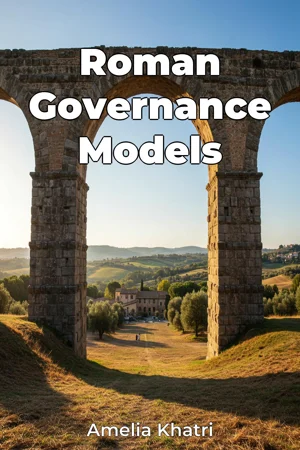
How did a relatively small republic in Italy rise to control a vast and diverse empire stretching across continents? "Roman Governance Models" delves into the intricate systems of law, infrastructure, and leadership that enabled Rome to exert its dominance for centuries, offering insights relevant to understanding power dynamics and governance challenges even today. This book explores three central pillars of Roman imperial administration. First, Roman law, far from being a static code, was a dynamic system which adapted to the needs of a growing empire, incorporating elements of natural law, precedent, and imperial decree to foster stability and manage diverse populations. Second, the book examines Rome's unparalleled engineering and infrastructural achievements, including roads, aqueducts, and public works, that facilitated trade, communication, and military control, binding disparate regions together. Third, this study analyzes the evolution of Roman leadership, from the republican ideals of the Senate to the centralized power of the emperors, investigating the strategies used to maintain authority, manage succession crises, and inspire loyalty in an environment of constant political intrigue and military expansion. Understanding Rome's success necessitates recognizing the specific historical context. From the Punic Wars to the rise of Christianity, Rome faced persistent external threats and internal conflicts that shaped its governance structures. Rather than assuming prior knowledge, the book provides accessible explanations of key historical events and figures, enabling readers of all backgrounds to appreciate the complexities of Roman political institutions. The central argument of "Roman Governance Models" is that Rome's enduring influence stems not from military might alone, but from its ability to develop and adapt sophisticated systems of governance that balanced centralized control with local autonomy, fostered economic integration, and provided a framework for social order. This argument challenges simplistic narratives of Roman conquest and highlights the nuanced strategies that underpinned its long-term stability. The book is structured in three parts. Part I introduces the foundational principles of Roman law, examining its development from the Twelve Tables to Justinian's Code. Part II explores Rome's impressive infrastructure, analyzing its economic and strategic impact on the empire. Part III investigates Roman leadership, tracing the evolution of political institutions from the Republic to the Dominate, and the challenges of imperial succession with famous examples of powerful emperors. The book concludes by examining the legacy of Roman governance, exploring its influence on modern legal systems, political thought, and engineering practices. The analysis draws upon a wide range of primary sources, including legal texts, historical accounts, architectural plans, and archaeological evidence. The book will present case studies of specific projects or actions by a leader that shows how the process worked in the field, comparing those actions to modern day. These sources are supplemented by secondary scholarship from diverse academic disciplines, providing a comprehensive and balanced perspective on Roman governance. "Roman Governance Models" also connects with diverse fields such as political science, economics, and sociology. For example, the book considers the role of economic factors in shaping Roman law and infrastructure, and examines the social consequences of Roman governance policies. Understanding the Roman empire provides a case study for later empires and organizations. This book adopts an interdisciplinary approach, combining historical analysis with insights from political science, economics, and sociology. This holistic perspective offers a new understanding of Roman governance. Written in a clear and accessible style, "Roman Governance Models" is aimed at students, educators, policymakers, and anyone interested in understanding the dynamics of power, governance, and empire. This book will provide value to those looking to understand the history of governance. As a work of history, this book emphasizes factual accuracy, balanced interpretation, and rigorous documentation of sources. While the book provides a broad overview of Roman governance, it does not aim to provide a complete history of the Roman Empire; instead, it focuses specifically on the systems and strategies that underpinned its long-term stability. The lessons from Roman governance can be applied to contemporary challenges in areas such as international relations, urban planning, and organizational management. By understanding the successes and failures of the Roman Empire, readers can gain valuable insights into the enduring challenges of governance in a complex world. The book acknowledges ongoing scholarly debates surrounding Roman governance, such as the extent of imperial control over local affairs and the impact of slavery on Roman society. By engaging with these debates, this book encourages critical thinking and a deeper understanding of the complexities of Roman history.
How did a relatively small republic in Italy rise to control a vast and diverse empire stretching across continents? "Roman Governance Models" delves into the intricate systems of law, infrastructure, and leadership that enabled Rome to exert its dominance for centuries, offering insights relevant to understanding power dynamics and governance challenges even today. This book explores three central pillars of Roman imperial administration. First, Roman law, far from being a static code, was a dynamic system which adapted to the needs of a growing empire, incorporating elements of natural law, precedent, and imperial decree to foster stability and manage diverse populations. Second, the book examines Rome's unparalleled engineering and infrastructural achievements, including roads, aqueducts, and public works, that facilitated trade, communication, and military control, binding disparate regions together. Third, this study analyzes the evolution of Roman leadership, from the republican ideals of the Senate to the centralized power of the emperors, investigating the strategies used to maintain authority, manage succession crises, and inspire loyalty in an environment of constant political intrigue and military expansion. Understanding Rome's success necessitates recognizing the specific historical context. From the Punic Wars to the rise of Christianity, Rome faced persistent external threats and internal conflicts that shaped its governance structures. Rather than assuming prior knowledge, the book provides accessible explanations of key historical events and figures, enabling readers of all backgrounds to appreciate the complexities of Roman political institutions. The central argument of "Roman Governance Models" is that Rome's enduring influence stems not from military might alone, but from its ability to develop and adapt sophisticated systems of governance that balanced centralized control with local autonomy, fostered economic integration, and provided a framework for social order. This argument challenges simplistic narratives of Roman conquest and highlights the nuanced strategies that underpinned its long-term stability. The book is structured in three parts. Part I introduces the foundational principles of Roman law, examining its development from the Twelve Tables to Justinian's Code. Part II explores Rome's impressive infrastructure, analyzing its economic and strategic impact on the empire. Part III investigates Roman leadership, tracing the evolution of political institutions from the Republic to the Dominate, and the challenges of imperial succession with famous examples of powerful emperors. The book concludes by examining the legacy of Roman governance, exploring its influence on modern legal systems, political thought, and engineering practices. The analysis draws upon a wide range of primary sources, including legal texts, historical accounts, architectural plans, and archaeological evidence. The book will present case studies of specific projects or actions by a leader that shows how the process worked in the field, comparing those actions to modern day. These sources are supplemented by secondary scholarship from diverse academic disciplines, providing a comprehensive and balanced perspective on Roman governance. "Roman Governance Models" also connects with diverse fields such as political science, economics, and sociology. For example, the book considers the role of economic factors in shaping Roman law and infrastructure, and examines the social consequences of Roman governance policies. Understanding the Roman empire provides a case study for later empires and organizations. This book adopts an interdisciplinary approach, combining historical analysis with insights from political science, economics, and sociology. This holistic perspective offers a new understanding of Roman governance. Written in a clear and accessible style, "Roman Governance Models" is aimed at students, educators, policymakers, and anyone interested in understanding the dynamics of power, governance, and empire. This book will provide value to those looking to understand the history of governance. As a work of history, this book emphasizes factual accuracy, balanced interpretation, and rigorous documentation of sources. While the book provides a broad overview of Roman governance, it does not aim to provide a complete history of the Roman Empire; instead, it focuses specifically on the systems and strategies that underpinned its long-term stability. The lessons from Roman governance can be applied to contemporary challenges in areas such as international relations, urban planning, and organizational management. By understanding the successes and failures of the Roman Empire, readers can gain valuable insights into the enduring challenges of governance in a complex world. The book acknowledges ongoing scholarly debates surrounding Roman governance, such as the extent of imperial control over local affairs and the impact of slavery on Roman society. By engaging with these debates, this book encourages critical thinking and a deeper understanding of the complexities of Roman history.
"Roman Governance Models" examines how a small republic rose to control a vast empire through sophisticated systems of law, infrastructure, and leadership. The book argues that Rome's lasting influence stemmed from its ability to balance centralized control with local autonomy, fostering economic integration and providing a framework for social order. For instance, Roman law dynamically adapted to manage diverse populations, while infrastructure like roads and aqueducts facilitated trade and military control. The book progresses through three parts, starting with the foundational principles of Roman law and its evolution, then exploring Rome's impressive infrastructure and its strategic impact. Finally, it investigates Roman leadership, tracing the evolution of political institutions from the Republic to the emperors. The narrative emphasizes factual accuracy, balanced interpretation, and rigorous documentation, making it valuable for those interested in history and governance.
Book Details
ISBN
9788235251183
Publisher
Publifye AS
Your Licenses
You don't own any licenses for this book
Purchase a license below to unlock this book and download the EPUB.
Purchase License
Select a tier to unlock this book
Need bulk licensing?
Contact us for enterprise agreements.