
About This Book
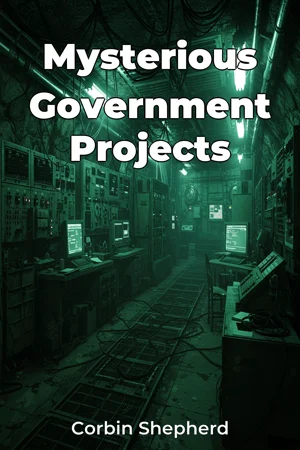
What if everything you thought you knew about government transparency was just the tip of the iceberg? "Mysterious Government Projects" delves into the murky depths of officially declassified programs, revealing a landscape of secretive endeavors that stretch the boundaries of scientific research, political strategy, and ethical considerations. This book is not about conspiracy theories; it is a fact-based exploration of documented projects, gleaned from declassified government documents, historical archives, and investigative research. The core of this work centers on three primary areas: mind control experiments, unconventional scientific research, and covert political operations. Mind control experiments, often conducted under the guise of national security, raise profound questions about individual rights and government overreach. Unconventional scientific research, pushing the limits of known science, blurs the line between innovation and recklessness. Covert political operations reveal the hidden mechanisms of influence and the lengths to which governments will go to achieve their objectives. These topics are significant because they expose the often-unseen levers of power and the ethical dilemmas inherent in their application. Understanding these projects requires a grasp of the historical context in which they emerged. The Cold War, with its climate of fear and intense ideological competition, fueled many of these programs. Scientific advancements in fields like psychology, neuroscience, and physics provided the tools and rationale for their execution. The book will explore this context, providing readers with the necessary background to fully appreciate the scope and implications of these projects. The central argument of "Mysterious Government Projects" is that while governments have a legitimate need for secrecy in certain circumstances, unchecked secrecy can lead to abuses of power and violations of fundamental rights. By examining previously classified projects, the book aims to shed light on the potential dangers of unchecked government authority and the importance of transparency in a democratic society. The book unfolds in three distinct parts. Part one introduces the concept of government secrecy and its justifications. Part two delves into specific case studies, examining the details of several declassified projects, analyzing their objectives, methodologies, and outcomes. Part three analyzes the ethical, legal, and societal implications of these projects. It culminates with a discussion of the lessons learned and recommendations for greater transparency and accountability in government research and operations. The evidence presented in this book is drawn from a variety of sources including declassified government documents obtained through Freedom of Information Act requests, archival research at presidential libraries and national archives, and investigative reports from reputable journalists and researchers. The methodology involves careful analysis of primary source materials, cross-referencing information from multiple sources, and presenting the findings in a clear and objective manner. This book connects to several other fields of study, including political science (exploring the dynamics of power and governance), ethics (examining the moral implications of government actions), and history (understanding the context in which these projects unfolded). These connections enhance the book's argument by providing a broader perspective on the issues at hand. “Mysterious Government Projects” adopts a fact-based approach, prioritizing accuracy and objectivity over sensationalism. The writing style is clear, accessible, and engaging, designed to appeal to a broad audience. The target audience includes anyone interested in history, politics, science, and government transparency, specifically readers who enjoy informed, unbiased analysis. The book is valuable to them because it provides a unique and insightful look into the hidden world of government projects. As a work of non-fiction, this book adheres to the conventions of historical accuracy, verifiable evidence, and balanced presentation. The scope of the book is limited to officially declassified projects, focusing on those for which substantial documentation is available. This ensures that the analysis is grounded in fact and avoids speculation or conjecture. The information in this book can be applied practically by readers in several ways. It can inform their understanding of current political issues, enhance their ability to critically evaluate government policies, and empower them to advocate for greater transparency and accountability. Some of the projects examined in this book are the subject of ongoing debate and controversy. For example, the legacy of certain mind control experiments continues to be disputed, with questions raised about the long-term effects on participants and the ethical responsibilities of the researchers involved. The book addresses these controversies by presenting different perspectives and allowing readers to draw their own conclusions.
What if everything you thought you knew about government transparency was just the tip of the iceberg? "Mysterious Government Projects" delves into the murky depths of officially declassified programs, revealing a landscape of secretive endeavors that stretch the boundaries of scientific research, political strategy, and ethical considerations. This book is not about conspiracy theories; it is a fact-based exploration of documented projects, gleaned from declassified government documents, historical archives, and investigative research. The core of this work centers on three primary areas: mind control experiments, unconventional scientific research, and covert political operations. Mind control experiments, often conducted under the guise of national security, raise profound questions about individual rights and government overreach. Unconventional scientific research, pushing the limits of known science, blurs the line between innovation and recklessness. Covert political operations reveal the hidden mechanisms of influence and the lengths to which governments will go to achieve their objectives. These topics are significant because they expose the often-unseen levers of power and the ethical dilemmas inherent in their application. Understanding these projects requires a grasp of the historical context in which they emerged. The Cold War, with its climate of fear and intense ideological competition, fueled many of these programs. Scientific advancements in fields like psychology, neuroscience, and physics provided the tools and rationale for their execution. The book will explore this context, providing readers with the necessary background to fully appreciate the scope and implications of these projects. The central argument of "Mysterious Government Projects" is that while governments have a legitimate need for secrecy in certain circumstances, unchecked secrecy can lead to abuses of power and violations of fundamental rights. By examining previously classified projects, the book aims to shed light on the potential dangers of unchecked government authority and the importance of transparency in a democratic society. The book unfolds in three distinct parts. Part one introduces the concept of government secrecy and its justifications. Part two delves into specific case studies, examining the details of several declassified projects, analyzing their objectives, methodologies, and outcomes. Part three analyzes the ethical, legal, and societal implications of these projects. It culminates with a discussion of the lessons learned and recommendations for greater transparency and accountability in government research and operations. The evidence presented in this book is drawn from a variety of sources including declassified government documents obtained through Freedom of Information Act requests, archival research at presidential libraries and national archives, and investigative reports from reputable journalists and researchers. The methodology involves careful analysis of primary source materials, cross-referencing information from multiple sources, and presenting the findings in a clear and objective manner. This book connects to several other fields of study, including political science (exploring the dynamics of power and governance), ethics (examining the moral implications of government actions), and history (understanding the context in which these projects unfolded). These connections enhance the book's argument by providing a broader perspective on the issues at hand. “Mysterious Government Projects” adopts a fact-based approach, prioritizing accuracy and objectivity over sensationalism. The writing style is clear, accessible, and engaging, designed to appeal to a broad audience. The target audience includes anyone interested in history, politics, science, and government transparency, specifically readers who enjoy informed, unbiased analysis. The book is valuable to them because it provides a unique and insightful look into the hidden world of government projects. As a work of non-fiction, this book adheres to the conventions of historical accuracy, verifiable evidence, and balanced presentation. The scope of the book is limited to officially declassified projects, focusing on those for which substantial documentation is available. This ensures that the analysis is grounded in fact and avoids speculation or conjecture. The information in this book can be applied practically by readers in several ways. It can inform their understanding of current political issues, enhance their ability to critically evaluate government policies, and empower them to advocate for greater transparency and accountability. Some of the projects examined in this book are the subject of ongoing debate and controversy. For example, the legacy of certain mind control experiments continues to be disputed, with questions raised about the long-term effects on participants and the ethical responsibilities of the researchers involved. The book addresses these controversies by presenting different perspectives and allowing readers to draw their own conclusions.
"Mysterious Government Projects" explores the world of declassified government programs, focusing on mind control experiments, unconventional scientific research, and covert political operations. It examines the ethical and political implications of these projects, revealing instances where government secrecy pushed the boundaries of accepted norms. Readers will gain insight into how the Cold War fueled unconventional government research and the lengths to which political operations went. The book uses declassified documents and historical archives to present a fact-based account of these secretive endeavors. It is structured in three parts, first introducing the concept of government secrecy, then presenting case studies of declassified projects, and finally analyzing the ethical and societal implications. The evidence is drawn from primary source materials, and the findings are presented clearly and objectively. This exploration of government accountability and transparency is designed for those interested in history and political science. It offers valuable insights into the potential dangers of unchecked authority. By examining these projects, the book encourages readers to critically evaluate government policies and advocate for greater openness.
Book Details
ISBN
9788235250407
Publisher
Publifye AS
Your Licenses
You don't own any licenses for this book
Purchase a license below to unlock this book and download the EPUB.
Purchase License
Select a tier to unlock this book
Need bulk licensing?
Contact us for enterprise agreements.