
About This Book
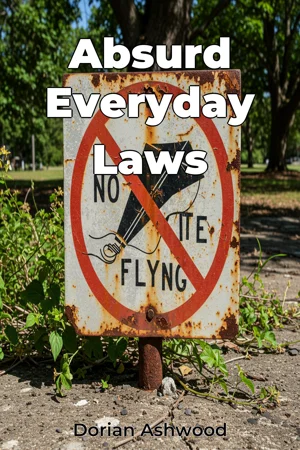
Did you know it’s technically illegal to enter Canada with more than one pocketful of coins? Or that in some locales, it’s against the law to sing off-key? Welcome to *Absurd Everyday Laws*, a fascinating exploration into the bizarre, antiquated, and often hilarious regulations that still exist on the books today. This book is not just a catalogue of oddities; it's a journey into the history, politics, and social context that birthed these strange rules, and a contemplation on why they persist. We delve into laws governing food and drink, personal conduct, and even animal ownership, revealing the surprising origins of regulations that seem utterly out of place in our modern world. From prohibitions on selling alcohol on Sundays to restrictions on kite flying within city limits, each law offers a glimpse into the past and raises questions about the present. Why do these seemingly nonsensical laws continue to exist? Do they serve any purpose, or are they merely relics of a bygone era? The central argument of *Absurd Everyday Laws* is that these laws, while often humorous on the surface, reveal deeper truths about power, social control, and the evolution of legal systems. They offer a unique lens through which to examine the values and anxieties of past societies and how those values continue to influence our lives today. We also argue that their continued existence underscores the inertia of legal systems and the challenges of adapting laws to changing social norms. The book unfolds in three major sections. First, we introduce the concept of "absurd laws" and explore the various reasons why such laws come into being, including historical context, special interest lobbying, and unintended consequences of legislation. The second section comprises themed chapters, each focusing on a specific category of laws – for example, laws related to food, transportation, or public behavior. Within each chapter, we present several examples of absurd laws, providing the historical background and social context for each. The final section analyzes the implications of these laws, examining the roles they play in society, the legal challenges they present, and the arguments for and against their repeal. We conclude by considering the broader impact of antiquated laws and offering a framework for evaluating the necessity and relevance of laws in a rapidly changing world. The evidence presented in *Absurd Everyday Laws* is drawn from primary legal texts, historical documents, news archives, and academic research. We utilize legal databases, historical societies, and government records to trace the origins and evolution of each law. Furthermore, we supplement our research with interviews from legal scholars, historians, and policy experts to provide a comprehensive and nuanced understanding of the issues. This book draws connections to several disciplines, including legal history, sociology, and political science. By examining the historical context of these laws, we shed light on the social and cultural forces that shaped them. Additionally, the book explores the political ramifications of these laws, considering how they are enforced, challenged, and sometimes exploited. *Absurd Everyday Laws* offers a unique perspective by examining the mundane and often overlooked aspects of legal systems. It invites readers to question the assumptions that underpin laws and to consider how laws can both reflect and shape society. Written in a conversational tone, the book is accessible to general readers while maintaining scholarly rigor. It avoids legal jargon and presents complex ideas in a clear and engaging manner. The target audience includes anyone with an interest in history, law, politics, or social oddities. It appeals to those curious about the quirks of everyday life and the stories behind the rules that govern us. As a non-fiction work in the realm of social science and politics, *Absurd Everyday Laws* adheres to the genre's conventions of accuracy, objectivity, and evidence-based analysis. However, it also embraces a more accessible and engaging style commonly found in narrative non-fiction. While the book aims to provide a broad overview of absurd laws across different jurisdictions, it does not attempt to be exhaustive or to offer legal advice. Instead, it focuses on providing a representative selection of laws that illustrate the key themes and arguments. The information in *Absurd Everyday Laws* can be practically applied by readers to better understand the legal systems in their own communities and to engage in informed discussions about law reform. It also encourages critical thinking about the role of law in shaping everyday life. Some of the laws discussed in the book raise debates about individual liberty, government overreach, and the appropriate role of law in regulating personal behavior. *Absurd Everyday Laws* explores these controversies and presents different perspectives on the issues. We will examine legal challenges made against them and the rationale behind any enforcement.
Did you know it’s technically illegal to enter Canada with more than one pocketful of coins? Or that in some locales, it’s against the law to sing off-key? Welcome to *Absurd Everyday Laws*, a fascinating exploration into the bizarre, antiquated, and often hilarious regulations that still exist on the books today. This book is not just a catalogue of oddities; it's a journey into the history, politics, and social context that birthed these strange rules, and a contemplation on why they persist. We delve into laws governing food and drink, personal conduct, and even animal ownership, revealing the surprising origins of regulations that seem utterly out of place in our modern world. From prohibitions on selling alcohol on Sundays to restrictions on kite flying within city limits, each law offers a glimpse into the past and raises questions about the present. Why do these seemingly nonsensical laws continue to exist? Do they serve any purpose, or are they merely relics of a bygone era? The central argument of *Absurd Everyday Laws* is that these laws, while often humorous on the surface, reveal deeper truths about power, social control, and the evolution of legal systems. They offer a unique lens through which to examine the values and anxieties of past societies and how those values continue to influence our lives today. We also argue that their continued existence underscores the inertia of legal systems and the challenges of adapting laws to changing social norms. The book unfolds in three major sections. First, we introduce the concept of "absurd laws" and explore the various reasons why such laws come into being, including historical context, special interest lobbying, and unintended consequences of legislation. The second section comprises themed chapters, each focusing on a specific category of laws – for example, laws related to food, transportation, or public behavior. Within each chapter, we present several examples of absurd laws, providing the historical background and social context for each. The final section analyzes the implications of these laws, examining the roles they play in society, the legal challenges they present, and the arguments for and against their repeal. We conclude by considering the broader impact of antiquated laws and offering a framework for evaluating the necessity and relevance of laws in a rapidly changing world. The evidence presented in *Absurd Everyday Laws* is drawn from primary legal texts, historical documents, news archives, and academic research. We utilize legal databases, historical societies, and government records to trace the origins and evolution of each law. Furthermore, we supplement our research with interviews from legal scholars, historians, and policy experts to provide a comprehensive and nuanced understanding of the issues. This book draws connections to several disciplines, including legal history, sociology, and political science. By examining the historical context of these laws, we shed light on the social and cultural forces that shaped them. Additionally, the book explores the political ramifications of these laws, considering how they are enforced, challenged, and sometimes exploited. *Absurd Everyday Laws* offers a unique perspective by examining the mundane and often overlooked aspects of legal systems. It invites readers to question the assumptions that underpin laws and to consider how laws can both reflect and shape society. Written in a conversational tone, the book is accessible to general readers while maintaining scholarly rigor. It avoids legal jargon and presents complex ideas in a clear and engaging manner. The target audience includes anyone with an interest in history, law, politics, or social oddities. It appeals to those curious about the quirks of everyday life and the stories behind the rules that govern us. As a non-fiction work in the realm of social science and politics, *Absurd Everyday Laws* adheres to the genre's conventions of accuracy, objectivity, and evidence-based analysis. However, it also embraces a more accessible and engaging style commonly found in narrative non-fiction. While the book aims to provide a broad overview of absurd laws across different jurisdictions, it does not attempt to be exhaustive or to offer legal advice. Instead, it focuses on providing a representative selection of laws that illustrate the key themes and arguments. The information in *Absurd Everyday Laws* can be practically applied by readers to better understand the legal systems in their own communities and to engage in informed discussions about law reform. It also encourages critical thinking about the role of law in shaping everyday life. Some of the laws discussed in the book raise debates about individual liberty, government overreach, and the appropriate role of law in regulating personal behavior. *Absurd Everyday Laws* explores these controversies and presents different perspectives on the issues. We will examine legal challenges made against them and the rationale behind any enforcement.
"Absurd Everyday Laws" explores the strange and often humorous regulations still in existence today, offering insights into legal history, social control, and the evolution of social norms. It's more than just a list of oddities; it reveals how seemingly nonsensical laws reflect the values and anxieties of past societies, influencing our lives even now. For instance, the book examines how laws governing everything from food and drink to personal conduct originated, and why some, like prohibitions on Sunday alcohol sales, persist. The book approaches its subject by first introducing the concept of absurd laws and their origins, from historical context to unintended legislative consequences. It then delves into themed chapters focusing on laws related to areas such as food, transportation, and public behavior, providing historical context for each. Finally, "Absurd Everyday Laws" analyzes the implications of these laws, examining their roles in society, the legal challenges they present, and arguments for and against their repeal, ultimately offering a framework for evaluating laws in a changing world, making it valuable for those interested in social science or politics.
Book Details
ISBN
9788235249968
Publisher
Publifye AS
Your Licenses
You don't own any licenses for this book
Purchase a license below to unlock this book and download the EPUB.
Purchase License
Select a tier to unlock this book
Need bulk licensing?
Contact us for enterprise agreements.