
About This Book
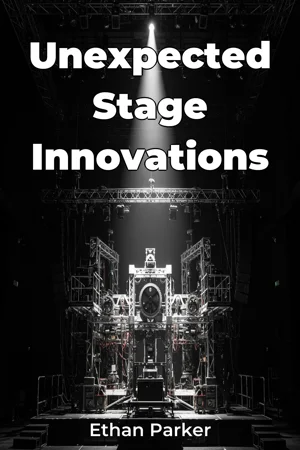
Ever wondered how stagecraft evolved from painted backdrops and gas lighting to the immersive, technologically advanced spectacles we witness today? "Unexpected Stage Innovations" explores the dramatic evolution of live performances, focusing on the pivotal technological advancements that have reshaped the performing arts. This book delves into the crucial intersections of technology and artistic expression, demonstrating how these innovations have not only enhanced productions but also redefined the very nature of storytelling on stage. The core of this exploration centers on stage technologies, special effects, and lighting advancements. Understanding these elements is vital because they represent a continuous quest for greater audience engagement, richer artistic vocabularies, and more compelling narrative possibilities. Examining their history reveals how creative visions, once limited by technical constraints, have been progressively liberated by inventive engineering and scientific breakthroughs. This book provides historical context through an examination of key periods that have fostered significant stage innovations, from the introduction of electricity in theaters to the digital revolutions of the late 20th and early 21st centuries. It builds on fundamental knowledge of theater history and basic physics principles related to light and sound. The central argument posited is that technological advancements are not merely tools but active agents shaping the artistic landscape of live performance. Their impact extends beyond aesthetics, influencing narrative structures, audience experiences, and the collaborative dynamics between artists and technicians. The book unfolds in three main sections. First, it introduces the foundational technologies, such as gas lighting and early sound systems, tracing their origins and initial impact on stagecraft. Second, it develops these ideas by examining specific case studies of groundbreaking innovations, including the integration of projection mapping, kinetic architecture, and advanced robotics. This will involve detailed analyses of well-known productions, highlighting the challenges faced and the creative solutions devised. Third, it culminates in an analysis of current trends and future possibilities, exploring emerging technologies like virtual reality and augmented reality and their potential to further revolutionize live performances. It concludes by discussing the ethical and creative implications of these advancements, considering their accessibility and impact on traditional performance practices. The arguments presented are supported by a mix of primary sources, including technical manuals, theatrical scripts, design sketches, and interviews with leading stage designers and technicians. Secondary scholarly research from theater studies, engineering, and media studies provides additional context and analysis. "Unexpected Stage Innovations" also draws connections between performing arts and fields like engineering (in the design and implementation of stage technologies), computer science (in the development of digital effects and interactive systems), and architecture (in the design of innovative performance spaces). By examining these interdisciplinary links, the book offers a more complete understanding of the complex interplay between creativity and technology. A unique aspect of this book lies in its focus on the collaborative process behind stage innovations, highlighting the often-unsung contributions of technicians and engineers. The writing style is accessible and engaging, seeking to bridge the gap between technical jargon and artistic interpretation. The intended audience includes theater students, stage designers, theatrical technicians, media artists, and anyone interested in the intersection of technology and the arts. The book provides valuable insights into the past, present, and future of stagecraft, appealing to those seeking to understand the transformative power of technology in shaping live performances. As a work of non-fiction, this book strives to provide a balanced and objective account of technological developments, acknowledging both their benefits and potential drawbacks. The scope is intentionally broad, covering a range of technologies and historical periods, but it focuses primarily on Western theatrical traditions. The information presented can be applied practically by stage designers and technicians seeking inspiration and new ideas for their work. It also offers valuable context for educators teaching courses in theater technology, design, or the history of performing arts. Finally, it addresses ongoing discussions concerning the role of technology in diluting the authenticity of live performance and the challenges of ensuring equitable access to advanced technologies in the theater world.
Ever wondered how stagecraft evolved from painted backdrops and gas lighting to the immersive, technologically advanced spectacles we witness today? "Unexpected Stage Innovations" explores the dramatic evolution of live performances, focusing on the pivotal technological advancements that have reshaped the performing arts. This book delves into the crucial intersections of technology and artistic expression, demonstrating how these innovations have not only enhanced productions but also redefined the very nature of storytelling on stage. The core of this exploration centers on stage technologies, special effects, and lighting advancements. Understanding these elements is vital because they represent a continuous quest for greater audience engagement, richer artistic vocabularies, and more compelling narrative possibilities. Examining their history reveals how creative visions, once limited by technical constraints, have been progressively liberated by inventive engineering and scientific breakthroughs. This book provides historical context through an examination of key periods that have fostered significant stage innovations, from the introduction of electricity in theaters to the digital revolutions of the late 20th and early 21st centuries. It builds on fundamental knowledge of theater history and basic physics principles related to light and sound. The central argument posited is that technological advancements are not merely tools but active agents shaping the artistic landscape of live performance. Their impact extends beyond aesthetics, influencing narrative structures, audience experiences, and the collaborative dynamics between artists and technicians. The book unfolds in three main sections. First, it introduces the foundational technologies, such as gas lighting and early sound systems, tracing their origins and initial impact on stagecraft. Second, it develops these ideas by examining specific case studies of groundbreaking innovations, including the integration of projection mapping, kinetic architecture, and advanced robotics. This will involve detailed analyses of well-known productions, highlighting the challenges faced and the creative solutions devised. Third, it culminates in an analysis of current trends and future possibilities, exploring emerging technologies like virtual reality and augmented reality and their potential to further revolutionize live performances. It concludes by discussing the ethical and creative implications of these advancements, considering their accessibility and impact on traditional performance practices. The arguments presented are supported by a mix of primary sources, including technical manuals, theatrical scripts, design sketches, and interviews with leading stage designers and technicians. Secondary scholarly research from theater studies, engineering, and media studies provides additional context and analysis. "Unexpected Stage Innovations" also draws connections between performing arts and fields like engineering (in the design and implementation of stage technologies), computer science (in the development of digital effects and interactive systems), and architecture (in the design of innovative performance spaces). By examining these interdisciplinary links, the book offers a more complete understanding of the complex interplay between creativity and technology. A unique aspect of this book lies in its focus on the collaborative process behind stage innovations, highlighting the often-unsung contributions of technicians and engineers. The writing style is accessible and engaging, seeking to bridge the gap between technical jargon and artistic interpretation. The intended audience includes theater students, stage designers, theatrical technicians, media artists, and anyone interested in the intersection of technology and the arts. The book provides valuable insights into the past, present, and future of stagecraft, appealing to those seeking to understand the transformative power of technology in shaping live performances. As a work of non-fiction, this book strives to provide a balanced and objective account of technological developments, acknowledging both their benefits and potential drawbacks. The scope is intentionally broad, covering a range of technologies and historical periods, but it focuses primarily on Western theatrical traditions. The information presented can be applied practically by stage designers and technicians seeking inspiration and new ideas for their work. It also offers valuable context for educators teaching courses in theater technology, design, or the history of performing arts. Finally, it addresses ongoing discussions concerning the role of technology in diluting the authenticity of live performance and the challenges of ensuring equitable access to advanced technologies in the theater world.
"Unexpected Stage Innovations" explores the fascinating evolution of theater, spotlighting the pivotal role of technology in transforming live performances. From rudimentary gas lighting to immersive projection mapping and robotics, the book examines how stage innovations have continually redefined storytelling. It highlights that these advancements aren't mere tools, but active agents that shape the artistic landscape, influencing everything from narrative structures to audience experiences. The book traces this evolution across three sections, beginning with foundational technologies and their initial impact. It then delves into specific innovations through case studies of groundbreaking productions. Did you know that the introduction of electricity in theaters marked a paradigm shift, enabling unprecedented control over lighting and atmosphere? Or that kinetic architecture is now being used to create stages that dynamically transform during a performance? Finally, the book analyzes current trends like virtual and augmented reality, pondering their potential to further revolutionize live performance. Ultimately, "Unexpected Stage Innovations" provides a unique perspective by focusing on the collaborative dynamics between artists and technicians, and underscoring the often-unsung contributions of those behind the scenes. By bridging technical jargon with artistic interpretation, the book offers valuable insights into the past, present, and future of stagecraft.
Book Details
ISBN
9788235249791
Publisher
Publifye AS
Your Licenses
You don't own any licenses for this book
Purchase a license below to unlock this book and download the EPUB.
Purchase License
Select a tier to unlock this book
Need bulk licensing?
Contact us for enterprise agreements.