
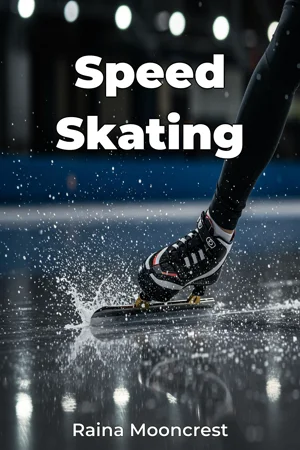
About This Book
Have you ever wondered how speed skaters achieve such incredible velocities on ice? This book, *Speed Skating*, delves into the science and technique behind this captivating sport, exploring the intricate interplay of physics, physiology, and skill that allows athletes to glide across the ice at breathtaking speeds. We will examine how skaters expertly manipulate their bodies to minimize friction, maximize power output, and ultimately achieve peak performance. This book focuses on three key areas: the physics of ice and friction, the biomechanics of skating movement, and the strategies for optimizing speed and efficiency. Understanding these elements is crucial not only for aspiring skaters and coaches but also for anyone interested in the scientific principles that underpin athletic performance. The history of speed skating, from its origins as a practical means of transportation to its evolution into an Olympic sport, provides valuable context. No prior knowledge of physics or sports science is required; we will build foundational concepts from the ground up. Our central argument is that success in speed skating relies on a deep understanding and application of physical principles to human movement. This understanding allows skaters to adapt to varying ice conditions, refine their technique, and push the boundaries of human speed. The book is structured to guide the reader through a comprehensive exploration of speed skating. First, we introduce the fundamental concepts of friction, ice properties, and aerodynamics, providing the necessary scientific foundation. Next, we analyze the biomechanics of the skating stride, focusing on muscle activation, force production, and energy transfer. This section includes detailed analyses of different skating techniques and their impact on performance. Then, we delve into advanced training methodologies, including strategies for improving power, endurance, and technique. We culminate with real-world applications of these principles, examining how coaches and athletes can use this knowledge to optimize training programs and enhance performance. To support our arguments, we draw upon a wide range of evidence, including scientific literature, biomechanical analyses, and performance data from elite skaters. We also incorporate case studies of successful skaters and training programs. Our analysis will include data derived from motion capture technology and force plate analysis. This book connects to several other fields, most notably physics, biomechanics, and sports science. The principles of physics govern the interaction between the skate blade and the ice, while biomechanics explains how the body generates and transmits force. Sports science provides a framework for understanding training methodologies and optimizing athletic performance. Our approach is unique in its integration of scientific principles with practical training applications. We bridge the gap between theory and practice, providing readers with actionable insights that can be used to improve skating performance. The tone is informative and accessible, balancing scientific rigor with clear and concise explanations. We aim to make complex concepts understandable to a broad audience, from students and coaches to skating enthusiasts. This book is intended for speed skaters of all levels, coaches, sports scientists, and anyone with an interest in the science of sports performance. Whether you are an aspiring Olympian or simply curious about the physics of speed skating, this book will provide you with a deeper understanding of this fascinating sport. As a non-fiction sports science book, it adheres to the genre conventions of providing evidence-based explanations, citing relevant research, and presenting information in a clear and organized manner. The scope of the book is limited to the science and technique of speed skating, with a focus on individual performance. We do not delve into the social or economic aspects of the sport. The information presented in this book has numerous real-world applications. Skaters and coaches can use this knowledge to refine their technique, design more effective training programs, and optimize equipment selection. The principles discussed can also be applied to other sports that involve gliding or sliding, such as ice hockey and skiing. While speed skating is generally considered a relatively straightforward sport, ongoing debates exist regarding the optimal skating technique and training methodologies. We address these debates by presenting different perspectives and analyzing the empirical evidence supporting each viewpoint.
Have you ever wondered how speed skaters achieve such incredible velocities on ice? This book, *Speed Skating*, delves into the science and technique behind this captivating sport, exploring the intricate interplay of physics, physiology, and skill that allows athletes to glide across the ice at breathtaking speeds. We will examine how skaters expertly manipulate their bodies to minimize friction, maximize power output, and ultimately achieve peak performance. This book focuses on three key areas: the physics of ice and friction, the biomechanics of skating movement, and the strategies for optimizing speed and efficiency. Understanding these elements is crucial not only for aspiring skaters and coaches but also for anyone interested in the scientific principles that underpin athletic performance. The history of speed skating, from its origins as a practical means of transportation to its evolution into an Olympic sport, provides valuable context. No prior knowledge of physics or sports science is required; we will build foundational concepts from the ground up. Our central argument is that success in speed skating relies on a deep understanding and application of physical principles to human movement. This understanding allows skaters to adapt to varying ice conditions, refine their technique, and push the boundaries of human speed. The book is structured to guide the reader through a comprehensive exploration of speed skating. First, we introduce the fundamental concepts of friction, ice properties, and aerodynamics, providing the necessary scientific foundation. Next, we analyze the biomechanics of the skating stride, focusing on muscle activation, force production, and energy transfer. This section includes detailed analyses of different skating techniques and their impact on performance. Then, we delve into advanced training methodologies, including strategies for improving power, endurance, and technique. We culminate with real-world applications of these principles, examining how coaches and athletes can use this knowledge to optimize training programs and enhance performance. To support our arguments, we draw upon a wide range of evidence, including scientific literature, biomechanical analyses, and performance data from elite skaters. We also incorporate case studies of successful skaters and training programs. Our analysis will include data derived from motion capture technology and force plate analysis. This book connects to several other fields, most notably physics, biomechanics, and sports science. The principles of physics govern the interaction between the skate blade and the ice, while biomechanics explains how the body generates and transmits force. Sports science provides a framework for understanding training methodologies and optimizing athletic performance. Our approach is unique in its integration of scientific principles with practical training applications. We bridge the gap between theory and practice, providing readers with actionable insights that can be used to improve skating performance. The tone is informative and accessible, balancing scientific rigor with clear and concise explanations. We aim to make complex concepts understandable to a broad audience, from students and coaches to skating enthusiasts. This book is intended for speed skaters of all levels, coaches, sports scientists, and anyone with an interest in the science of sports performance. Whether you are an aspiring Olympian or simply curious about the physics of speed skating, this book will provide you with a deeper understanding of this fascinating sport. As a non-fiction sports science book, it adheres to the genre conventions of providing evidence-based explanations, citing relevant research, and presenting information in a clear and organized manner. The scope of the book is limited to the science and technique of speed skating, with a focus on individual performance. We do not delve into the social or economic aspects of the sport. The information presented in this book has numerous real-world applications. Skaters and coaches can use this knowledge to refine their technique, design more effective training programs, and optimize equipment selection. The principles discussed can also be applied to other sports that involve gliding or sliding, such as ice hockey and skiing. While speed skating is generally considered a relatively straightforward sport, ongoing debates exist regarding the optimal skating technique and training methodologies. We address these debates by presenting different perspectives and analyzing the empirical evidence supporting each viewpoint.
"Speed Skating" explores the captivating blend of physics and technique that allows athletes to achieve incredible speeds on ice. By delving into friction, biomechanics, and training methodologies, the book reveals how skaters manipulate their bodies to minimize resistance and maximize power. A key insight is understanding how ice properties affect skating, as even slight changes in temperature can impact an athlete's performance. The book progresses logically, first laying a foundation in physics by explaining friction and aerodynamics. It then analyzes the biomechanics of the skating stride, including force production and energy transfer. Finally, it examines advanced training strategies to enhance athletic performance. This approach connects scientific principles with real-world applications, providing skaters and coaches with actionable insights to optimize training and improve technique.
Book Details
ISBN
9788235249067
Publisher
Publifye AS
Your Licenses
You don't own any licenses for this book
Purchase a license below to unlock this book and download the EPUB.
Purchase License
Select a tier to unlock this book
Need bulk licensing?
Contact us for enterprise agreements.