
About This Book
Imagine a city where the streets are free of delivery trucks, where congestion is eased, and air quality improves dramatically. This is the potential of underground freight tunnels, a revolutionary approach to urban logistics that this book, "Underground Freight Tunnels," explores in comprehensive detail. This book examines the design, technology, and implementation of subterranean transport systems dedicated to moving goods, analyzing their impact on urban environments and logistical efficiency. The core topics include a thorough investigation of tunnel construction methodologies appropriate for varied geological conditions, the automated technologies essential for efficient freight handling within these systems, and the economic and environmental consequences of integrating such infrastructure into existing urban landscapes. These topics are vital because they offer a pathway to addressing the growing challenges of urban congestion, pollution, and the escalating costs of surface-level freight transport. Historically, underground tunnels have been primarily associated with passenger transport or utilities. This book places emphasis on the emergence of dedicated freight tunnels as a viable and increasingly necessary component of future urban infrastructure. Readers will benefit from a foundational understanding of civil engineering principles, logistics, and urban planning to grasp the intricacies of these systems fully. The central argument posits that underground freight tunnels represent a feasible and sustainable solution to the multifaceted problems arising from increasing urbanization and the ever-growing demands of e-commerce, provided that the planning and execution are strategically integrated within a broader urban development framework. The book substantiates this by analyzing case studies, technological advancements, and financial models, showcasing how these systems can provide long-term economic and environmental benefits. The book is structured into several key sections. It begins by introducing the fundamental concepts of underground logistics and their potential benefits, moving on to a detailed exploration of tunnel construction techniques, including boring methods, ground stabilization, and environmental impact mitigation. The subsequent chapters delve into the automated systems crucial for operating freight tunnels, such as automated vehicle guidance, robotic loading and unloading, and centralized control systems. Economic feasibility studies, environmental impact assessments, and social considerations are also thoroughly examined. The book culminates by discussing the potential future expansion of underground freight networks and the policy changes required to facilitate their development. Support for these arguments will be derived from a variety of sources, including engineering reports, economic analyses, environmental impact studies, and case studies of existing and proposed underground freight systems worldwide. Furthermore, interviews with engineers, urban planners, and policymakers involved in the planning and implementation of these projects will provide valuable insights. The book establishes connections to several interdisciplinary areas. It intersects with urban planning by considering how underground freight systems can reshape city layouts and improve livability. It also ties into environmental science through analyses of the carbon footprint and energy efficiency of these systems compared to traditional freight transport methods. Finally, it relates to economics by examining the costs and benefits of infrastructure investment and the potential for job creation. A unique facet of this book lies in its holistic approach, integrating technological feasibility with economic viability and environmental sustainability. It moves past theoretical possibilities to offer practical guidelines for implementation, addressing potential challenges and providing real-world solutions. The writing style is informative and analytical, targeting engineers, urban planners, policymakers, academics, and anyone interested in innovative solutions to urban challenges. The information will be presented in a clear and accessible manner, using diagrams, illustrations, and case studies to enhance understanding. The scope of this book encompasses a global perspective, examining projects and proposals from various countries to provide a comprehensive overview of the field. However, it acknowledges limitations in providing exhaustive details on every single project, focusing instead on representative examples and key trends. The information presented can be applied practically by urban planners seeking to alleviate congestion, engineers designing efficient transport systems, and policymakers evaluating infrastructure investments. Finally, the book acknowledges ongoing debates surrounding the high initial costs of tunnel construction and potential disruptions during construction. It addresses these concerns by presenting innovative financing models and mitigation strategies that aim to make underground freight tunnels a viable and sustainable option for the future of urban logistics.
Imagine a city where the streets are free of delivery trucks, where congestion is eased, and air quality improves dramatically. This is the potential of underground freight tunnels, a revolutionary approach to urban logistics that this book, "Underground Freight Tunnels," explores in comprehensive detail. This book examines the design, technology, and implementation of subterranean transport systems dedicated to moving goods, analyzing their impact on urban environments and logistical efficiency. The core topics include a thorough investigation of tunnel construction methodologies appropriate for varied geological conditions, the automated technologies essential for efficient freight handling within these systems, and the economic and environmental consequences of integrating such infrastructure into existing urban landscapes. These topics are vital because they offer a pathway to addressing the growing challenges of urban congestion, pollution, and the escalating costs of surface-level freight transport. Historically, underground tunnels have been primarily associated with passenger transport or utilities. This book places emphasis on the emergence of dedicated freight tunnels as a viable and increasingly necessary component of future urban infrastructure. Readers will benefit from a foundational understanding of civil engineering principles, logistics, and urban planning to grasp the intricacies of these systems fully. The central argument posits that underground freight tunnels represent a feasible and sustainable solution to the multifaceted problems arising from increasing urbanization and the ever-growing demands of e-commerce, provided that the planning and execution are strategically integrated within a broader urban development framework. The book substantiates this by analyzing case studies, technological advancements, and financial models, showcasing how these systems can provide long-term economic and environmental benefits. The book is structured into several key sections. It begins by introducing the fundamental concepts of underground logistics and their potential benefits, moving on to a detailed exploration of tunnel construction techniques, including boring methods, ground stabilization, and environmental impact mitigation. The subsequent chapters delve into the automated systems crucial for operating freight tunnels, such as automated vehicle guidance, robotic loading and unloading, and centralized control systems. Economic feasibility studies, environmental impact assessments, and social considerations are also thoroughly examined. The book culminates by discussing the potential future expansion of underground freight networks and the policy changes required to facilitate their development. Support for these arguments will be derived from a variety of sources, including engineering reports, economic analyses, environmental impact studies, and case studies of existing and proposed underground freight systems worldwide. Furthermore, interviews with engineers, urban planners, and policymakers involved in the planning and implementation of these projects will provide valuable insights. The book establishes connections to several interdisciplinary areas. It intersects with urban planning by considering how underground freight systems can reshape city layouts and improve livability. It also ties into environmental science through analyses of the carbon footprint and energy efficiency of these systems compared to traditional freight transport methods. Finally, it relates to economics by examining the costs and benefits of infrastructure investment and the potential for job creation. A unique facet of this book lies in its holistic approach, integrating technological feasibility with economic viability and environmental sustainability. It moves past theoretical possibilities to offer practical guidelines for implementation, addressing potential challenges and providing real-world solutions. The writing style is informative and analytical, targeting engineers, urban planners, policymakers, academics, and anyone interested in innovative solutions to urban challenges. The information will be presented in a clear and accessible manner, using diagrams, illustrations, and case studies to enhance understanding. The scope of this book encompasses a global perspective, examining projects and proposals from various countries to provide a comprehensive overview of the field. However, it acknowledges limitations in providing exhaustive details on every single project, focusing instead on representative examples and key trends. The information presented can be applied practically by urban planners seeking to alleviate congestion, engineers designing efficient transport systems, and policymakers evaluating infrastructure investments. Finally, the book acknowledges ongoing debates surrounding the high initial costs of tunnel construction and potential disruptions during construction. It addresses these concerns by presenting innovative financing models and mitigation strategies that aim to make underground freight tunnels a viable and sustainable option for the future of urban logistics.
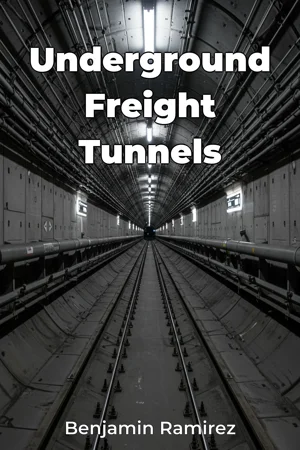
"Underground Freight Tunnels" explores the revolutionary concept of moving freight underground to alleviate urban congestion and improve air quality. Historically, tunnels have been used for passenger transport and utilities; however, this book focuses on the emergence of subterranean systems dedicated to freight, highlighting their potential to reshape urban logistics. It examines the intricate aspects of tunnel construction, automated freight handling technologies, and the economic and environmental impacts of integrating these systems, arguing that they offer a sustainable solution to the challenges posed by urbanization and e-commerce. The book delves into various tunnel construction methodologies suited for different geological conditions and emphasizes the importance of automated systems, such as robotic loading and centralized controls, for efficient freight management. It also presents a holistic view by integrating technological feasibility with economic viability and environmental sustainability. Case studies, financial models, and insights from engineers and urban planners demonstrate the long-term benefits of underground freight systems, addressing concerns about initial costs and construction disruptions. The book progresses from introducing the fundamentals of underground logistics to exploring tunnel construction techniques and automated systems. Later chapters assess economic feasibility, environmental impact, and social considerations, culminating in a discussion of future expansion and necessary policy changes. It offers practical guidelines for implementation, making it a valuable resource for engineers, urban planners, and policymakers interested in innovative urban solutions.
Book Details
ISBN
9788235248909
Publisher
Publifye AS
Your Licenses
You don't own any licenses for this book
Purchase a license below to unlock this book and download the EPUB.
Purchase License
Select a tier to unlock this book
Need bulk licensing?
Contact us for enterprise agreements.