
About This Book
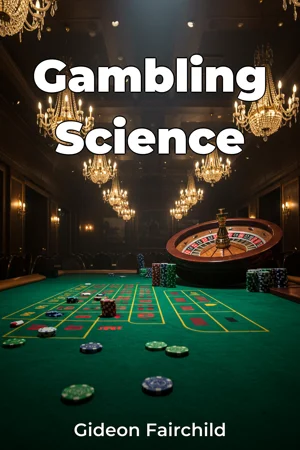
Have you ever wondered what truly drives the choices made at the roulette wheel or the poker table? "Gambling Science" delves into the fascinating interplay of psychology, probability, and risk management that underlies the world of gambling, exploring how casinos and players alike navigate the complexities of chance. We will unpack the core principles that govern gambling behavior and the strategies employed in this high-stakes environment. This book is structured around three key pillars: the psychology of decision-making under uncertainty, the mathematical framework of probability and statistics, and the practical application of risk management techniques. Understanding these areas is crucial, whether you're a casual gambler, a professional player, an academic researcher, or simply curious about the forces that shape our choices. Gambling has a rich history, evolving from ancient games of chance to a multi-billion dollar global industry. Social attitudes toward gambling vary widely, and its regulation is a complex issue with significant economic and ethical implications. While no prior expertise is required, a basic understanding of mathematical concepts like expected value, standard deviation, and cognitive biases will enhance the reader's experience. The central argument of "Gambling Science" is that a comprehensive understanding of the psychological, probabilistic, and risk-related elements involved allows for a more informed and rational approach to gambling, whether from the perspective of the player or the operator. This understanding is not about guaranteeing wins, but about making informed decisions and mitigating potential losses. The book begins by introducing fundamental concepts in behavioral economics, exploring common biases such as the gambler's fallacy, loss aversion, and the availability heuristic. We will then move into a detailed examination of probability theory, covering topics like random variables, distributions, and statistical inference, illustrating these concepts with real-world examples from various casino games. We will focus on the house edge and how it plays out in the long run. We will study risk management, including strategies for setting limits, managing bankrolls, and diversifying bets. Finally, we integrate these three perspectives to offer practical insights into responsible gambling practices and strategies for minimizing risks. Throughout the book, we draw on a wide range of evidence, including experimental studies in behavioral psychology, statistical analyses of gambling data, and case studies of successful and unsuccessful gamblers. We use data from publicly available sources as well as academic research to support our analysis. "Gambling Science" connects to several other fields, including economics, sociology, and computer science. Economics helps us understand the market dynamics of the gambling industry. Sociology provides insights into the social and cultural factors that influence gambling behavior. Computer science offers tools for simulating games and analyzing large datasets. These interdisciplinary connections enrich the book's perspective and provide a more complete picture of the gambling world. Our approach combines rigorous scientific analysis with practical applications. We aim to present complex concepts in an accessible and engaging manner, avoiding jargon and using real-world examples to illustrate key points. The target audience includes students and researchers in fields such as psychology, economics, and statistics, as well as anyone interested in understanding the science behind gambling. The book will be valuable to those seeking to improve their understanding of risk and decision-making in uncertain environments. As a work of non-fiction, "Gambling Science" adheres to the principles of accuracy, objectivity, and evidence-based analysis. While we explore different perspectives on gambling, we do not promote or endorse any particular gambling strategy. The book's scope is limited to the scientific analysis of gambling, focusing on the underlying psychology, probability, and risk management principles. We do not delve into the legal or ethical aspects of gambling in detail, although we acknowledge their importance. The information presented can be applied to various real-world situations beyond gambling, such as investment decisions, business strategy, and risk assessment in other domains. Understanding the biases and probabilities at play can lead to more rational choices in many areas of life. Ethical discussions surrounding regulation and responsible gambling practices are ongoing. This book aims to contribute to these discussions by providing a scientific framework for understanding the factors that influence gambling behavior.
Have you ever wondered what truly drives the choices made at the roulette wheel or the poker table? "Gambling Science" delves into the fascinating interplay of psychology, probability, and risk management that underlies the world of gambling, exploring how casinos and players alike navigate the complexities of chance. We will unpack the core principles that govern gambling behavior and the strategies employed in this high-stakes environment. This book is structured around three key pillars: the psychology of decision-making under uncertainty, the mathematical framework of probability and statistics, and the practical application of risk management techniques. Understanding these areas is crucial, whether you're a casual gambler, a professional player, an academic researcher, or simply curious about the forces that shape our choices. Gambling has a rich history, evolving from ancient games of chance to a multi-billion dollar global industry. Social attitudes toward gambling vary widely, and its regulation is a complex issue with significant economic and ethical implications. While no prior expertise is required, a basic understanding of mathematical concepts like expected value, standard deviation, and cognitive biases will enhance the reader's experience. The central argument of "Gambling Science" is that a comprehensive understanding of the psychological, probabilistic, and risk-related elements involved allows for a more informed and rational approach to gambling, whether from the perspective of the player or the operator. This understanding is not about guaranteeing wins, but about making informed decisions and mitigating potential losses. The book begins by introducing fundamental concepts in behavioral economics, exploring common biases such as the gambler's fallacy, loss aversion, and the availability heuristic. We will then move into a detailed examination of probability theory, covering topics like random variables, distributions, and statistical inference, illustrating these concepts with real-world examples from various casino games. We will focus on the house edge and how it plays out in the long run. We will study risk management, including strategies for setting limits, managing bankrolls, and diversifying bets. Finally, we integrate these three perspectives to offer practical insights into responsible gambling practices and strategies for minimizing risks. Throughout the book, we draw on a wide range of evidence, including experimental studies in behavioral psychology, statistical analyses of gambling data, and case studies of successful and unsuccessful gamblers. We use data from publicly available sources as well as academic research to support our analysis. "Gambling Science" connects to several other fields, including economics, sociology, and computer science. Economics helps us understand the market dynamics of the gambling industry. Sociology provides insights into the social and cultural factors that influence gambling behavior. Computer science offers tools for simulating games and analyzing large datasets. These interdisciplinary connections enrich the book's perspective and provide a more complete picture of the gambling world. Our approach combines rigorous scientific analysis with practical applications. We aim to present complex concepts in an accessible and engaging manner, avoiding jargon and using real-world examples to illustrate key points. The target audience includes students and researchers in fields such as psychology, economics, and statistics, as well as anyone interested in understanding the science behind gambling. The book will be valuable to those seeking to improve their understanding of risk and decision-making in uncertain environments. As a work of non-fiction, "Gambling Science" adheres to the principles of accuracy, objectivity, and evidence-based analysis. While we explore different perspectives on gambling, we do not promote or endorse any particular gambling strategy. The book's scope is limited to the scientific analysis of gambling, focusing on the underlying psychology, probability, and risk management principles. We do not delve into the legal or ethical aspects of gambling in detail, although we acknowledge their importance. The information presented can be applied to various real-world situations beyond gambling, such as investment decisions, business strategy, and risk assessment in other domains. Understanding the biases and probabilities at play can lead to more rational choices in many areas of life. Ethical discussions surrounding regulation and responsible gambling practices are ongoing. This book aims to contribute to these discussions by providing a scientific framework for understanding the factors that influence gambling behavior.
"Gambling Science" explores the fascinating intersection of psychology, probability, and risk management in the world of gambling. It examines how cognitive biases, like the gambler's fallacy, influence decision-making, and how understanding the house edge can inform strategies. The book uniquely blends behavioral economics with statistical analysis to provide insights into both player and casino behavior. The book presents these complex concepts in an accessible manner, using real-world examples and avoiding jargon. It begins by introducing behavioral economics and probability theory, then delves into risk management techniques like bankroll diversification. Ultimately, it integrates these perspectives to promote responsible gambling practices. By understanding the psychological, probabilistic, and risk-related elements, the book aims to provide a more informed approach to gambling, emphasizing rational decision-making and risk mitigation, rather than guaranteeing wins. Whether you're interested in finance, psychology, or the science of decision-making, this book offers valuable perspectives on navigating uncertainty.
Book Details
ISBN
9788235248855
Publisher
Publifye AS
Your Licenses
You don't own any licenses for this book
Purchase a license below to unlock this book and download the EPUB.
Purchase License
Select a tier to unlock this book
Need bulk licensing?
Contact us for enterprise agreements.