
About This Book
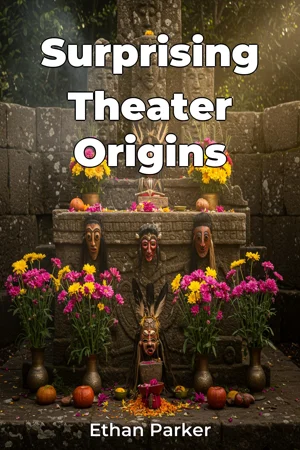
Did modern theater truly emerge from the stages we imagine, or do its roots lie in more unexpected terrain? "Surprising Theater Origins" delves into the often-overlooked and unconventional precursors to contemporary theatrical performance, tracing its evolution from ancient religious rituals to politically charged street actions. This book is essential because it challenges conventional understandings of theater history, revealing the diverse and dynamic forces that shaped this vital art form. This book examines three key areas. First, it explores the deep connection between early dramatic forms and religious ceremonies, analyzing how rituals honoring deities and marking seasonal changes gradually incorporated elements of storytelling and character impersonation. Second, it investigates the role of political and social movements in the development of theater, focusing on how performances evolved as tools for protest, propaganda, and the expression of dissenting voices. Finally, it considers the influence of popular entertainment, such as folk festivals, traveling minstrels, and public executions, in shaping theatrical conventions and engaging audiences. The central argument of "Surprising Theater Origins" is that modern theater is not solely the product of a linear progression from classical Greek drama, but rather a synthesis of disparate cultural practices, many of which existed outside of established theatrical institutions. This argument is important because it broadens our understanding of theater history and acknowledges the contributions of marginalized groups and non-traditional performance styles. The book begins by introducing the concept of "proto-theater"—the various ritualistic and performative activities that laid the foundation for formal dramatic presentation. The following sections examine the religious, political, and popular roots of theater in detail, drawing on case studies from different historical periods and cultural contexts. These case studies explore how ancient Egyptian religious rites contained theatrical elements; the role of medieval mystery plays in disseminating religious beliefs; and how street performances during the Renaissance served as vehicles for social critique. The book culminates by demonstrating how these diverse influences converged to shape the theatrical landscape of the modern era, influencing playwrights, directors, and performance artists. The evidence presented in "Surprising Theater Origins" draws from a wide range of sources, including archaeological findings, ancient texts, religious scriptures, political pamphlets, play scripts, and eyewitness accounts of public performances. It also incorporates interdisciplinary insights from anthropology, religious studies, political science, and folklore. This book connects to other fields by examining the intersection of performance with religious studies, demonstrating how rituals embody and transmit cultural values. It also integrates political science by analyzing how theater has been used as a tool for social change and political resistance. The book further connects to folklore studies through its exploration of how folk traditions have enriched theatrical performances and provided alternative narratives. "Surprising Theater Origins" takes a unique approach by focusing on the peripheral and often-overlooked aspects of theater history. It challenges the traditional canon and highlights the contributions of marginalized groups and non-Western performance traditions. The book is written in a clear and accessible style, making it suitable for students, theater practitioners, and general readers with an interest in the performing arts and cultural history. It avoids jargon and technical terms whenever possible and provides clear explanations of complex concepts. The intended readership includes university students studying theater, history, or cultural studies; theater professionals seeking a broader understanding of their craft; and general readers interested in the history of the performing arts. It offers a valuable perspective on the evolution of theater, encouraging readers to think critically about its origins and its role in society. As a work of non-fiction, "Surprising Theater Origins" adheres to the standards of academic scholarship, providing accurate information, citing sources, and presenting evidence-based arguments. It acknowledges the limitations of historical evidence and recognizes the possibility of multiple interpretations. The book focuses primarily on Western theatrical traditions, with occasional references to non-Western forms for comparative purposes. While it strives for broad coverage, it acknowledges that a comprehensive survey of all theatrical traditions worldwide is beyond its scope. The information in "Surprising Theater Origins" has practical applications for theater practitioners, educators, and cultural historians. By understanding the diverse origins of theater, artists can draw inspiration from a wider range of sources and create more innovative and inclusive performances. Educators can use the book to broaden their students' understanding of theater history and to challenge conventional assumptions about its development. Cultural historians can use the book to gain insights into the social, political, and religious contexts that shaped theatrical traditions. One ongoing debate in the field concerns the relative importance of different influences on the development of theater. Some scholars emphasize the role of classical Greek drama, while others highlight the contributions of non-Western performance traditions. "Surprising Theater Origins" addresses this debate by arguing that modern theater is a product of multiple influences, and that no single tradition should be seen as dominant.
Did modern theater truly emerge from the stages we imagine, or do its roots lie in more unexpected terrain? "Surprising Theater Origins" delves into the often-overlooked and unconventional precursors to contemporary theatrical performance, tracing its evolution from ancient religious rituals to politically charged street actions. This book is essential because it challenges conventional understandings of theater history, revealing the diverse and dynamic forces that shaped this vital art form. This book examines three key areas. First, it explores the deep connection between early dramatic forms and religious ceremonies, analyzing how rituals honoring deities and marking seasonal changes gradually incorporated elements of storytelling and character impersonation. Second, it investigates the role of political and social movements in the development of theater, focusing on how performances evolved as tools for protest, propaganda, and the expression of dissenting voices. Finally, it considers the influence of popular entertainment, such as folk festivals, traveling minstrels, and public executions, in shaping theatrical conventions and engaging audiences. The central argument of "Surprising Theater Origins" is that modern theater is not solely the product of a linear progression from classical Greek drama, but rather a synthesis of disparate cultural practices, many of which existed outside of established theatrical institutions. This argument is important because it broadens our understanding of theater history and acknowledges the contributions of marginalized groups and non-traditional performance styles. The book begins by introducing the concept of "proto-theater"—the various ritualistic and performative activities that laid the foundation for formal dramatic presentation. The following sections examine the religious, political, and popular roots of theater in detail, drawing on case studies from different historical periods and cultural contexts. These case studies explore how ancient Egyptian religious rites contained theatrical elements; the role of medieval mystery plays in disseminating religious beliefs; and how street performances during the Renaissance served as vehicles for social critique. The book culminates by demonstrating how these diverse influences converged to shape the theatrical landscape of the modern era, influencing playwrights, directors, and performance artists. The evidence presented in "Surprising Theater Origins" draws from a wide range of sources, including archaeological findings, ancient texts, religious scriptures, political pamphlets, play scripts, and eyewitness accounts of public performances. It also incorporates interdisciplinary insights from anthropology, religious studies, political science, and folklore. This book connects to other fields by examining the intersection of performance with religious studies, demonstrating how rituals embody and transmit cultural values. It also integrates political science by analyzing how theater has been used as a tool for social change and political resistance. The book further connects to folklore studies through its exploration of how folk traditions have enriched theatrical performances and provided alternative narratives. "Surprising Theater Origins" takes a unique approach by focusing on the peripheral and often-overlooked aspects of theater history. It challenges the traditional canon and highlights the contributions of marginalized groups and non-Western performance traditions. The book is written in a clear and accessible style, making it suitable for students, theater practitioners, and general readers with an interest in the performing arts and cultural history. It avoids jargon and technical terms whenever possible and provides clear explanations of complex concepts. The intended readership includes university students studying theater, history, or cultural studies; theater professionals seeking a broader understanding of their craft; and general readers interested in the history of the performing arts. It offers a valuable perspective on the evolution of theater, encouraging readers to think critically about its origins and its role in society. As a work of non-fiction, "Surprising Theater Origins" adheres to the standards of academic scholarship, providing accurate information, citing sources, and presenting evidence-based arguments. It acknowledges the limitations of historical evidence and recognizes the possibility of multiple interpretations. The book focuses primarily on Western theatrical traditions, with occasional references to non-Western forms for comparative purposes. While it strives for broad coverage, it acknowledges that a comprehensive survey of all theatrical traditions worldwide is beyond its scope. The information in "Surprising Theater Origins" has practical applications for theater practitioners, educators, and cultural historians. By understanding the diverse origins of theater, artists can draw inspiration from a wider range of sources and create more innovative and inclusive performances. Educators can use the book to broaden their students' understanding of theater history and to challenge conventional assumptions about its development. Cultural historians can use the book to gain insights into the social, political, and religious contexts that shaped theatrical traditions. One ongoing debate in the field concerns the relative importance of different influences on the development of theater. Some scholars emphasize the role of classical Greek drama, while others highlight the contributions of non-Western performance traditions. "Surprising Theater Origins" addresses this debate by arguing that modern theater is a product of multiple influences, and that no single tradition should be seen as dominant.
"Surprising Theater Origins" challenges conventional wisdom about the history of performing arts. It argues that modern theater's roots lie not solely in classical Greek drama but also in diverse cultural practices, many existing outside traditional institutions. The book explores proto-theater, religious rituals, political theater, and popular entertainment, revealing how these elements shaped the dramatic forms we recognize today. The book examines the deep connections between early dramatic forms and religious ceremonies, highlighting how rituals evolved to incorporate storytelling. It also investigates how social movements used performance as a tool for protest and expression. Presenting case studies from various historical periods, the book progresses from ancient rites to medieval plays and Renaissance street performances, demonstrating their convergence in shaping modern theatrical landscapes.
Book Details
ISBN
9788235248848
Publisher
Publifye AS
Your Licenses
You don't own any licenses for this book
Purchase a license below to unlock this book and download the EPUB.
Purchase License
Select a tier to unlock this book
Need bulk licensing?
Contact us for enterprise agreements.