
About This Book
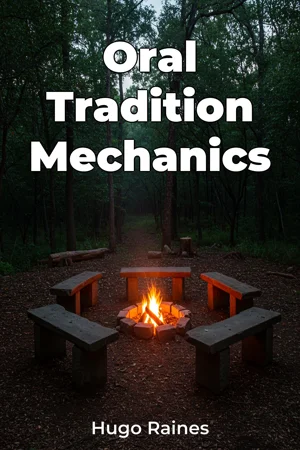
How did ancient societies preserve their histories, cultures, and laws before widespread literacy? "Oral Tradition Mechanics" delves into the intricate structures and inherent limitations of oral transmission, a fundamental aspect of human history and cultural development. This book is important because understanding oral tradition provides critical insights into the past, shaping our understanding of ancient societies and their belief systems, social structures, and cognitive processes. It’s relevant to those interested in how knowledge was managed, adapted, and sometimes lost in pre-literate cultures. This book explores three key pillars of oral tradition: the structures of mnemonic devices used to aid memory, the social contexts that influenced transmission accuracy and change, and the cognitive constraints that shaped the narratives themselves. It will argue that oral tradition, far from being a simple act of memorization, was a complex, dynamic system shaped by cultural priorities, social dynamics, and the limits of human cognition. This argument is essential because it challenges simplistic views of pre-literate societies and highlights the sophisticated mechanisms they developed to preserve and transmit knowledge. "Oral Tradition Mechanics" begins by establishing a theoretical framework for understanding oral transmission, drawing upon fields such as anthropology, linguistics, and cognitive science. It explores the common mnemonic devices employed in oral cultures, such as rhythm, rhyme, formulaic language, and narrative structures, with examples drawn from diverse cultures around the world. The book then delves into the social contexts that shaped oral transmission, examining the roles of storytellers, bards, and other cultural gatekeepers, as well as the influence of social hierarchies, power dynamics, and ritual practices. It investigates how these social factors could either reinforce or distort the accuracy of oral traditions over time. Finally, it examines the cognitive constraints that influenced the content and structure of oral narratives, exploring how factors such as memory capacity, attention span, and cognitive biases shaped the way stories were told and remembered. The evidence presented in "Oral Tradition Mechanics" is drawn from a wide range of sources, including ethnographic studies of contemporary oral cultures, analyses of ancient texts that were likely derived from oral traditions, and experimental studies of memory and cognition. It will also incorporate findings from archaeology and historical linguistics to reconstruct the social and cultural contexts in which oral traditions flourished. A unique aspect of the book is its interdisciplinary approach, combining insights from diverse fields to create a more holistic understanding of oral transmission. This book is relevant to students in Language Arts, History, Anthropology, and Folklore. It offers a fresh perspective on the importance of oral tradition. By understanding the mechanics of oral transmission, we can gain a deeper appreciation for the richness and complexity of pre-literate societies. Moreover, this book addresses a gap in the literature by offering a systematic analysis of the structures, social contexts, and cognitive constraints that shaped oral traditions. The tone of "Oral Tradition Mechanics" is academic yet accessible, aiming to engage both scholars and general readers interested in the topic. While it draws upon complex theoretical frameworks, it strives to present information in a clear and concise manner, using concrete examples and case studies to illustrate key concepts. The book acknowledges the challenges of reconstructing oral traditions from the past but emphasizes the importance of using interdisciplinary approaches to overcome these limitations. While the book draws on examples from various societies around the world, the coverage is not exhaustive, focusing on representative case studies that illustrate key principles of oral transmission. It does not delve into specific debates on authenticity but rather focuses on the mechanisms involved. This book can be applied to understanding how folklore, mythology, and epic poetry were developed and transmitted through time. These principles allow us to analyze modern communication and cultural transmission.
How did ancient societies preserve their histories, cultures, and laws before widespread literacy? "Oral Tradition Mechanics" delves into the intricate structures and inherent limitations of oral transmission, a fundamental aspect of human history and cultural development. This book is important because understanding oral tradition provides critical insights into the past, shaping our understanding of ancient societies and their belief systems, social structures, and cognitive processes. It’s relevant to those interested in how knowledge was managed, adapted, and sometimes lost in pre-literate cultures. This book explores three key pillars of oral tradition: the structures of mnemonic devices used to aid memory, the social contexts that influenced transmission accuracy and change, and the cognitive constraints that shaped the narratives themselves. It will argue that oral tradition, far from being a simple act of memorization, was a complex, dynamic system shaped by cultural priorities, social dynamics, and the limits of human cognition. This argument is essential because it challenges simplistic views of pre-literate societies and highlights the sophisticated mechanisms they developed to preserve and transmit knowledge. "Oral Tradition Mechanics" begins by establishing a theoretical framework for understanding oral transmission, drawing upon fields such as anthropology, linguistics, and cognitive science. It explores the common mnemonic devices employed in oral cultures, such as rhythm, rhyme, formulaic language, and narrative structures, with examples drawn from diverse cultures around the world. The book then delves into the social contexts that shaped oral transmission, examining the roles of storytellers, bards, and other cultural gatekeepers, as well as the influence of social hierarchies, power dynamics, and ritual practices. It investigates how these social factors could either reinforce or distort the accuracy of oral traditions over time. Finally, it examines the cognitive constraints that influenced the content and structure of oral narratives, exploring how factors such as memory capacity, attention span, and cognitive biases shaped the way stories were told and remembered. The evidence presented in "Oral Tradition Mechanics" is drawn from a wide range of sources, including ethnographic studies of contemporary oral cultures, analyses of ancient texts that were likely derived from oral traditions, and experimental studies of memory and cognition. It will also incorporate findings from archaeology and historical linguistics to reconstruct the social and cultural contexts in which oral traditions flourished. A unique aspect of the book is its interdisciplinary approach, combining insights from diverse fields to create a more holistic understanding of oral transmission. This book is relevant to students in Language Arts, History, Anthropology, and Folklore. It offers a fresh perspective on the importance of oral tradition. By understanding the mechanics of oral transmission, we can gain a deeper appreciation for the richness and complexity of pre-literate societies. Moreover, this book addresses a gap in the literature by offering a systematic analysis of the structures, social contexts, and cognitive constraints that shaped oral traditions. The tone of "Oral Tradition Mechanics" is academic yet accessible, aiming to engage both scholars and general readers interested in the topic. While it draws upon complex theoretical frameworks, it strives to present information in a clear and concise manner, using concrete examples and case studies to illustrate key concepts. The book acknowledges the challenges of reconstructing oral traditions from the past but emphasizes the importance of using interdisciplinary approaches to overcome these limitations. While the book draws on examples from various societies around the world, the coverage is not exhaustive, focusing on representative case studies that illustrate key principles of oral transmission. It does not delve into specific debates on authenticity but rather focuses on the mechanisms involved. This book can be applied to understanding how folklore, mythology, and epic poetry were developed and transmitted through time. These principles allow us to analyze modern communication and cultural transmission.
"Oral Tradition Mechanics" explores how pre-literate and ancient societies preserved knowledge through oral tradition, a complex system far beyond simple memorization. It examines the mnemonic devices, social contexts, and cognitive constraints that shaped the transmission of history, culture, and laws. Understanding these mechanics provides insights into ancient societies' belief systems and social structures. For example, rhythm and rhyme acted as memory aids, while storytellers and social hierarchies influenced accuracy. The book uniquely combines anthropology, linguistics, cognitive science, and language arts to present a holistic view of oral transmission. It begins by establishing a theoretical framework, then explores mnemonic devices and social contexts, and finally examines cognitive constraints. By understanding the structures, social dynamics, and cognitive limits, we can better appreciate the richness of pre-literate cultures and the development of folklore and epic poetry. This interdisciplinary approach offers a fresh perspective on cultural preservation.
Book Details
ISBN
9788235247582
Publisher
Publifye AS
Your Licenses
You don't own any licenses for this book
Purchase a license below to unlock this book and download the EPUB.
Purchase License
Select a tier to unlock this book
Need bulk licensing?
Contact us for enterprise agreements.