
About This Book
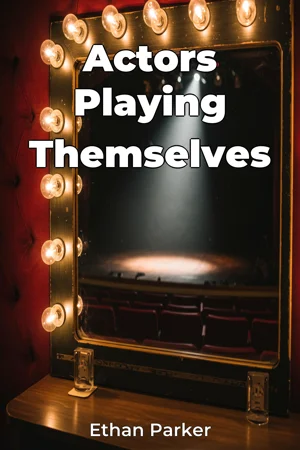
Have you ever wondered about the line between an actor's public persona and their true self, especially when that actor willingly blurs it on screen? "Actors Playing Themselves" delves into the fascinating world of performers who have crafted memorable roles by exaggerating, satirizing, or deconstructing their own celebrity images. This book examines how these performances reflect broader cultural trends, influence audience perception, and challenge traditional notions of acting. This work focuses on two primary topics: the construction of the “self” in the context of celebrity culture and the use of meta-performance as a tool for social commentary. Understanding these topics is crucial in an era where the lines between reality and performance are increasingly blurred, especially within the entertainment industry. It is also important to understand the degree of control celebrities exhibit over their public image. The book provides a historical context for this phenomenon, tracing its roots from early vaudeville and self-deprecating humor to contemporary film and television. We explore the evolution of celebrity culture and how the media landscape shapes an actor's public image, noting how social media has allowed actors to control their narrative in an unprecedented manner. No prior knowledge is needed, as the book provides a comprehensive overview of key concepts and relevant theories. The central argument of "Actors Playing Themselves" posits that these self-reflexive performances are not merely narcissistic exercises but serve as a unique form of artistic expression and cultural critique. These roles invite audiences to question the authenticity of celebrity culture and consider the complex relationship between an actor's private life and public persona. The book begins by defining key terms and concepts, such as “meta-performance,” “persona,” and “celebrity culture.” It then dedicates several chapters to examining specific case studies of actors who have successfully employed this technique. One major section analyzes actors who use self-parody to subvert expectations and challenge their established images. Another examines the use of biographical elements from actors' lives in film and television. Finally, the book explores the implications of these performances, examining their impact on audiences and the future of acting. The analysis is grounded in film and television theory, cultural studies, and performance studies, incorporating close readings of films, television shows, and interviews. The work will incorporate existing biographies, academic research, and press coverage. “Actors Playing Themselves” connects to broader discussions in sociology, media studies, and psychology. The book's exploration of identity construction resonates with sociological theories of self and identity. Its analysis of media representation connects to media studies theories of framing and agenda-setting. The examination of audience perception draws from psychological research on perception and attitude formation. The book adopts a unique approach by combining detailed analyses of specific performances with broader theoretical frameworks. This interdisciplinary perspective offers a nuanced understanding of the complex interplay between performance, identity, and culture. The writing style is accessible and engaging, balancing academic rigor with a conversational tone. Case studies are presented with clarity, and theoretical concepts are explained in a way that is easy to understand for a broad audience. The target audience includes film students, media scholars, cultural critics, and anyone interested in the intersection of celebrity culture and performance. It will appeal to readers who seek a deeper understanding of how actors manipulate their public images and how these performances reflect broader cultural trends. As a work of non-fiction, "Actors Playing Themselves" adheres to standards of academic integrity, providing accurate information, clear citations, and a balanced perspective on complex issues. The scope of the book is limited to examples primarily from American and British cinema and television. Readers can apply the insights from this book to their own media consumption, developing a more critical understanding of celebrity culture and media representation. The book encourages viewers to question the authenticity of what they see on screen and to consider the complex relationship between an actor's persona and their true self. The book will address questions about ethical boundaries in biographical portrayals and the potential for exploiting an actor's personal life for entertainment purposes. The role of audience interpretation and the impact of social media on shaping perceptions of authenticity will also be considered.
Have you ever wondered about the line between an actor's public persona and their true self, especially when that actor willingly blurs it on screen? "Actors Playing Themselves" delves into the fascinating world of performers who have crafted memorable roles by exaggerating, satirizing, or deconstructing their own celebrity images. This book examines how these performances reflect broader cultural trends, influence audience perception, and challenge traditional notions of acting. This work focuses on two primary topics: the construction of the “self” in the context of celebrity culture and the use of meta-performance as a tool for social commentary. Understanding these topics is crucial in an era where the lines between reality and performance are increasingly blurred, especially within the entertainment industry. It is also important to understand the degree of control celebrities exhibit over their public image. The book provides a historical context for this phenomenon, tracing its roots from early vaudeville and self-deprecating humor to contemporary film and television. We explore the evolution of celebrity culture and how the media landscape shapes an actor's public image, noting how social media has allowed actors to control their narrative in an unprecedented manner. No prior knowledge is needed, as the book provides a comprehensive overview of key concepts and relevant theories. The central argument of "Actors Playing Themselves" posits that these self-reflexive performances are not merely narcissistic exercises but serve as a unique form of artistic expression and cultural critique. These roles invite audiences to question the authenticity of celebrity culture and consider the complex relationship between an actor's private life and public persona. The book begins by defining key terms and concepts, such as “meta-performance,” “persona,” and “celebrity culture.” It then dedicates several chapters to examining specific case studies of actors who have successfully employed this technique. One major section analyzes actors who use self-parody to subvert expectations and challenge their established images. Another examines the use of biographical elements from actors' lives in film and television. Finally, the book explores the implications of these performances, examining their impact on audiences and the future of acting. The analysis is grounded in film and television theory, cultural studies, and performance studies, incorporating close readings of films, television shows, and interviews. The work will incorporate existing biographies, academic research, and press coverage. “Actors Playing Themselves” connects to broader discussions in sociology, media studies, and psychology. The book's exploration of identity construction resonates with sociological theories of self and identity. Its analysis of media representation connects to media studies theories of framing and agenda-setting. The examination of audience perception draws from psychological research on perception and attitude formation. The book adopts a unique approach by combining detailed analyses of specific performances with broader theoretical frameworks. This interdisciplinary perspective offers a nuanced understanding of the complex interplay between performance, identity, and culture. The writing style is accessible and engaging, balancing academic rigor with a conversational tone. Case studies are presented with clarity, and theoretical concepts are explained in a way that is easy to understand for a broad audience. The target audience includes film students, media scholars, cultural critics, and anyone interested in the intersection of celebrity culture and performance. It will appeal to readers who seek a deeper understanding of how actors manipulate their public images and how these performances reflect broader cultural trends. As a work of non-fiction, "Actors Playing Themselves" adheres to standards of academic integrity, providing accurate information, clear citations, and a balanced perspective on complex issues. The scope of the book is limited to examples primarily from American and British cinema and television. Readers can apply the insights from this book to their own media consumption, developing a more critical understanding of celebrity culture and media representation. The book encourages viewers to question the authenticity of what they see on screen and to consider the complex relationship between an actor's persona and their true self. The book will address questions about ethical boundaries in biographical portrayals and the potential for exploiting an actor's personal life for entertainment purposes. The role of audience interpretation and the impact of social media on shaping perceptions of authenticity will also be considered.
"Actors Playing Themselves" explores how performers deliberately blur the lines between their public personas and private selves, creating memorable roles through self-parody and deconstruction. This examination delves into the fascinating world of meta-performance, revealing how it serves as both artistic expression and social commentary within celebrity culture. The book highlights the degree of control actors exhibit over their public image and how performances reflect broader cultural trends, influencing audience perception of authenticity. The book traces the historical roots of this phenomenon, examining the evolution of celebrity culture from early vaudeville to contemporary film and television. Beginning with key definitions and concepts, the book then offers case studies of actors who have mastered this technique, analyzing those who use self-parody to subvert expectations and challenge their established images. It uniquely combines detailed analyses of specific performances with broader theoretical frameworks, offering a nuanced understanding of the interplay between performance, identity, and culture. Finally, "Actors Playing Themselves" examines the implications of these performances, exploring their impact on audiences and the future of acting. The book progresses across chapters by first defining key terms, then transitioning to case studies, and concluding with an exploration of the impact of these performances. This work encourages viewers to question media representation and consider the complex relationship between an actor's persona and their true self.
Book Details
ISBN
9788235245939
Publisher
Publifye AS
Your Licenses
You don't own any licenses for this book
Purchase a license below to unlock this book and download the EPUB.
Purchase License
Select a tier to unlock this book
Need bulk licensing?
Contact us for enterprise agreements.