
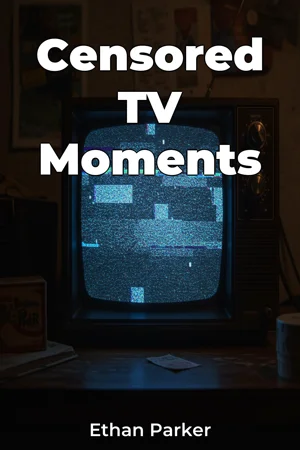
About This Book
What happens when the boundaries of entertainment clash with the sensitivities of society? "Censored TV Moments" delves into the complex world of television censorship, exploring the most controversial scenes and episodes that were deemed unfit for broadcast, the reasons behind the outrage they provoked, and the ongoing influence of censorship on the content we consume. This book is important because it dissects how cultural values, political climates, and corporate interests shape the narratives that reach millions of homes, prompting a critical examination of who decides what we see and why. The central argument of "Censored TV Moments" is that censorship in television, rather than simply being a tool for maintaining public decency, is a dynamic force that reflects and reinforces societal power structures. It serves not only to suppress certain types of content but also to subtly guide and normalize particular ideologies and behaviors. This argument is significant because it encourages viewers to critically assess the messages they receive from television and to recognize the potential for bias and manipulation inherent in the censoring process. This book unfolds by first establishing a historical context of television censorship, tracing its evolution from the early days of broadcasting to the present digital age. It introduces key concepts such as indecency standards, network policies, and the role of regulatory bodies like the FCC. The book then examines specific case studies of censored moments, categorized into themes such as: political satire, sexual content, violence, and religious expression. Each case study analyzes the content that triggered censorship, the immediate public reaction, the rationale provided by networks or regulators, and the long-term consequences for both the program and the broader media landscape. One section presents an analysis of how censorship varies across different television genres, comparing the restrictions placed on news programs, sitcoms, dramas, and reality shows. Another examines the impact of audience demographics on censorship decisions, considering how factors like age, gender, and cultural background influence perceptions of what is acceptable. A subsequent chapter addresses the growing influence of streaming services and the challenges they pose to traditional censorship models, exploring how these platforms navigate content restrictions and international regulations. The book culminates by discussing the ethical implications of television censorship, weighing the need to protect vulnerable audiences against the principles of free speech and artistic expression. The evidence presented in "Censored TV Moments" draws from a variety of sources, including archival footage of censored scenes, transcripts of regulatory hearings, interviews with television producers and executives, and audience surveys gauging public opinion on controversial content. The book benefits from an interdisciplinary approach, connecting media studies to sociology and political science. It considers how censorship intersects with broader debates about cultural identity, social justice, and the role of media in a democratic society. The book's unique perspective lies in its focus on the power dynamics that underlie censorship decisions, exposing how these decisions are often driven by factors beyond simple notions of offensiveness. Written in an accessible and engaging style, "Censored TV Moments" is aimed at students of media studies, television enthusiasts, and anyone interested in understanding the forces that shape the content they consume. It is valuable to them as it provides a framework for analyzing the complex relationship between television, censorship, and society. The book acknowledges the ongoing debates surrounding censorship in the digital age, particularly the challenges of regulating content on streaming platforms and social media. It avoids settling on simplistic solutions but proposes a set of principles for navigating these complex issues in a way that respects both freedom of expression and the need to protect vulnerable audiences. While the book primarily focuses on the US television landscape, it also incorporates examples from other countries to illustrate the global dimensions of censorship debates.
What happens when the boundaries of entertainment clash with the sensitivities of society? "Censored TV Moments" delves into the complex world of television censorship, exploring the most controversial scenes and episodes that were deemed unfit for broadcast, the reasons behind the outrage they provoked, and the ongoing influence of censorship on the content we consume. This book is important because it dissects how cultural values, political climates, and corporate interests shape the narratives that reach millions of homes, prompting a critical examination of who decides what we see and why. The central argument of "Censored TV Moments" is that censorship in television, rather than simply being a tool for maintaining public decency, is a dynamic force that reflects and reinforces societal power structures. It serves not only to suppress certain types of content but also to subtly guide and normalize particular ideologies and behaviors. This argument is significant because it encourages viewers to critically assess the messages they receive from television and to recognize the potential for bias and manipulation inherent in the censoring process. This book unfolds by first establishing a historical context of television censorship, tracing its evolution from the early days of broadcasting to the present digital age. It introduces key concepts such as indecency standards, network policies, and the role of regulatory bodies like the FCC. The book then examines specific case studies of censored moments, categorized into themes such as: political satire, sexual content, violence, and religious expression. Each case study analyzes the content that triggered censorship, the immediate public reaction, the rationale provided by networks or regulators, and the long-term consequences for both the program and the broader media landscape. One section presents an analysis of how censorship varies across different television genres, comparing the restrictions placed on news programs, sitcoms, dramas, and reality shows. Another examines the impact of audience demographics on censorship decisions, considering how factors like age, gender, and cultural background influence perceptions of what is acceptable. A subsequent chapter addresses the growing influence of streaming services and the challenges they pose to traditional censorship models, exploring how these platforms navigate content restrictions and international regulations. The book culminates by discussing the ethical implications of television censorship, weighing the need to protect vulnerable audiences against the principles of free speech and artistic expression. The evidence presented in "Censored TV Moments" draws from a variety of sources, including archival footage of censored scenes, transcripts of regulatory hearings, interviews with television producers and executives, and audience surveys gauging public opinion on controversial content. The book benefits from an interdisciplinary approach, connecting media studies to sociology and political science. It considers how censorship intersects with broader debates about cultural identity, social justice, and the role of media in a democratic society. The book's unique perspective lies in its focus on the power dynamics that underlie censorship decisions, exposing how these decisions are often driven by factors beyond simple notions of offensiveness. Written in an accessible and engaging style, "Censored TV Moments" is aimed at students of media studies, television enthusiasts, and anyone interested in understanding the forces that shape the content they consume. It is valuable to them as it provides a framework for analyzing the complex relationship between television, censorship, and society. The book acknowledges the ongoing debates surrounding censorship in the digital age, particularly the challenges of regulating content on streaming platforms and social media. It avoids settling on simplistic solutions but proposes a set of principles for navigating these complex issues in a way that respects both freedom of expression and the need to protect vulnerable audiences. While the book primarily focuses on the US television landscape, it also incorporates examples from other countries to illustrate the global dimensions of censorship debates.
"Censored TV Moments" explores the intricate world of television censorship, revealing how cultural values, political climates, and corporate interests dictate what makes it to our screens. The book argues that censorship isn't merely about maintaining decency but actively shapes societal norms by suppressing certain content while subtly promoting specific ideologies. Did you know that even political satire faces the censor's cut, highlighting the fine line between entertainment and challenging the status quo? The book unfolds by tracing the history of television censorship, examining key concepts like indecency standards and the role of regulatory bodies. Through specific case studies, the narrative categorizes censored moments by themes such as sexual content, violence, and religious expression. It analyzes the public's reactions and the long-term consequences for both the programs and the media landscape. Another intriguing insight lies in how streaming services challenge traditional censorship models, navigating content restrictions and international regulations in new ways. Ultimately, the book prompts readers to critically assess the messages they receive and understand the power dynamics at play in shaping our viewing experience.
Book Details
ISBN
9788235245823
Publisher
Publifye AS
Your Licenses
You don't own any licenses for this book
Purchase a license below to unlock this book and download the EPUB.
Purchase License
Select a tier to unlock this book
Need bulk licensing?
Contact us for enterprise agreements.