
About This Book
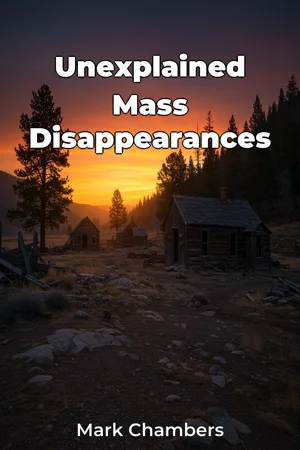
What happens when entire communities vanish, leaving behind only unanswered questions and unsettling silence? "Unexplained Mass Disappearances" delves into documented cases of groups of people who have vanished without a trace, exploring the historical context, potential causes, and enduring mysteries surrounding these events. This book examines not just individual disappearances, but incidents involving entire villages, settlements, and even large groups of travelers, probing the depths of human experience and the fragility of civilization. This book is structured around three core themes: the documented historical record of mass disappearances, the potential explanations offered by various fields of study, and the lasting impact these events have on our understanding of history and human nature. Each theme is crucial to analyzing the complexities of these cases and appreciating the profound questions they raise about safety, society, and the unknown. The historical context is paramount. Many disappearances occur during times of conflict, environmental stress, or societal upheaval. Understanding these background factors helps narrow down potential explanations and highlights the vulnerability of communities in the face of extreme circumstances. For example, events like the Lost Colony of Roanoke, the disappearance of the Anasazi people from their cliff dwellings, and the Dyatlov Pass incident each contain layers of historical and environmental clues that offer partial explanations, even if a complete picture remains elusive. The central argument of "Unexplained Mass Disappearances" is that while complete explanations may never be possible in some cases, a rigorous interdisciplinary approach—combining historical analysis, scientific investigation, and sociological perspectives—can shed light on the most plausible scenarios and reveal patterns that might otherwise remain hidden. It’s critical to move beyond sensationalism and approach these events with a commitment to evidence-based reasoning. The book unfolds systematically. First, key examples of mass disappearances are introduced, each presented with detailed historical context and available evidence. Second, potential explanations are explored, drawing on fields such as geology, anthropology, criminology, and even folklore. This section examines theories ranging from natural disasters and disease outbreaks to mass migrations, criminal activity, and paranormal phenomena. Finally, the book synthesizes these diverse perspectives to assess the most likely explanations for each case, acknowledging the limits of current knowledge and highlighting areas for future research. Support for these arguments comes from a range of sources, including historical documents, archaeological findings, scientific reports, and eyewitness accounts. The book critically evaluates the reliability of these sources and presents a balanced assessment of the available evidence. Unique data, such as geological surveys of affected areas and forensic analysis of recovered remains, is incorporated to provide a comprehensive analysis. "Unexplained Mass Disappearances" also connects to broader fields of study, including sociology (examining societal collapse and group behavior under stress), environmental science (assessing the impact of natural disasters on human populations), and psychology (exploring the role of mass hysteria and collective delusion). These interdisciplinary connections enrich the analysis and provide a more holistic understanding of the factors that may contribute to mass disappearances. The book distinguishes itself through its commitment to rigorous, evidence-based analysis and its avoidance of sensationalism. It adopts a methodical approach, carefully weighing the available evidence and considering a range of potential explanations before drawing conclusions. This perspective sets it apart from many other books on the topic, which often focus on speculation and conjecture. Written in a clear and accessible style, "Unexplained Mass Disappearances" is aimed at readers interested in history, true crime, and unexplained phenomena. It offers valuable insights for anyone intrigued by mysteries of the past and the limits of human understanding. The book will appeal those who appreciate detailed investigations and are interested in exploring complex historical events from multiple angles. As a work of history and true crime, the book adheres to the conventions of thorough research, accurate representation of facts, and responsible speculation. It strives to present a balanced and nuanced account of each disappearance, avoiding sensationalism and respecting the victims and their families. The scope of the book is intentionally broad, encompassing a range of cases from different historical periods and geographical locations. However, it does not attempt to provide an exhaustive list of every mass disappearance on record. Instead, it focuses on selected cases that offer the most compelling evidence and raise the most significant questions. The information presented in "Unexplained Mass Disappearances" has practical applications for researchers, historians, and anyone interested in disaster preparedness and community resilience. By studying past disappearances, we can learn valuable lessons about the factors that make communities vulnerable and develop strategies to mitigate the risk of future tragedies. These events are often shrouded in controversy and debate, with competing theories vying for acceptance. The book acknowledges these controversies and presents a range of perspectives, allowing readers to draw their own conclusions based on the available evidence. It addresses topics that require careful consideration and presents them in a way that nurtures critical thinking.
What happens when entire communities vanish, leaving behind only unanswered questions and unsettling silence? "Unexplained Mass Disappearances" delves into documented cases of groups of people who have vanished without a trace, exploring the historical context, potential causes, and enduring mysteries surrounding these events. This book examines not just individual disappearances, but incidents involving entire villages, settlements, and even large groups of travelers, probing the depths of human experience and the fragility of civilization. This book is structured around three core themes: the documented historical record of mass disappearances, the potential explanations offered by various fields of study, and the lasting impact these events have on our understanding of history and human nature. Each theme is crucial to analyzing the complexities of these cases and appreciating the profound questions they raise about safety, society, and the unknown. The historical context is paramount. Many disappearances occur during times of conflict, environmental stress, or societal upheaval. Understanding these background factors helps narrow down potential explanations and highlights the vulnerability of communities in the face of extreme circumstances. For example, events like the Lost Colony of Roanoke, the disappearance of the Anasazi people from their cliff dwellings, and the Dyatlov Pass incident each contain layers of historical and environmental clues that offer partial explanations, even if a complete picture remains elusive. The central argument of "Unexplained Mass Disappearances" is that while complete explanations may never be possible in some cases, a rigorous interdisciplinary approach—combining historical analysis, scientific investigation, and sociological perspectives—can shed light on the most plausible scenarios and reveal patterns that might otherwise remain hidden. It’s critical to move beyond sensationalism and approach these events with a commitment to evidence-based reasoning. The book unfolds systematically. First, key examples of mass disappearances are introduced, each presented with detailed historical context and available evidence. Second, potential explanations are explored, drawing on fields such as geology, anthropology, criminology, and even folklore. This section examines theories ranging from natural disasters and disease outbreaks to mass migrations, criminal activity, and paranormal phenomena. Finally, the book synthesizes these diverse perspectives to assess the most likely explanations for each case, acknowledging the limits of current knowledge and highlighting areas for future research. Support for these arguments comes from a range of sources, including historical documents, archaeological findings, scientific reports, and eyewitness accounts. The book critically evaluates the reliability of these sources and presents a balanced assessment of the available evidence. Unique data, such as geological surveys of affected areas and forensic analysis of recovered remains, is incorporated to provide a comprehensive analysis. "Unexplained Mass Disappearances" also connects to broader fields of study, including sociology (examining societal collapse and group behavior under stress), environmental science (assessing the impact of natural disasters on human populations), and psychology (exploring the role of mass hysteria and collective delusion). These interdisciplinary connections enrich the analysis and provide a more holistic understanding of the factors that may contribute to mass disappearances. The book distinguishes itself through its commitment to rigorous, evidence-based analysis and its avoidance of sensationalism. It adopts a methodical approach, carefully weighing the available evidence and considering a range of potential explanations before drawing conclusions. This perspective sets it apart from many other books on the topic, which often focus on speculation and conjecture. Written in a clear and accessible style, "Unexplained Mass Disappearances" is aimed at readers interested in history, true crime, and unexplained phenomena. It offers valuable insights for anyone intrigued by mysteries of the past and the limits of human understanding. The book will appeal those who appreciate detailed investigations and are interested in exploring complex historical events from multiple angles. As a work of history and true crime, the book adheres to the conventions of thorough research, accurate representation of facts, and responsible speculation. It strives to present a balanced and nuanced account of each disappearance, avoiding sensationalism and respecting the victims and their families. The scope of the book is intentionally broad, encompassing a range of cases from different historical periods and geographical locations. However, it does not attempt to provide an exhaustive list of every mass disappearance on record. Instead, it focuses on selected cases that offer the most compelling evidence and raise the most significant questions. The information presented in "Unexplained Mass Disappearances" has practical applications for researchers, historians, and anyone interested in disaster preparedness and community resilience. By studying past disappearances, we can learn valuable lessons about the factors that make communities vulnerable and develop strategies to mitigate the risk of future tragedies. These events are often shrouded in controversy and debate, with competing theories vying for acceptance. The book acknowledges these controversies and presents a range of perspectives, allowing readers to draw their own conclusions based on the available evidence. It addresses topics that require careful consideration and presents them in a way that nurtures critical thinking.
"Unexplained Mass Disappearances" explores the unsettling phenomenon of entire communities vanishing, delving into historical mysteries and true crime events where groups of people disappeared without a trace. The book examines cases like the Lost Colony of Roanoke, where a settlement vanished leaving behind only the cryptic word "Croatoan," and the baffling Dyatlov Pass incident, where experienced hikers met an unexplained end in the Ural Mountains. By focusing on documented historical disappearances, the book aims to uncover potential causes and offer insights into these enduring enigmas. The book approaches these events with a rigorous, evidence-based methodology, moving beyond sensationalism to present a balanced analysis. It considers various explanations, from natural disasters and disease outbreaks to sociological factors and even folklore, to assess the most plausible scenarios. "Unexplained Mass Disappearances" highlights the fragility of civilization and the vulnerability of communities facing extreme circumstances, emphasizing the importance of understanding historical context when examining these events. The narrative unfolds systematically, first introducing key examples with detailed historical context. It then explores potential explanations, drawing on fields like geology, anthropology, and criminology. Finally, the book synthesizes these perspectives, acknowledging the limits of current knowledge and highlighting areas for future research, making it a valuable resource for those intrigued by unsolved mysteries and historical events.
Book Details
ISBN
9788235245113
Publisher
Publifye AS
Your Licenses
You don't own any licenses for this book
Purchase a license below to unlock this book and download the EPUB.
Purchase License
Select a tier to unlock this book
Need bulk licensing?
Contact us for enterprise agreements.