
About This Book
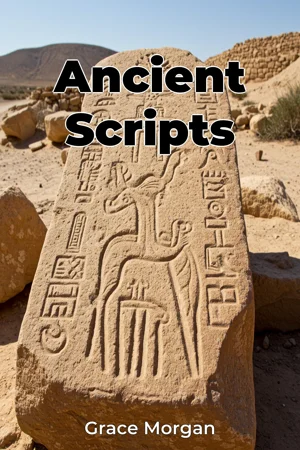
Have you ever wondered how voices from millennia ago continue to resonate today? This book, "Ancient Scripts," embarks on a journey through time to explore the world's oldest written languages, revealing their origins, decipherment, and enduring role in preserving history. We delve into the fascinating stories behind these scripts, examining not only their linguistic structures but also their cultural and societal contexts. Our exploration revolves around three key topics: the genesis of writing systems, the intricate processes of decipherment, and the impact of ancient texts on our understanding of the past. These topics are significant because they offer invaluable insights into the development of human communication, the evolution of civilizations, and the methods by which we reconstruct and interpret history. Understanding ancient scripts allows a deeper appreciation for the complexities of human culture and its transmission across generations. To fully appreciate the significance of ancient scripts, it's crucial to consider the historical and social landscapes in which they emerged. From the fertile crescent of Mesopotamia to the valleys of ancient Egypt and the distant lands of China, writing systems evolved in response to specific societal needs, ranging from administrative record-keeping to religious expression. No prior knowledge of linguistics is required, as we provide clear explanations of key concepts throughout the book. The central argument of "Ancient Scripts" is that the ability to decipher and interpret ancient writing systems is not merely an academic exercise but a fundamental means of accessing and understanding the foundations of human civilization. By unlocking these ancient voices, we gain a richer, more nuanced comprehension of our shared history. The book's structure is designed to guide you through this intricate subject. First, we introduce the fundamental concepts of writing systems, exploring their diverse forms and functions. Then, we delve into specific examples, such as Mesopotamian cuneiform and Egyptian hieroglyphs, examining their origins, evolution, and unique characteristics. A significant portion of the book is dedicated to the remarkable stories of decipherment, highlighting the brilliant minds and painstaking efforts that unlocked these ancient secrets. Finally, we explore the broader impact of these deciphered texts, demonstrating how they have transformed our understanding of ancient history, religion, and culture. The evidence presented throughout the book stems from a variety of sources, including archaeological findings, linguistic analyses, and historical records. We draw upon the work of leading scholars in the fields of archaeology, linguistics, and ancient history, incorporating the latest research and interpretations. Unique data sources, such as newly discovered inscriptions and previously overlooked texts, are also examined. "Ancient Scripts" bridges multiple disciplines, connecting linguistics with history, archaeology, and anthropology. This interdisciplinary approach provides a more holistic understanding of ancient writing systems, revealing their significance not only as linguistic tools but also as cultural artifacts and historical documents. For example, the study of ancient legal codes sheds light on social structures and ethical values. Similarly, the analysis of religious texts provides insights into ancient belief systems and ritual practices. This book's unique perspective lies in its emphasis on the human element behind the scripts. While providing detailed linguistic analyses, it also tells the stories of the people who created, used, and ultimately deciphered these ancient writing systems. This approach brings the subject to life, making it accessible and engaging for a broad audience. The tone of the book is informative and accessible, aiming to convey complex information in a clear and engaging manner. While grounded in academic rigor, the writing style avoids unnecessary jargon, making it suitable for both scholars and general readers with an interest in history, language, and archaeology. The target audience includes anyone with an interest in ancient history, linguistics, archaeology, or cultural studies. It will be valuable to students, educators, and general readers seeking a comprehensive and engaging introduction to the world of ancient scripts. As a work of non-fiction, "Ancient Scripts" prioritizes accuracy, clarity, and objectivity. Information is presented in a balanced and evidence-based manner, with careful attention to detail and proper citation of sources. While the book covers a wide range of ancient scripts, it is not exhaustive. We have focused on some of the most historically significant and well-documented examples, such as cuneiform, hieroglyphs, Linear B, and early Chinese writing systems. Other scripts, while important in their own right, receive less attention due to space constraints and available research. The knowledge gained from "Ancient Scripts" has numerous real-world applications. It provides a deeper understanding of cultural heritage, informs modern linguistic studies, and enhances our ability to interpret historical documents. Additionally, it fosters a greater appreciation for the diversity and complexity of human communication. While the decipherment of some ancient scripts, like Egyptian hieroglyphs, is widely accepted, the interpretation of certain texts and the reconstruction of ancient languages continue to be subjects of debate among scholars. We address these controversies where relevant, presenting different perspectives and highlighting areas of ongoing research.
Have you ever wondered how voices from millennia ago continue to resonate today? This book, "Ancient Scripts," embarks on a journey through time to explore the world's oldest written languages, revealing their origins, decipherment, and enduring role in preserving history. We delve into the fascinating stories behind these scripts, examining not only their linguistic structures but also their cultural and societal contexts. Our exploration revolves around three key topics: the genesis of writing systems, the intricate processes of decipherment, and the impact of ancient texts on our understanding of the past. These topics are significant because they offer invaluable insights into the development of human communication, the evolution of civilizations, and the methods by which we reconstruct and interpret history. Understanding ancient scripts allows a deeper appreciation for the complexities of human culture and its transmission across generations. To fully appreciate the significance of ancient scripts, it's crucial to consider the historical and social landscapes in which they emerged. From the fertile crescent of Mesopotamia to the valleys of ancient Egypt and the distant lands of China, writing systems evolved in response to specific societal needs, ranging from administrative record-keeping to religious expression. No prior knowledge of linguistics is required, as we provide clear explanations of key concepts throughout the book. The central argument of "Ancient Scripts" is that the ability to decipher and interpret ancient writing systems is not merely an academic exercise but a fundamental means of accessing and understanding the foundations of human civilization. By unlocking these ancient voices, we gain a richer, more nuanced comprehension of our shared history. The book's structure is designed to guide you through this intricate subject. First, we introduce the fundamental concepts of writing systems, exploring their diverse forms and functions. Then, we delve into specific examples, such as Mesopotamian cuneiform and Egyptian hieroglyphs, examining their origins, evolution, and unique characteristics. A significant portion of the book is dedicated to the remarkable stories of decipherment, highlighting the brilliant minds and painstaking efforts that unlocked these ancient secrets. Finally, we explore the broader impact of these deciphered texts, demonstrating how they have transformed our understanding of ancient history, religion, and culture. The evidence presented throughout the book stems from a variety of sources, including archaeological findings, linguistic analyses, and historical records. We draw upon the work of leading scholars in the fields of archaeology, linguistics, and ancient history, incorporating the latest research and interpretations. Unique data sources, such as newly discovered inscriptions and previously overlooked texts, are also examined. "Ancient Scripts" bridges multiple disciplines, connecting linguistics with history, archaeology, and anthropology. This interdisciplinary approach provides a more holistic understanding of ancient writing systems, revealing their significance not only as linguistic tools but also as cultural artifacts and historical documents. For example, the study of ancient legal codes sheds light on social structures and ethical values. Similarly, the analysis of religious texts provides insights into ancient belief systems and ritual practices. This book's unique perspective lies in its emphasis on the human element behind the scripts. While providing detailed linguistic analyses, it also tells the stories of the people who created, used, and ultimately deciphered these ancient writing systems. This approach brings the subject to life, making it accessible and engaging for a broad audience. The tone of the book is informative and accessible, aiming to convey complex information in a clear and engaging manner. While grounded in academic rigor, the writing style avoids unnecessary jargon, making it suitable for both scholars and general readers with an interest in history, language, and archaeology. The target audience includes anyone with an interest in ancient history, linguistics, archaeology, or cultural studies. It will be valuable to students, educators, and general readers seeking a comprehensive and engaging introduction to the world of ancient scripts. As a work of non-fiction, "Ancient Scripts" prioritizes accuracy, clarity, and objectivity. Information is presented in a balanced and evidence-based manner, with careful attention to detail and proper citation of sources. While the book covers a wide range of ancient scripts, it is not exhaustive. We have focused on some of the most historically significant and well-documented examples, such as cuneiform, hieroglyphs, Linear B, and early Chinese writing systems. Other scripts, while important in their own right, receive less attention due to space constraints and available research. The knowledge gained from "Ancient Scripts" has numerous real-world applications. It provides a deeper understanding of cultural heritage, informs modern linguistic studies, and enhances our ability to interpret historical documents. Additionally, it fosters a greater appreciation for the diversity and complexity of human communication. While the decipherment of some ancient scripts, like Egyptian hieroglyphs, is widely accepted, the interpretation of certain texts and the reconstruction of ancient languages continue to be subjects of debate among scholars. We address these controversies where relevant, presenting different perspectives and highlighting areas of ongoing research.
"Ancient Scripts" unveils the captivating stories behind the world's oldest writing systems, exploring their origins, decipherment, and profound impact on our understanding of history. The book delves into how these scripts served as vital tools for ancient societies, from administrative record-keeping to religious expression, highlighting the intricate link between language and culture. Discover how the ability to decipher these ancient voices provides a richer comprehension of our shared past, unlocking invaluable insights into the evolution of civilizations. The study of ancient scripts bridges multiple disciplines, connecting linguistics with history and archaeology. For example, the book explores how the analysis of ancient legal codes sheds light on social structures and ethical values. Beginning with the fundamental concepts of writing systems, the book progresses to specific examples like Mesopotamian cuneiform and Egyptian hieroglyphs, showcasing the remarkable stories of decipherment and the brilliant minds that unlocked their secrets. The book emphasizes the human element behind these scripts, telling the stories of those who created, used, and ultimately deciphered them. By exploring how these texts have transformed our understanding of ancient history, religion, and culture, "Ancient Scripts" offers a unique and accessible journey through time, making it a valuable resource for anyone interested in foreign language study, history, or language learning.
Book Details
ISBN
9788235244567
Publisher
Publifye AS
Your Licenses
You don't own any licenses for this book
Purchase a license below to unlock this book and download the EPUB.
Purchase License
Select a tier to unlock this book
Need bulk licensing?
Contact us for enterprise agreements.