
About This Book
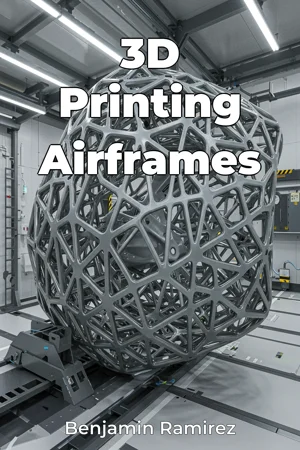
Could the future of flight lie not in assembling aircraft, but in printing them whole? This book, *3D Printing Airframes*, delves into the burgeoning field of additive manufacturing applied to the creation of complete aircraft structures, exploring its potential to revolutionize aerospace design, production, and performance. The core of our investigation revolves around three central themes: material innovation enabled by 3D printing, the unprecedented design freedom it unlocks, and the enhanced durability achievable through optimized, additively manufactured structures. These elements collectively represent a paradigm shift from traditional subtractive manufacturing methods. Aerospace manufacturing has historically been constrained by the limitations of conventional materials and fabrication techniques. This book provides background context, outlining the evolution of airframe construction from wood and fabric to aluminum and composites, showcasing the industry’s continuous pursuit of lighter, stronger, and more efficient materials. Readers with a basic understanding of aerospace engineering principles and materials science will particularly appreciate the depth of our analysis, although we provide accessible explanations of key concepts throughout. The central argument of *3D Printing Airframes* is that additive manufacturing offers a pathway to create airframes with superior performance characteristics, reduced manufacturing costs, and increased sustainability compared to traditionally manufactured counterparts. This claim is substantiated through a comprehensive examination of current research, case studies, and technological advancements in the field. The book is structured to guide the reader through a logical progression of ideas. Initially, we introduce the fundamentals of 3D printing technologies relevant to airframe construction, including powder bed fusion, directed energy deposition, and binder jetting, clarifying the strengths and weaknesses of each. The subsequent section explores material innovation, focusing on the development and application of novel alloys, composites, and metamaterials specifically designed for additive manufacturing. We will then dedicate chapters to design optimization, showcasing how 3D printing enables the creation of complex geometries and internal lattice structures that enhance structural integrity and reduce weight. A significant portion of the book is devoted to analyzing the durability and performance of 3D-printed airframe components, considering fatigue resistance, crack propagation, and environmental factors. Finally, we will provide real-world examples and analyze the practical implications like: reduced fuel consumption, optimized flight performance, and decreased environmental impact. Our analysis is supported by a wealth of evidence, drawing upon academic research, industry reports, and experimental data. We present findings from material characterization studies, finite element analysis simulations, and flight testing programs to validate our claims. Unique data sources, including proprietary datasets from aerospace manufacturers and research institutions, are also incorporated. *3D Printing Airframes* exists at the intersection of several disciplines. We explore connections to materials science, examining the properties and behavior of additively manufactured materials. We relate to design engineering, demonstrating how 3D printing transforms the design process. We also connect to sustainability studies, assessing the environmental impact of additive manufacturing. These interdisciplinary connections enrich our analysis and provide a more holistic understanding of the subject matter. One of the book's unique aspects lies in its focus on topology optimization and multi-material printing for airframe design. We explore how these advanced techniques can be used to create structures with unprecedented strength-to-weight ratios, incorporating functionally graded materials to tailor performance characteristics. The book adopts a fact-based writing style, presenting information in a clear, concise, and objective manner. We balance technical depth with accessibility, ensuring that the content is engaging and informative for a wide range of readers. The primary target audiences for this book include aerospace engineers, materials scientists, manufacturing professionals, and researchers interested in advanced manufacturing technologies. It will also be of value to students pursuing degrees in aerospace engineering, mechanical engineering, and materials science. The book will empower readers to: understand the current state-of-the-art, identify opportunities for innovation, and contribute to the advancement of 3D printing in aerospace. As a work of non-fiction in the fields of design and technology, *3D Printing Airframes* adheres to the genre's emphasis on accuracy, objectivity, and evidence-based analysis, providing a technical and practical approach. The book focuses specifically on the application of 3D printing to airframe construction, excluding other potential aerospace applications such as engine components or interior fittings. We acknowledge that the field is rapidly evolving and that some of the technologies discussed are still under development; however, we aim to provide a comprehensive overview of the current state-of-the-art and the potential future directions of this exciting field. Additive manufacturing promises to fundamentally alter how aircraft are designed, built, and maintained. While challenges remain in terms of material certification, production scalability, and regulatory frameworks, this book shows that 3D printing presents a game-changing opportunity to revolutionize the aerospace industry. Ongoing debates surrounding the cost-effectiveness and long-term reliability of 3D-printed airframes are addressed head-on, providing a balanced perspective on the opportunities and challenges that lie ahead.
Could the future of flight lie not in assembling aircraft, but in printing them whole? This book, *3D Printing Airframes*, delves into the burgeoning field of additive manufacturing applied to the creation of complete aircraft structures, exploring its potential to revolutionize aerospace design, production, and performance. The core of our investigation revolves around three central themes: material innovation enabled by 3D printing, the unprecedented design freedom it unlocks, and the enhanced durability achievable through optimized, additively manufactured structures. These elements collectively represent a paradigm shift from traditional subtractive manufacturing methods. Aerospace manufacturing has historically been constrained by the limitations of conventional materials and fabrication techniques. This book provides background context, outlining the evolution of airframe construction from wood and fabric to aluminum and composites, showcasing the industry’s continuous pursuit of lighter, stronger, and more efficient materials. Readers with a basic understanding of aerospace engineering principles and materials science will particularly appreciate the depth of our analysis, although we provide accessible explanations of key concepts throughout. The central argument of *3D Printing Airframes* is that additive manufacturing offers a pathway to create airframes with superior performance characteristics, reduced manufacturing costs, and increased sustainability compared to traditionally manufactured counterparts. This claim is substantiated through a comprehensive examination of current research, case studies, and technological advancements in the field. The book is structured to guide the reader through a logical progression of ideas. Initially, we introduce the fundamentals of 3D printing technologies relevant to airframe construction, including powder bed fusion, directed energy deposition, and binder jetting, clarifying the strengths and weaknesses of each. The subsequent section explores material innovation, focusing on the development and application of novel alloys, composites, and metamaterials specifically designed for additive manufacturing. We will then dedicate chapters to design optimization, showcasing how 3D printing enables the creation of complex geometries and internal lattice structures that enhance structural integrity and reduce weight. A significant portion of the book is devoted to analyzing the durability and performance of 3D-printed airframe components, considering fatigue resistance, crack propagation, and environmental factors. Finally, we will provide real-world examples and analyze the practical implications like: reduced fuel consumption, optimized flight performance, and decreased environmental impact. Our analysis is supported by a wealth of evidence, drawing upon academic research, industry reports, and experimental data. We present findings from material characterization studies, finite element analysis simulations, and flight testing programs to validate our claims. Unique data sources, including proprietary datasets from aerospace manufacturers and research institutions, are also incorporated. *3D Printing Airframes* exists at the intersection of several disciplines. We explore connections to materials science, examining the properties and behavior of additively manufactured materials. We relate to design engineering, demonstrating how 3D printing transforms the design process. We also connect to sustainability studies, assessing the environmental impact of additive manufacturing. These interdisciplinary connections enrich our analysis and provide a more holistic understanding of the subject matter. One of the book's unique aspects lies in its focus on topology optimization and multi-material printing for airframe design. We explore how these advanced techniques can be used to create structures with unprecedented strength-to-weight ratios, incorporating functionally graded materials to tailor performance characteristics. The book adopts a fact-based writing style, presenting information in a clear, concise, and objective manner. We balance technical depth with accessibility, ensuring that the content is engaging and informative for a wide range of readers. The primary target audiences for this book include aerospace engineers, materials scientists, manufacturing professionals, and researchers interested in advanced manufacturing technologies. It will also be of value to students pursuing degrees in aerospace engineering, mechanical engineering, and materials science. The book will empower readers to: understand the current state-of-the-art, identify opportunities for innovation, and contribute to the advancement of 3D printing in aerospace. As a work of non-fiction in the fields of design and technology, *3D Printing Airframes* adheres to the genre's emphasis on accuracy, objectivity, and evidence-based analysis, providing a technical and practical approach. The book focuses specifically on the application of 3D printing to airframe construction, excluding other potential aerospace applications such as engine components or interior fittings. We acknowledge that the field is rapidly evolving and that some of the technologies discussed are still under development; however, we aim to provide a comprehensive overview of the current state-of-the-art and the potential future directions of this exciting field. Additive manufacturing promises to fundamentally alter how aircraft are designed, built, and maintained. While challenges remain in terms of material certification, production scalability, and regulatory frameworks, this book shows that 3D printing presents a game-changing opportunity to revolutionize the aerospace industry. Ongoing debates surrounding the cost-effectiveness and long-term reliability of 3D-printed airframes are addressed head-on, providing a balanced perspective on the opportunities and challenges that lie ahead.
"3D Printing Airframes" explores how additive manufacturing is poised to revolutionize aerospace design and production. The book argues that 3D printing allows for lighter, stronger, and more sustainable airframes than traditional methods. Readers will discover how material innovation and unprecedented design freedom, including topology optimization, are key to this transformation. One intriguing aspect is the potential to create complex geometries and internal lattice structures, enhancing structural integrity while minimizing weight. The book progresses logically, beginning with an overview of relevant 3D printing technologies like powder bed fusion. It then delves into material science, design optimization, and the durability of 3D-printed components, supported by data from research and industry. A significant portion of the analysis is devoted to understanding how multi-material printing can tailor performance characteristics, leading to reduced fuel consumption and improved flight performance. This book uniquely focuses on airframe construction, demonstrating how 3D printing connects materials science, design engineering, and sustainability. It offers a fact-based exploration of the current state and future potential of additive manufacturing in the aerospace industry, making it a valuable resource for aerospace engineers, materials scientists, and anyone interested in the cutting edge of aerospace manufacturing.
Book Details
ISBN
9788235243300
Publisher
Publifye AS
Your Licenses
You don't own any licenses for this book
Purchase a license below to unlock this book and download the EPUB.
Purchase License
Select a tier to unlock this book
Need bulk licensing?
Contact us for enterprise agreements.