
About This Book
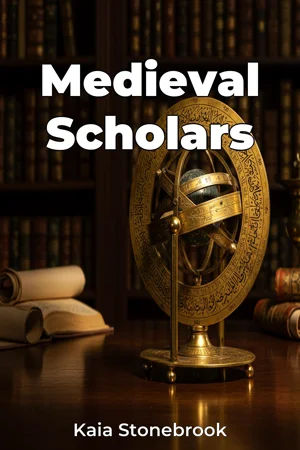
How did intellectual pursuits flourish during a period often mischaracterized as the "Dark Ages"? This book, *Medieval Scholars*, unveils the significant and often overlooked contributions of Middle Eastern scholars to the advancement of mathematics, astronomy, and medicine during the medieval period, and meticulously traces the profound impact these advancements had on the subsequent European Renaissance. These topics are vital as they challenge Eurocentric perspectives of scientific progress and underscore the interconnectedness of global intellectual history. Understanding the intellectual landscape of the medieval world requires acknowledging the historical context of the Islamic Golden Age, a period of remarkable cultural and scientific flourishing in the Middle East spanning roughly from the 8th to the 13th centuries. This era witnessed the translation and preservation of classical Greek texts, the development of sophisticated mathematical concepts like algebra, advancements in astronomical observation and instrumentation, and groundbreaking medical discoveries. The central argument of *Medieval Scholars* is that the intellectual achievements of Middle Eastern scholars were not merely a continuation of classical knowledge, but represented a significant leap forward that directly fueled the European Renaissance. We demonstrate that European scholars actively sought out and translated Arabic texts, incorporating this knowledge into their own scientific and intellectual pursuits. This exchange of ideas formed a critical foundation for the scientific revolution that reshaped the Western world. This book is structured to offer a comprehensive exploration of this pivotal period. First, we introduce the key figures and institutions that fostered intellectual growth in the Middle East. We then delve into specific advancements in mathematics, examining the development of algebra, trigonometry, and number theory, and their eventual transmission to Europe. Next, we explore the significant contributions to astronomy, including the creation of sophisticated observatories, the refinement of astronomical models, and the accurate measurement of celestial phenomena. The book then focuses on medical innovations, detailing advances in pharmacology, surgery, and the understanding of infectious diseases, and their subsequent influence on European medical practices. Finally, we culminate by tracing the pathways through which this knowledge was transmitted to Europe, highlighting the role of translation movements, trade routes, and intellectual exchange. The evidence presented in *Medieval Scholars* is drawn from a wide range of primary sources, including original Arabic manuscripts, translations of these texts into Latin and other European languages, and contemporary accounts of scientific and intellectual exchange. We supplement this with analysis of secondary scholarship from the fields of history, science, and Islamic studies. The book connects to several interdisciplinary areas, including the history of science, the history of medicine, and Islamic studies. These connections contribute to a more holistic understanding of the medieval world and the cross-cultural exchange of knowledge. *Medieval Scholars* offers a unique perspective by focusing specifically on the tangible contributions of Middle Eastern scholars and providing concrete examples of how their work influenced the development of European science and thought. We aim to move beyond general claims of influence by providing detailed analyses of specific scientific and medical concepts and their transmission across cultures. The tone and writing style will be accessible and engaging, while maintaining scholarly rigor. The book is aimed at a broad audience, including students, academics, and general readers interested in the history of science, the history of medicine, and the cultural history of the Middle East. It would be valuable to readers seeking a more nuanced and globally-aware perspective on the development of Western science. As a work of non-fiction, *Medieval Scholars* adheres to the genre's conventions of accuracy, objectivity, and thorough documentation. It provides detailed endnotes and a comprehensive bibliography to support its arguments and allow readers to explore the topics further. The scope of the book is limited to the medieval period and focuses primarily on the contributions of scholars in the Middle East and their influence on Europe. We acknowledge that other regions and cultures also made significant contributions to science and medicine during this period, but our focus is specifically on the Middle Eastern contribution. The information in this book has practical applications for understanding the interconnectedness of modern scientific and medical knowledge and appreciating the diverse cultural roots of scientific progress. Understanding the contributions of medieval Middle Eastern scholars allows us to appreciate the global nature of scientific advancement and challenge simplistic, Eurocentric narratives. While the influence of Middle Eastern scholars on the European Renaissance is widely acknowledged, there are ongoing debates about the extent of this influence and the specific mechanisms through which knowledge was transmitted. *Medieval Scholars* engages with these debates, presenting a balanced and nuanced perspective based on rigorous research and analysis.
How did intellectual pursuits flourish during a period often mischaracterized as the "Dark Ages"? This book, *Medieval Scholars*, unveils the significant and often overlooked contributions of Middle Eastern scholars to the advancement of mathematics, astronomy, and medicine during the medieval period, and meticulously traces the profound impact these advancements had on the subsequent European Renaissance. These topics are vital as they challenge Eurocentric perspectives of scientific progress and underscore the interconnectedness of global intellectual history. Understanding the intellectual landscape of the medieval world requires acknowledging the historical context of the Islamic Golden Age, a period of remarkable cultural and scientific flourishing in the Middle East spanning roughly from the 8th to the 13th centuries. This era witnessed the translation and preservation of classical Greek texts, the development of sophisticated mathematical concepts like algebra, advancements in astronomical observation and instrumentation, and groundbreaking medical discoveries. The central argument of *Medieval Scholars* is that the intellectual achievements of Middle Eastern scholars were not merely a continuation of classical knowledge, but represented a significant leap forward that directly fueled the European Renaissance. We demonstrate that European scholars actively sought out and translated Arabic texts, incorporating this knowledge into their own scientific and intellectual pursuits. This exchange of ideas formed a critical foundation for the scientific revolution that reshaped the Western world. This book is structured to offer a comprehensive exploration of this pivotal period. First, we introduce the key figures and institutions that fostered intellectual growth in the Middle East. We then delve into specific advancements in mathematics, examining the development of algebra, trigonometry, and number theory, and their eventual transmission to Europe. Next, we explore the significant contributions to astronomy, including the creation of sophisticated observatories, the refinement of astronomical models, and the accurate measurement of celestial phenomena. The book then focuses on medical innovations, detailing advances in pharmacology, surgery, and the understanding of infectious diseases, and their subsequent influence on European medical practices. Finally, we culminate by tracing the pathways through which this knowledge was transmitted to Europe, highlighting the role of translation movements, trade routes, and intellectual exchange. The evidence presented in *Medieval Scholars* is drawn from a wide range of primary sources, including original Arabic manuscripts, translations of these texts into Latin and other European languages, and contemporary accounts of scientific and intellectual exchange. We supplement this with analysis of secondary scholarship from the fields of history, science, and Islamic studies. The book connects to several interdisciplinary areas, including the history of science, the history of medicine, and Islamic studies. These connections contribute to a more holistic understanding of the medieval world and the cross-cultural exchange of knowledge. *Medieval Scholars* offers a unique perspective by focusing specifically on the tangible contributions of Middle Eastern scholars and providing concrete examples of how their work influenced the development of European science and thought. We aim to move beyond general claims of influence by providing detailed analyses of specific scientific and medical concepts and their transmission across cultures. The tone and writing style will be accessible and engaging, while maintaining scholarly rigor. The book is aimed at a broad audience, including students, academics, and general readers interested in the history of science, the history of medicine, and the cultural history of the Middle East. It would be valuable to readers seeking a more nuanced and globally-aware perspective on the development of Western science. As a work of non-fiction, *Medieval Scholars* adheres to the genre's conventions of accuracy, objectivity, and thorough documentation. It provides detailed endnotes and a comprehensive bibliography to support its arguments and allow readers to explore the topics further. The scope of the book is limited to the medieval period and focuses primarily on the contributions of scholars in the Middle East and their influence on Europe. We acknowledge that other regions and cultures also made significant contributions to science and medicine during this period, but our focus is specifically on the Middle Eastern contribution. The information in this book has practical applications for understanding the interconnectedness of modern scientific and medical knowledge and appreciating the diverse cultural roots of scientific progress. Understanding the contributions of medieval Middle Eastern scholars allows us to appreciate the global nature of scientific advancement and challenge simplistic, Eurocentric narratives. While the influence of Middle Eastern scholars on the European Renaissance is widely acknowledged, there are ongoing debates about the extent of this influence and the specific mechanisms through which knowledge was transmitted. *Medieval Scholars* engages with these debates, presenting a balanced and nuanced perspective based on rigorous research and analysis.
*Medieval Scholars* illuminates the often-underappreciated role of Middle Eastern scholars during the medieval period in shaping the course of scientific progress, challenging the traditional Eurocentric view of history. This book explores the profound advancements made during the Islamic Golden Age, particularly in mathematics, astronomy, and medicine, and how this intellectual powerhouse influenced the subsequent European Renaissance. Discover how scholars preserved and expanded upon classical Greek texts and developed sophisticated mathematical concepts like algebra, which were later transmitted to Europe, fueling advancements in various fields. The book meticulously traces the pathways through which this knowledge was disseminated, highlighting the crucial role of translation movements and cross-cultural exchange. For example, the establishment of sophisticated observatories allowed for precise astronomical measurements, contributing to a more accurate understanding of celestial phenomena. Furthermore, groundbreaking medical discoveries, such as advancements in pharmacology and surgery, had a lasting impact on European medical practices. Through detailed analyses of scientific and medical concepts, *Medieval Scholars* offers a unique perspective on the interconnectedness of intellectual history. The book progresses through chapters that first introduce key figures and institutions, then delve into specific advancements in mathematics, astronomy, and medicine, finally tracing the transmission of this knowledge to Europe. By focusing on tangible contributions and providing concrete examples, the book aims to foster a deeper appreciation for the diverse cultural roots of scientific progress and to challenge simplistic narratives.
Book Details
ISBN
9788235242396
Publisher
Publifye AS
Your Licenses
You don't own any licenses for this book
Purchase a license below to unlock this book and download the EPUB.
Purchase License
Select a tier to unlock this book
Need bulk licensing?
Contact us for enterprise agreements.