
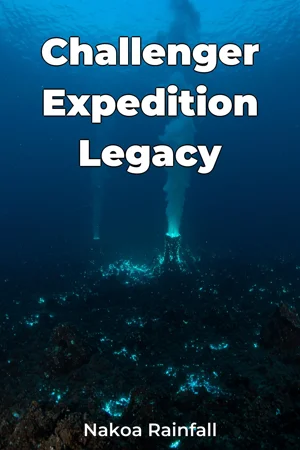
About This Book
What if the ocean's depths held secrets that could reshape our understanding of the planet? "Challenger Expedition Legacy" delves into the groundbreaking discoveries made during the HMS Challenger's voyage in the 1870s, a journey that laid the foundation for modern oceanography. This book explores three central themes: the expedition's methodologies in uncharted waters, the unexpected biodiversity revealed in the deep sea, and the lasting impact of the Challenger's findings on Earth sciences. These themes are important because they illuminate the birth of a scientific discipline and demonstrate how early explorations continue to influence our comprehension of the ocean's role in global processes. The 19th century saw growing interest in Earth's unexplored regions. The Challenger expedition, funded by the British government and the Royal Society, was a direct response to this curiosity. Readers will learn about the prevailing scientific theories of the time regarding the ocean's composition, depth, and the possibility of life below the sunlit zone. The central argument of "Challenger Expedition Legacy" is that the expedition was not merely an exploratory endeavor; it was a paradigm shift that redefined ocean science and provided a baseline for future research. By meticulously documenting its findings across diverse areas like marine biology, chemistry, and geology, the Challenger expedition established a new standard for comprehensive oceanographic study. The book unfolds in three parts. First, it introduces the context of the expedition, the ship and its crew, and the novel methodologies they employed to collect data in the deepest parts of the ocean. This includes details of sounding techniques to measure ocean depth, dredging to collect samples from the seafloor, and water sample analysis. Second, it examines the major biological discoveries, with dedicated chapters exploring the diverse range of organisms collected. This section also covers novel insights into the distribution of marine life, the existence of deep-sea fauna, and the fundamental understanding of the ocean's food web. Finally, the book investigates the expedition's geological findings, focusing on the composition of seafloor sediments, the formation of oceanic islands, and the discovery of manganese nodules. It culminates by illustrating how the Challenger's data were compiled into the 50-volume Challenger Reports and how these reports continue to be relevant to current oceanographic studies. The book draws heavily on primary sources, including the Challenger Reports themselves, the personal logs and diaries of expedition members, and contemporary scientific publications. It also integrates modern analyses of the Challenger's data, providing updated interpretations of the expedition's findings. This interdisciplinary approach connects oceanography with history and geography, showing how human exploration and scientific discovery are intertwined. The book is unique in its comprehensive analysis of the Challenger expedition's legacy, providing a balanced perspective on both its achievements and its limitations. Written in a clear and accessible style, "Challenger Expedition Legacy" is aimed at students, researchers, and anyone with an interest in Earth sciences and the history of scientific exploration. It is particularly relevant for those studying oceanography, marine biology, and environmental science. The book acknowledges the limitations of the Challenger's technology and the evolving nature of scientific knowledge. It also addresses early debates about the origin of life and the distribution of species, controversies that shaped early oceanographic thought. The knowledge gained during the Challenger expedition has practical applications in diverse fields such as climate modeling, resource management, and conservation efforts, making this book a valuable resource for understanding the historical roots of contemporary ocean science.
What if the ocean's depths held secrets that could reshape our understanding of the planet? "Challenger Expedition Legacy" delves into the groundbreaking discoveries made during the HMS Challenger's voyage in the 1870s, a journey that laid the foundation for modern oceanography. This book explores three central themes: the expedition's methodologies in uncharted waters, the unexpected biodiversity revealed in the deep sea, and the lasting impact of the Challenger's findings on Earth sciences. These themes are important because they illuminate the birth of a scientific discipline and demonstrate how early explorations continue to influence our comprehension of the ocean's role in global processes. The 19th century saw growing interest in Earth's unexplored regions. The Challenger expedition, funded by the British government and the Royal Society, was a direct response to this curiosity. Readers will learn about the prevailing scientific theories of the time regarding the ocean's composition, depth, and the possibility of life below the sunlit zone. The central argument of "Challenger Expedition Legacy" is that the expedition was not merely an exploratory endeavor; it was a paradigm shift that redefined ocean science and provided a baseline for future research. By meticulously documenting its findings across diverse areas like marine biology, chemistry, and geology, the Challenger expedition established a new standard for comprehensive oceanographic study. The book unfolds in three parts. First, it introduces the context of the expedition, the ship and its crew, and the novel methodologies they employed to collect data in the deepest parts of the ocean. This includes details of sounding techniques to measure ocean depth, dredging to collect samples from the seafloor, and water sample analysis. Second, it examines the major biological discoveries, with dedicated chapters exploring the diverse range of organisms collected. This section also covers novel insights into the distribution of marine life, the existence of deep-sea fauna, and the fundamental understanding of the ocean's food web. Finally, the book investigates the expedition's geological findings, focusing on the composition of seafloor sediments, the formation of oceanic islands, and the discovery of manganese nodules. It culminates by illustrating how the Challenger's data were compiled into the 50-volume Challenger Reports and how these reports continue to be relevant to current oceanographic studies. The book draws heavily on primary sources, including the Challenger Reports themselves, the personal logs and diaries of expedition members, and contemporary scientific publications. It also integrates modern analyses of the Challenger's data, providing updated interpretations of the expedition's findings. This interdisciplinary approach connects oceanography with history and geography, showing how human exploration and scientific discovery are intertwined. The book is unique in its comprehensive analysis of the Challenger expedition's legacy, providing a balanced perspective on both its achievements and its limitations. Written in a clear and accessible style, "Challenger Expedition Legacy" is aimed at students, researchers, and anyone with an interest in Earth sciences and the history of scientific exploration. It is particularly relevant for those studying oceanography, marine biology, and environmental science. The book acknowledges the limitations of the Challenger's technology and the evolving nature of scientific knowledge. It also addresses early debates about the origin of life and the distribution of species, controversies that shaped early oceanographic thought. The knowledge gained during the Challenger expedition has practical applications in diverse fields such as climate modeling, resource management, and conservation efforts, making this book a valuable resource for understanding the historical roots of contemporary ocean science.
"Challenger Expedition Legacy" explores the HMS Challenger's pivotal voyage in the 1870s, a journey that fundamentally shaped modern oceanography and Earth sciences. The book highlights the innovative methodologies used during the expedition, such as sounding techniques for measuring ocean depth, and showcases the astonishing biodiversity discovered in the deep sea, challenging previous assumptions about life below the sunlit zone. It emphasizes that the Challenger Expedition was more than just exploration; it marked a paradigm shift in understanding our oceans. The book unfolds across three distinct parts, starting with the historical context, the ship, and its crew. It then delves into the expedition's major biological discoveries, including the surprising range of marine life and insights into the ocean's food web. Finally, it examines the geological findings, such as the composition of seafloor sediments and the formation of oceanic islands. One intriguing aspect covered is the compilation of data into the extensive Challenger Reports, which remain relevant to ocean science today. This book uniquely connects oceanography with history and geography. It emphasizes the lasting impact of the Challenger Expedition on our understanding of the ocean's role in global processes. By drawing on primary sources and integrating modern analyses, "Challenger Expedition Legacy" provides a comprehensive and accessible account of this landmark scientific exploration for a broad audience.
Book Details
ISBN
9788235242310
Publisher
Publifye AS
Your Licenses
You don't own any licenses for this book
Purchase a license below to unlock this book and download the EPUB.
Purchase License
Select a tier to unlock this book
Need bulk licensing?
Contact us for enterprise agreements.