
About This Book
Have you ever wondered why casinos consistently profit despite players occasionally winning big? "Gambling Probability" delves into the science and economics underpinning casino games, providing a comprehensive understanding of how probability theory dictates outcomes, how the house edge ensures profitability, and how statistical analysis can inform betting strategies. This book explores the intricate relationship between mathematics, chance, and decision-making in the context of gambling. This book primarily covers three key topics. First, we explore the application of probability theory to various casino games, including dice games, card games, and roulette. Second, we offer a detailed explanation of the house edge – the inherent advantage casinos possess in each game – exploring its calculation and impact on long-term outcomes. Third, the book analyzes how statistical methods, such as expected value and variance, can be used to develop informed betting strategies that maximize potential gains and minimize risks. These topics are important because understanding these principles can empower individuals to make more rational and informed decisions when participating in gambling activities and can enhance the understanding of gambling from an economics point of view. To fully appreciate the concepts discussed, the book assumes a basic understanding of mathematics, including arithmetic, algebra, and introductory statistics. The historical context of gambling, from its ancient origins to its modern, regulated form, is also examined, offering insights into the societal impact and evolution of casino games. The central argument of "Gambling Probability" is that a thorough understanding of probability theory and statistical analysis provides players—and industry professionals—with a rational framework for evaluating risk and reward in casino games, even though, in the long run, the house edge ensures the casino's profitability. This argument is important because it demystifies the illusion of "luck" often associated with gambling, revealing the underlying mathematical principles at play. The book is structured to progressively build upon fundamental concepts. The initial chapters introduce basic probability concepts and their application to simple games of chance. Subsequent chapters delve into more complex games and the intricacies of the house edge. We will then explore the various ways in which statistics can be applied to risk management. Finally, the book culminates in a discussion of advanced betting strategies and their limitations, alongside the economic impact of casinos and the gambling industry. The arguments presented are supported by extensive research, including mathematical models, simulations of casino games, and analyses of real-world gambling data. Publicly available data from gaming commissions is also used to illustrate key concepts and validate theoretical findings. "Gambling Probability" establishes interdisciplinary connections by drawing upon insights from economics, psychology, and mathematics. Economics provides a framework for understanding the market dynamics of the gambling industry. Psychology explores the cognitive biases that influence betting behavior. Mathematics provides the tools for quantifying risk and reward. These interdisciplinary connections enrich the book's analysis, providing a more holistic understanding of gambling. This book offers a unique approach by focusing on the practical application of probability to real-world casino games. It emphasizes clarity, precision, and accessibility, making complex concepts understandable to a wide audience. The tone is professional but accessible, avoiding jargon and using clear explanations to convey technical information. The target audience includes casino enthusiasts, students of mathematics and economics, and anyone interested in understanding the science behind gambling. The book's value lies in its ability to empower readers with the knowledge to make informed decisions and critically evaluate the risks and rewards associated with casino games. As a work of scientific and economic analysis, "Gambling Probability" adheres to the conventions of non-fiction writing, emphasizing accuracy, objectivity, and evidence-based reasoning. The book's scope is limited to the mathematical and statistical aspects of casino gambling, intentionally excluding discussions of specific gambling addictions or ethical considerations related to gambling. The information in this book can be applied in various real-world scenarios, from understanding the odds of winning at a particular game to developing effective betting strategies and managing personal gambling budgets. While the principles discussed can be used to inform betting decisions, the book emphasizes that the house edge ultimately favors the casino in the long term. “Gambling Probability” addresses ongoing debates surrounding the effectiveness of various betting systems and the potential for exploiting biases in casino games. While some systems may offer short-term advantages, the book clarifies that no system can consistently overcome the house edge in the long run.
Have you ever wondered why casinos consistently profit despite players occasionally winning big? "Gambling Probability" delves into the science and economics underpinning casino games, providing a comprehensive understanding of how probability theory dictates outcomes, how the house edge ensures profitability, and how statistical analysis can inform betting strategies. This book explores the intricate relationship between mathematics, chance, and decision-making in the context of gambling. This book primarily covers three key topics. First, we explore the application of probability theory to various casino games, including dice games, card games, and roulette. Second, we offer a detailed explanation of the house edge – the inherent advantage casinos possess in each game – exploring its calculation and impact on long-term outcomes. Third, the book analyzes how statistical methods, such as expected value and variance, can be used to develop informed betting strategies that maximize potential gains and minimize risks. These topics are important because understanding these principles can empower individuals to make more rational and informed decisions when participating in gambling activities and can enhance the understanding of gambling from an economics point of view. To fully appreciate the concepts discussed, the book assumes a basic understanding of mathematics, including arithmetic, algebra, and introductory statistics. The historical context of gambling, from its ancient origins to its modern, regulated form, is also examined, offering insights into the societal impact and evolution of casino games. The central argument of "Gambling Probability" is that a thorough understanding of probability theory and statistical analysis provides players—and industry professionals—with a rational framework for evaluating risk and reward in casino games, even though, in the long run, the house edge ensures the casino's profitability. This argument is important because it demystifies the illusion of "luck" often associated with gambling, revealing the underlying mathematical principles at play. The book is structured to progressively build upon fundamental concepts. The initial chapters introduce basic probability concepts and their application to simple games of chance. Subsequent chapters delve into more complex games and the intricacies of the house edge. We will then explore the various ways in which statistics can be applied to risk management. Finally, the book culminates in a discussion of advanced betting strategies and their limitations, alongside the economic impact of casinos and the gambling industry. The arguments presented are supported by extensive research, including mathematical models, simulations of casino games, and analyses of real-world gambling data. Publicly available data from gaming commissions is also used to illustrate key concepts and validate theoretical findings. "Gambling Probability" establishes interdisciplinary connections by drawing upon insights from economics, psychology, and mathematics. Economics provides a framework for understanding the market dynamics of the gambling industry. Psychology explores the cognitive biases that influence betting behavior. Mathematics provides the tools for quantifying risk and reward. These interdisciplinary connections enrich the book's analysis, providing a more holistic understanding of gambling. This book offers a unique approach by focusing on the practical application of probability to real-world casino games. It emphasizes clarity, precision, and accessibility, making complex concepts understandable to a wide audience. The tone is professional but accessible, avoiding jargon and using clear explanations to convey technical information. The target audience includes casino enthusiasts, students of mathematics and economics, and anyone interested in understanding the science behind gambling. The book's value lies in its ability to empower readers with the knowledge to make informed decisions and critically evaluate the risks and rewards associated with casino games. As a work of scientific and economic analysis, "Gambling Probability" adheres to the conventions of non-fiction writing, emphasizing accuracy, objectivity, and evidence-based reasoning. The book's scope is limited to the mathematical and statistical aspects of casino gambling, intentionally excluding discussions of specific gambling addictions or ethical considerations related to gambling. The information in this book can be applied in various real-world scenarios, from understanding the odds of winning at a particular game to developing effective betting strategies and managing personal gambling budgets. While the principles discussed can be used to inform betting decisions, the book emphasizes that the house edge ultimately favors the casino in the long term. “Gambling Probability” addresses ongoing debates surrounding the effectiveness of various betting systems and the potential for exploiting biases in casino games. While some systems may offer short-term advantages, the book clarifies that no system can consistently overcome the house edge in the long run.
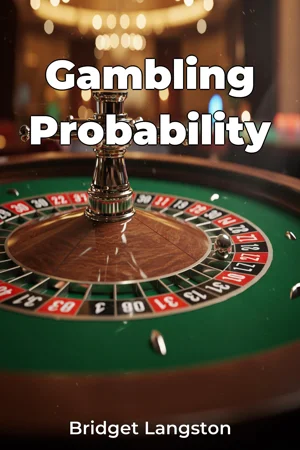
"Gambling Probability" explores the intersection of science and economics in casino games, revealing how probability theory governs outcomes and the house edge ensures casino profitability. It highlights the application of statistical analysis to betting strategies, offering insights into risk management. One intriguing fact is how the house edge, though seemingly small, guarantees long-term gains for casinos. Another is that understanding expected value and variance can empower players to make more informed decisions, even if it cannot overcome the house advantage. This book progresses logically, starting with basic probability concepts and their applications to simple games. It then delves into the complexities of the house edge in various casino games like dice, cards, and roulette. The book advances into statistical methods for risk management and concludes with advanced betting strategies and the economic impact of the gambling industry. The approach emphasizes clarity and precision, using mathematical models and real-world data to make complex concepts accessible.
Book Details
ISBN
9788235241801
Publisher
Publifye AS
Your Licenses
You don't own any licenses for this book
Purchase a license below to unlock this book and download the EPUB.
Purchase License
Select a tier to unlock this book
Need bulk licensing?
Contact us for enterprise agreements.