
About This Book
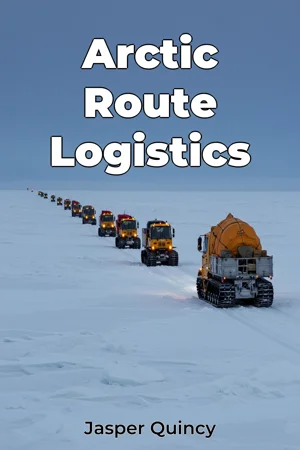
How do expeditions overcome the seemingly insurmountable challenges of traversing the Arctic, where survival hinges on precise logistical planning and execution? 'Arctic Route Logistics' delves into the crucial aspects of transport, safety protocols, and fuel management that underpin successful Arctic expeditions, revealing the complex interplay between human ingenuity and the unforgiving environment. This book is vital for understanding how to navigate and operate safely in one of the planet’s most demanding regions. The book focuses on three key areas: transportation strategies, safety management, and fuel logistics, all of which are intrinsically linked in the Arctic context. Transportation covers the various modes used to navigate the challenging Arctic terrains, including specialized vehicles, air support, and traditional methods like dog sleds. Safety management encompasses the protocols and technologies used to mitigate risks associated with extreme cold, whiteout conditions, and remote locations. Fuel logistics examines the strategies for transporting, storing, and managing fuel supplies across vast distances, which is critical for sustaining operations and ensuring survival. 'Arctic Route Logistics' draws on historical expeditions, contemporary scientific research, and practical field experience to present a comprehensive understanding of Arctic operations. It moves beyond anecdotal accounts to provide a fact-based guide to the logistical challenges and solutions in this region. The central argument of the book is that effective logistical planning, prioritizing safety and sustainable practices, is not only essential for the success of Arctic expeditions but also for minimizing environmental impact. The book begins by setting the historical stage, outlining the evolution of Arctic exploration and the lessons learned. Then it explains the critical factors of the Arctic environment, including weather patterns, ice conditions, and terrain characteristics. The core of the book is divided into three sections aligned with its main topics. Transportation strategies dissect the pros and cons of different transport methods, along with case studies of their successful deployment. Safety management addresses risk assessment, emergency response protocols, and the use of technologies like satellite communication and GPS navigation. Fuel logistics discusses supply chain management, fuel storage solutions adapted to the Arctic climate, and strategies for reducing fuel consumption. The book culminates with a discussion on the future of Arctic logistics, exploring emerging technologies and sustainable practices to minimize the environmental footprint and improve the safety and efficiency of future expeditions. The book relies on a combination of primary and secondary research, including expedition reports, scientific data, and interviews with experienced Arctic explorers and logistics personnel. It incorporates data from environmental monitoring agencies and climate research institutions to provide an accurate picture of the Arctic environment. 'Arctic Route Logistics' is inherently interdisciplinary, drawing from earth sciences, geography, and engineering. It intersects with climatology by considering the impacts of climate change on Arctic routes and logistics. Furthermore, it connects with engineering through discussions of specialized equipment and infrastructure designed to withstand Arctic conditions. The book also has links to environmental science, examining the impact of human activities on the fragile Arctic ecosystem and promoting sustainable practices. This book provides a practical, evidence-based approach to Arctic logistics, avoiding romanticized notions of exploration and presenting a realistic view of the challenges and opportunities. It uses clear, concise language and incorporates visual aids to facilitate understanding. The primary audience includes students and researchers in earth sciences and geography, logistics professionals, and adventure travelers considering Arctic expeditions. It is also relevant to policymakers and organizations involved in Arctic resource management and conservation. As a non-fiction text in earth sciences and geography, 'Arctic Route Logistics' adheres to standards of accuracy, objectivity, and thorough research. It provides a comprehensive overview of the subject, acknowledging limitations in the available data and the evolving nature of the Arctic environment. The scope of the book is limited to the logistical aspects of Arctic expeditions, focusing on transport, safety, and fuel management. It does not delve into the scientific research conducted during these expeditions, although it acknowledges the importance of scientific data in informing logistical decisions. 'Arctic Route Logistics' provides practical guidance for planning and executing Arctic expeditions, improving safety protocols, and minimizing environmental impact. It also offers insights into the logistical challenges of operating in other extreme environments. The book also addresses the ongoing debates regarding resource extraction and tourism in the Arctic, highlighting the importance of sustainable practices and responsible logistical planning to minimize the negative impacts of these activities.
How do expeditions overcome the seemingly insurmountable challenges of traversing the Arctic, where survival hinges on precise logistical planning and execution? 'Arctic Route Logistics' delves into the crucial aspects of transport, safety protocols, and fuel management that underpin successful Arctic expeditions, revealing the complex interplay between human ingenuity and the unforgiving environment. This book is vital for understanding how to navigate and operate safely in one of the planet’s most demanding regions. The book focuses on three key areas: transportation strategies, safety management, and fuel logistics, all of which are intrinsically linked in the Arctic context. Transportation covers the various modes used to navigate the challenging Arctic terrains, including specialized vehicles, air support, and traditional methods like dog sleds. Safety management encompasses the protocols and technologies used to mitigate risks associated with extreme cold, whiteout conditions, and remote locations. Fuel logistics examines the strategies for transporting, storing, and managing fuel supplies across vast distances, which is critical for sustaining operations and ensuring survival. 'Arctic Route Logistics' draws on historical expeditions, contemporary scientific research, and practical field experience to present a comprehensive understanding of Arctic operations. It moves beyond anecdotal accounts to provide a fact-based guide to the logistical challenges and solutions in this region. The central argument of the book is that effective logistical planning, prioritizing safety and sustainable practices, is not only essential for the success of Arctic expeditions but also for minimizing environmental impact. The book begins by setting the historical stage, outlining the evolution of Arctic exploration and the lessons learned. Then it explains the critical factors of the Arctic environment, including weather patterns, ice conditions, and terrain characteristics. The core of the book is divided into three sections aligned with its main topics. Transportation strategies dissect the pros and cons of different transport methods, along with case studies of their successful deployment. Safety management addresses risk assessment, emergency response protocols, and the use of technologies like satellite communication and GPS navigation. Fuel logistics discusses supply chain management, fuel storage solutions adapted to the Arctic climate, and strategies for reducing fuel consumption. The book culminates with a discussion on the future of Arctic logistics, exploring emerging technologies and sustainable practices to minimize the environmental footprint and improve the safety and efficiency of future expeditions. The book relies on a combination of primary and secondary research, including expedition reports, scientific data, and interviews with experienced Arctic explorers and logistics personnel. It incorporates data from environmental monitoring agencies and climate research institutions to provide an accurate picture of the Arctic environment. 'Arctic Route Logistics' is inherently interdisciplinary, drawing from earth sciences, geography, and engineering. It intersects with climatology by considering the impacts of climate change on Arctic routes and logistics. Furthermore, it connects with engineering through discussions of specialized equipment and infrastructure designed to withstand Arctic conditions. The book also has links to environmental science, examining the impact of human activities on the fragile Arctic ecosystem and promoting sustainable practices. This book provides a practical, evidence-based approach to Arctic logistics, avoiding romanticized notions of exploration and presenting a realistic view of the challenges and opportunities. It uses clear, concise language and incorporates visual aids to facilitate understanding. The primary audience includes students and researchers in earth sciences and geography, logistics professionals, and adventure travelers considering Arctic expeditions. It is also relevant to policymakers and organizations involved in Arctic resource management and conservation. As a non-fiction text in earth sciences and geography, 'Arctic Route Logistics' adheres to standards of accuracy, objectivity, and thorough research. It provides a comprehensive overview of the subject, acknowledging limitations in the available data and the evolving nature of the Arctic environment. The scope of the book is limited to the logistical aspects of Arctic expeditions, focusing on transport, safety, and fuel management. It does not delve into the scientific research conducted during these expeditions, although it acknowledges the importance of scientific data in informing logistical decisions. 'Arctic Route Logistics' provides practical guidance for planning and executing Arctic expeditions, improving safety protocols, and minimizing environmental impact. It also offers insights into the logistical challenges of operating in other extreme environments. The book also addresses the ongoing debates regarding resource extraction and tourism in the Arctic, highlighting the importance of sustainable practices and responsible logistical planning to minimize the negative impacts of these activities.
"Arctic Route Logistics" explores the complex world of Arctic expeditions, focusing on the critical logistics that enable safe and successful journeys across this challenging terrain. It highlights the intricate balance between human innovation and the harsh realities of the Arctic environment, where even minor miscalculations can have severe consequences. The book delves into transportation strategies, examining the use of specialized vehicles and even traditional methods like dog sleds, while also covering the safety management protocols necessary to mitigate risks like extreme cold and whiteout conditions. A key insight is the vital role of fuel logistics, showcasing how the careful planning, storage, and management of fuel supplies are essential for sustaining operations across vast distances. The book argues that prioritizing safety and sustainable practices through effective logistical planning is essential for successful Arctic expeditions and for minimizing environmental impact. It progresses by first outlining the history of Arctic exploration and the environment's critical factors, followed by in-depth sections on transportation, safety, and fuel. Case studies demonstrate the deployment of different transport methods, while risk assessment and emergency response protocols are also addressed. Ultimately, "Arctic Route Logistics" provides a fact-based guide to navigating the logistical challenges of the Arctic. By drawing on historical expeditions, scientific research, and practical field experience, it offers valuable insights for students, researchers, logistics professionals, and adventure travelers alike, ensuring a greater understanding of how to operate responsibly in this unique and demanding region.
Book Details
ISBN
9788235240965
Publisher
Publifye AS
Your Licenses
You don't own any licenses for this book
Purchase a license below to unlock this book and download the EPUB.
Purchase License
Select a tier to unlock this book
Need bulk licensing?
Contact us for enterprise agreements.