
About This Book
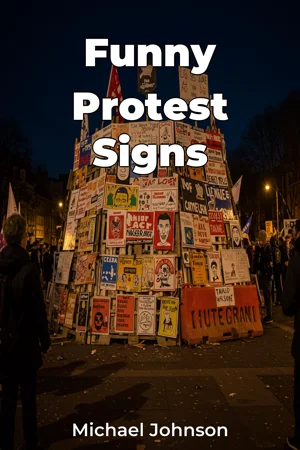
Have you ever wondered how a simple cardboard sign can encapsulate a complex political issue and simultaneously make people laugh? "Funny Protest Signs" delves into the world of witty, sarcastic, and often hilarious expressions of dissent, examining how humor becomes a powerful tool for social and political commentary. This book explores the intersection of politics, humor, and social movements, revealing the underlying mechanisms that allow protest signs to effectively deliver messages while captivating the public's attention. This exploration is important because it sheds light on the ways creative expression can shape public discourse and influence social change. It is relevant because the use of humor in political activism is a widespread phenomenon, and understanding its function can provide insights into the dynamics of social movements and the psychology of persuasion. Understanding the context of protest signs requires acknowledging the history of social movements and the role of visual communication in these movements. From the suffragettes to the Civil Rights era and contemporary demonstrations, signs have served as a crucial medium for expressing grievances and demands. The book builds upon existing literature in political science and social psychology, particularly studies on framing, agenda-setting, and the impact of emotions on political attitudes. The central argument of "Funny Protest Signs" is that humor can circumvent traditional barriers to communication, making political messages more accessible, memorable, and persuasive. By using wit and sarcasm, protesters can challenge authority, disrupt the status quo, and engage a wider audience in critical conversations. The book begins by introducing the concept of humor as a rhetorical device in political communication. It examines the different types of humor employed in protest signs, such as irony, satire, parody, and puns, analyzing their effects on viewers. The book then develops its argument through three major sections. First, it explores the psychological mechanisms through which humor influences attitudes and behaviors, including the role of cognitive processing, emotional arousal, and social identification. Second, it examines the strategic use of humor in different protest contexts, analyzing how protesters tailor their messages to specific audiences and political goals. Third, it analyzes the cultural and social factors that shape the interpretation and impact of funny protest signs, considering issues of identity, power, and social norms. The book culminates in a discussion of the ethical implications of using humor in protest and its potential for both positive and negative social consequences. The book draws on a diverse range of evidence, including a collection of photographs and descriptions of protest signs from various social movements around the world. It also incorporates insights from content analysis, survey research, and case studies of specific protest events. The unique data source is a curated collection of hundreds of protest sign images, categorized and analyzed for their humor type, political message, and target audience. "Funny Protest Signs" connects to several other fields, including sociology (through its analysis of social movements and collective action), communication studies (through its examination of rhetoric and persuasion), and psychology (through its exploration of cognitive and emotional processes). These interdisciplinary connections enrich the book's argument by providing a more comprehensive understanding of the complex dynamics at play. This book stands out due to its interdisciplinary approach, combining theories and methods from political science, psychology, and communication studies to provide a nuanced analysis of the phenomenon of funny protest signs. It utilizes humor theory, such as the benign-violation theory, to illustrate why certain signs are funny and effective. The tone is accessible, aiming to reach a broad audience interested in politics, humor, and social issues. The writing style is engaging and informative, blending scholarly analysis with real-world examples and anecdotes. The target audience includes students and scholars in political science, sociology, communication studies, and psychology, as well as anyone interested in social movements, political activism, and the power of humor. The book would be valuable to them as it provides a novel perspective on the role of humor in shaping public discourse and influencing social change. As a work in the 'Politics, Social Science General' genres, the book adheres to standards of academic rigor, providing evidence-based arguments and citing relevant scholarly sources. The scope of the book is broad, covering a wide range of social and political issues and movements across different historical periods and geographical locations. However, the book is limited to the analysis of visual protest signs, excluding other forms of humorous political expression. The information in the book can be applied to real-world situations by those engaging in political activism by employing effective humorous communication. For example, aspiring activists can learn how to craft messages that are both funny and persuasive, increasing their chances of engaging a wider audience and influencing public opinion. The use of humor in protest is not without its controversies. Some argue that humor can trivialize serious issues or alienate certain groups. The book addresses these concerns by critically examining the ethical implications of using humor in political communication and exploring the potential for both positive and negative social consequences.
Have you ever wondered how a simple cardboard sign can encapsulate a complex political issue and simultaneously make people laugh? "Funny Protest Signs" delves into the world of witty, sarcastic, and often hilarious expressions of dissent, examining how humor becomes a powerful tool for social and political commentary. This book explores the intersection of politics, humor, and social movements, revealing the underlying mechanisms that allow protest signs to effectively deliver messages while captivating the public's attention. This exploration is important because it sheds light on the ways creative expression can shape public discourse and influence social change. It is relevant because the use of humor in political activism is a widespread phenomenon, and understanding its function can provide insights into the dynamics of social movements and the psychology of persuasion. Understanding the context of protest signs requires acknowledging the history of social movements and the role of visual communication in these movements. From the suffragettes to the Civil Rights era and contemporary demonstrations, signs have served as a crucial medium for expressing grievances and demands. The book builds upon existing literature in political science and social psychology, particularly studies on framing, agenda-setting, and the impact of emotions on political attitudes. The central argument of "Funny Protest Signs" is that humor can circumvent traditional barriers to communication, making political messages more accessible, memorable, and persuasive. By using wit and sarcasm, protesters can challenge authority, disrupt the status quo, and engage a wider audience in critical conversations. The book begins by introducing the concept of humor as a rhetorical device in political communication. It examines the different types of humor employed in protest signs, such as irony, satire, parody, and puns, analyzing their effects on viewers. The book then develops its argument through three major sections. First, it explores the psychological mechanisms through which humor influences attitudes and behaviors, including the role of cognitive processing, emotional arousal, and social identification. Second, it examines the strategic use of humor in different protest contexts, analyzing how protesters tailor their messages to specific audiences and political goals. Third, it analyzes the cultural and social factors that shape the interpretation and impact of funny protest signs, considering issues of identity, power, and social norms. The book culminates in a discussion of the ethical implications of using humor in protest and its potential for both positive and negative social consequences. The book draws on a diverse range of evidence, including a collection of photographs and descriptions of protest signs from various social movements around the world. It also incorporates insights from content analysis, survey research, and case studies of specific protest events. The unique data source is a curated collection of hundreds of protest sign images, categorized and analyzed for their humor type, political message, and target audience. "Funny Protest Signs" connects to several other fields, including sociology (through its analysis of social movements and collective action), communication studies (through its examination of rhetoric and persuasion), and psychology (through its exploration of cognitive and emotional processes). These interdisciplinary connections enrich the book's argument by providing a more comprehensive understanding of the complex dynamics at play. This book stands out due to its interdisciplinary approach, combining theories and methods from political science, psychology, and communication studies to provide a nuanced analysis of the phenomenon of funny protest signs. It utilizes humor theory, such as the benign-violation theory, to illustrate why certain signs are funny and effective. The tone is accessible, aiming to reach a broad audience interested in politics, humor, and social issues. The writing style is engaging and informative, blending scholarly analysis with real-world examples and anecdotes. The target audience includes students and scholars in political science, sociology, communication studies, and psychology, as well as anyone interested in social movements, political activism, and the power of humor. The book would be valuable to them as it provides a novel perspective on the role of humor in shaping public discourse and influencing social change. As a work in the 'Politics, Social Science General' genres, the book adheres to standards of academic rigor, providing evidence-based arguments and citing relevant scholarly sources. The scope of the book is broad, covering a wide range of social and political issues and movements across different historical periods and geographical locations. However, the book is limited to the analysis of visual protest signs, excluding other forms of humorous political expression. The information in the book can be applied to real-world situations by those engaging in political activism by employing effective humorous communication. For example, aspiring activists can learn how to craft messages that are both funny and persuasive, increasing their chances of engaging a wider audience and influencing public opinion. The use of humor in protest is not without its controversies. Some argue that humor can trivialize serious issues or alienate certain groups. The book addresses these concerns by critically examining the ethical implications of using humor in political communication and exploring the potential for both positive and negative social consequences.
"Funny Protest Signs" explores the intriguing intersection of political activism and humor, revealing how wit and sarcasm can become potent tools for social commentary. The book argues that humor circumvents traditional communication barriers, making political messages more accessible and memorable. For instance, a clever pun on a protest sign can capture public attention more effectively than a straightforward slogan. This social science investigation begins by examining types of humor used in protest signs, like irony and satire. It then analyzes the psychological effects of humor on attitudes and behaviors, considering cognitive processing and emotional responses. The book also delves into the strategic use of humor in different protest contexts, tailoring messages for specific audiences. Finally, it addresses cultural and social factors influencing the interpretation of these signs, culminating in a discussion of the ethical implications of using humor in protest. The book uses a curated collection of protest sign images to support its arguments.
Book Details
ISBN
9788235240613
Publisher
Publifye AS
Your Licenses
You don't own any licenses for this book
Purchase a license below to unlock this book and download the EPUB.
Purchase License
Select a tier to unlock this book
Need bulk licensing?
Contact us for enterprise agreements.