
About This Book
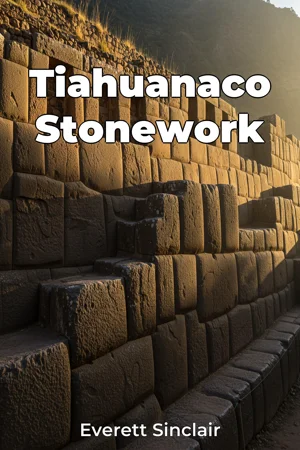
How did a pre-Columbian civilization, without access to iron tools or the wheel, manage to construct monumental structures from precisely cut andesite blocks, some weighing several tons? This book, "Tiahuanaco Stonework," delves into the sophisticated stone-cutting techniques employed by the builders of Tiahuanaco, a significant archaeological site located near Lake Titicaca in modern-day Bolivia. We will explore the processes involved in quarrying, shaping, transporting, and assembling these massive stones, revealing a mastery of engineering and craftsmanship that challenges conventional understanding of ancient Andean technology. The central argument presented is that the Tiahuanaco stonemasons possessed a deep understanding of the properties of stone and employed a combination of ingenious techniques, including precise hammering, abrasion, and potentially water-based methods, to achieve their remarkable architectural feats. This understanding was not merely practical but also embedded within a cultural and cosmological framework that imbued these structures with symbolic significance. Understanding their methods provides insight into the organizational capabilities and intellectual achievements of the Tiahuanaco society. This book is structured to provide a comprehensive analysis of Tiahuanaco stonework. First, the historical and environmental context of Tiahuanaco is established, outlining the rise and decline of this influential civilization and describing the geological resources available to its builders. We then move on to detailed examinations of specific architectural features at Tiahuanaco, such as the Kalasasaya, Akapana, and Puma Punku complexes. Chapters are dedicated to identifying the types of stone used, the sources of these materials, and the tools and techniques likely employed in quarrying and shaping them. The book will also examine the theories surrounding the transportation of these blocks, which weighed in at many tons. The evidence presented is based on extensive archaeological research, including direct examination of the stonework at Tiahuanaco, analysis of tool marks, and comparison with experimental archaeology. We incorporate insights from ethnohistorical accounts and geological studies to provide a holistic understanding of the construction processes. This study also connects to other fields, such as geology, engineering, and anthropology. Geological analysis helps identify the quarries and source the stone used. Engineering principles help us understand the physics involved in moving and placing massive blocks. Anthropological perspectives illuminate the social organization and belief systems that motivated and sustained the construction of these monumental structures. This book distinguishes itself by offering a detailed and accessible analysis of Tiahuanaco stonework, moving beyond speculation to provide evidence-based explanations for the observed techniques. The aim is to provide a rigorous yet engaging account suitable for scholars, students, and anyone with an interest in archaeology, ancient technology, or the history of the Andes. While the book focuses specifically on the stonework of Tiahuanaco, it also acknowledges the limitations of current knowledge. The exact methods used for some aspects of construction remain debated, and the book will outline areas for future research. The primary goal is to present the current state of knowledge about Tiahuanaco stonework, acknowledging both what is known and what remains a mystery. While focusing on the stonework, the book touches upon the broader implications for understanding Tiahuanaco society, its relationship to other Andean cultures, and the challenges it presents to conventional theories of technological development. The information presented in this book has real-world applications for understanding ancient technologies and preserving cultural heritage. By understanding the techniques used by the Tiahuanaco builders, we can gain insights into sustainable building practices and develop new approaches to conserving and restoring ancient monuments.
How did a pre-Columbian civilization, without access to iron tools or the wheel, manage to construct monumental structures from precisely cut andesite blocks, some weighing several tons? This book, "Tiahuanaco Stonework," delves into the sophisticated stone-cutting techniques employed by the builders of Tiahuanaco, a significant archaeological site located near Lake Titicaca in modern-day Bolivia. We will explore the processes involved in quarrying, shaping, transporting, and assembling these massive stones, revealing a mastery of engineering and craftsmanship that challenges conventional understanding of ancient Andean technology. The central argument presented is that the Tiahuanaco stonemasons possessed a deep understanding of the properties of stone and employed a combination of ingenious techniques, including precise hammering, abrasion, and potentially water-based methods, to achieve their remarkable architectural feats. This understanding was not merely practical but also embedded within a cultural and cosmological framework that imbued these structures with symbolic significance. Understanding their methods provides insight into the organizational capabilities and intellectual achievements of the Tiahuanaco society. This book is structured to provide a comprehensive analysis of Tiahuanaco stonework. First, the historical and environmental context of Tiahuanaco is established, outlining the rise and decline of this influential civilization and describing the geological resources available to its builders. We then move on to detailed examinations of specific architectural features at Tiahuanaco, such as the Kalasasaya, Akapana, and Puma Punku complexes. Chapters are dedicated to identifying the types of stone used, the sources of these materials, and the tools and techniques likely employed in quarrying and shaping them. The book will also examine the theories surrounding the transportation of these blocks, which weighed in at many tons. The evidence presented is based on extensive archaeological research, including direct examination of the stonework at Tiahuanaco, analysis of tool marks, and comparison with experimental archaeology. We incorporate insights from ethnohistorical accounts and geological studies to provide a holistic understanding of the construction processes. This study also connects to other fields, such as geology, engineering, and anthropology. Geological analysis helps identify the quarries and source the stone used. Engineering principles help us understand the physics involved in moving and placing massive blocks. Anthropological perspectives illuminate the social organization and belief systems that motivated and sustained the construction of these monumental structures. This book distinguishes itself by offering a detailed and accessible analysis of Tiahuanaco stonework, moving beyond speculation to provide evidence-based explanations for the observed techniques. The aim is to provide a rigorous yet engaging account suitable for scholars, students, and anyone with an interest in archaeology, ancient technology, or the history of the Andes. While the book focuses specifically on the stonework of Tiahuanaco, it also acknowledges the limitations of current knowledge. The exact methods used for some aspects of construction remain debated, and the book will outline areas for future research. The primary goal is to present the current state of knowledge about Tiahuanaco stonework, acknowledging both what is known and what remains a mystery. While focusing on the stonework, the book touches upon the broader implications for understanding Tiahuanaco society, its relationship to other Andean cultures, and the challenges it presents to conventional theories of technological development. The information presented in this book has real-world applications for understanding ancient technologies and preserving cultural heritage. By understanding the techniques used by the Tiahuanaco builders, we can gain insights into sustainable building practices and develop new approaches to conserving and restoring ancient monuments.
"Tiahuanaco Stonework" explores the remarkable feats of engineering achieved by the pre-Columbian civilization of Tiahuanaco, near Lake Titicaca in Bolivia. This book investigates how, without iron tools or the wheel, they constructed massive monumental structures using precisely cut stones. It delves into the ancient engineering and stone-cutting techniques that enabled them to shape, transport, and assemble andesite blocks weighing several tons. The study highlights the ingenuity required to build complexes like Kalasasaya, Akapana, and Puma Punku, revealing their profound understanding of stone properties. The book argues that Tiahuanaco stonemasons possessed advanced knowledge, combining hammering, abrasion, and possibly water-based methods. It examines archaeological evidence, including tool marks, geological studies, and ethnohistorical accounts, to provide a holistic understanding of their construction processes. Each chapter builds upon the previous, starting with historical context, then moving to specific architectural features, and finally discussing the tools, transportation methods, and techniques. This book is unique in its detailed, evidence-based analysis, making it valuable for anyone interested in archaeology, ancient Andean technology, or the history of the Andes.
Book Details
ISBN
9788235240576
Publisher
Publifye AS
Your Licenses
You don't own any licenses for this book
Purchase a license below to unlock this book and download the EPUB.
Purchase License
Select a tier to unlock this book
Need bulk licensing?
Contact us for enterprise agreements.