
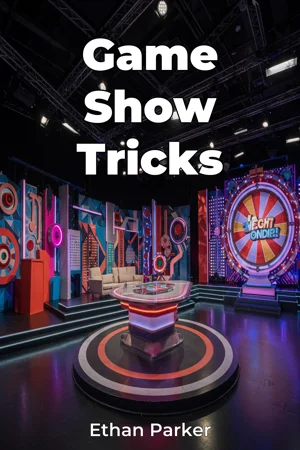
About This Book
Have you ever wondered what truly goes on behind the scenes of your favorite game shows? "Game Show Tricks" delves into the meticulously crafted world of competitive entertainment, explaining the design principles, casting processes, and psychological strategies that shape the viewing experience and influence contestant behavior. This book explores three central topics: the architecture of game show formats, the science of contestant selection, and the manipulation of psychological levers that producers use to maximize audience engagement. These elements are crucial to understand because they reveal the calculated nature of what appears to be spontaneous fun, and they highlight the subtle ways in which our perceptions and emotions can be influenced through media. To understand the modern game show, it is necessary to consider its historical roots in vaudeville and early radio programming, alongside the evolution of television as a mass medium. Basic familiarity with psychological concepts like behavioral economics and cognitive biases will enhance the reader's understanding, but these will be explained where relevant. The central argument of "Game Show Tricks" is that game shows are not simply innocent diversions but sophisticated systems designed to elicit specific emotional responses and behaviors from both contestants and viewers. Understanding this underlying structure allows for a more critical and informed engagement with these popular forms of entertainment. The book begins by introducing the foundational elements of game show design, including the selection of games, the structure of rounds, and the use of set design and music to build tension and excitement. It then moves into a detailed examination of contestant selection, revealing the criteria used to identify individuals who are not only knowledgeable but also charismatic and emotionally expressive. Finally, it explores the psychological techniques employed by producers, such as framing effects, social pressure, and the strategic use of uncertainty, to keep viewers hooked and contestants motivated. The evidence presented in "Game Show Tricks" draws from a variety of sources, including analysis of game show episodes, interviews with industry professionals, and research from the fields of psychology, media studies, and game theory. Unique data sources include internal production manuals and behind-the-scenes footage, providing an inside look at the decision-making processes that shape these programs. This book connects to several other fields of study. Firstly, marketing and advertising since they both rely on similar psychological techniques to influence consumer behavior. Secondly, sociology, especially in its analysis of how game shows reflect and reinforce societal values and norms. Finally, economics due to the examination of risk-reward scenarios presented to contestants. "Game Show Tricks" offers a unique perspective by combining theoretical analysis with practical insights from industry insiders. It moves beyond the typical fan-oriented approach to provide a critical examination of the mechanics and motivations behind game show production and design. The tone of the book is informative and analytical, presenting information in a clear and accessible manner while avoiding overly academic jargon. The writing style aims to be engaging and thought-provoking, encouraging readers to question their assumptions about the nature of entertainment. The target audience includes media studies students, psychology enthusiasts, television industry professionals, and anyone curious about the inner workings of popular entertainment. This book would be valuable to them because it provides a deeper understanding of the psychological and strategic elements that shape the viewing experience. As a work of non-fiction, "Game Show Tricks" adheres to principles of accuracy and objectivity, presenting information in a fair and balanced manner. It avoids sensationalism and instead focuses on providing a nuanced analysis of the topic. The scope of the book is limited to the design, contestant selection, and psychological manipulation techniques used in contemporary game shows, primarily focusing on those produced in North America and the United Kingdom. The information in this book can be applied practically by viewers seeking to become more discerning consumers of media, by aspiring game show contestants looking to improve their chances of success, and by industry professionals seeking to enhance their understanding of audience engagement. While the book strives for objectivity, it acknowledges the ongoing debate about the ethical implications of using psychological techniques to influence contestant behavior and viewer engagement. It aims to provide a balanced perspective on these controversies, presenting arguments from both sides of the issue.
Have you ever wondered what truly goes on behind the scenes of your favorite game shows? "Game Show Tricks" delves into the meticulously crafted world of competitive entertainment, explaining the design principles, casting processes, and psychological strategies that shape the viewing experience and influence contestant behavior. This book explores three central topics: the architecture of game show formats, the science of contestant selection, and the manipulation of psychological levers that producers use to maximize audience engagement. These elements are crucial to understand because they reveal the calculated nature of what appears to be spontaneous fun, and they highlight the subtle ways in which our perceptions and emotions can be influenced through media. To understand the modern game show, it is necessary to consider its historical roots in vaudeville and early radio programming, alongside the evolution of television as a mass medium. Basic familiarity with psychological concepts like behavioral economics and cognitive biases will enhance the reader's understanding, but these will be explained where relevant. The central argument of "Game Show Tricks" is that game shows are not simply innocent diversions but sophisticated systems designed to elicit specific emotional responses and behaviors from both contestants and viewers. Understanding this underlying structure allows for a more critical and informed engagement with these popular forms of entertainment. The book begins by introducing the foundational elements of game show design, including the selection of games, the structure of rounds, and the use of set design and music to build tension and excitement. It then moves into a detailed examination of contestant selection, revealing the criteria used to identify individuals who are not only knowledgeable but also charismatic and emotionally expressive. Finally, it explores the psychological techniques employed by producers, such as framing effects, social pressure, and the strategic use of uncertainty, to keep viewers hooked and contestants motivated. The evidence presented in "Game Show Tricks" draws from a variety of sources, including analysis of game show episodes, interviews with industry professionals, and research from the fields of psychology, media studies, and game theory. Unique data sources include internal production manuals and behind-the-scenes footage, providing an inside look at the decision-making processes that shape these programs. This book connects to several other fields of study. Firstly, marketing and advertising since they both rely on similar psychological techniques to influence consumer behavior. Secondly, sociology, especially in its analysis of how game shows reflect and reinforce societal values and norms. Finally, economics due to the examination of risk-reward scenarios presented to contestants. "Game Show Tricks" offers a unique perspective by combining theoretical analysis with practical insights from industry insiders. It moves beyond the typical fan-oriented approach to provide a critical examination of the mechanics and motivations behind game show production and design. The tone of the book is informative and analytical, presenting information in a clear and accessible manner while avoiding overly academic jargon. The writing style aims to be engaging and thought-provoking, encouraging readers to question their assumptions about the nature of entertainment. The target audience includes media studies students, psychology enthusiasts, television industry professionals, and anyone curious about the inner workings of popular entertainment. This book would be valuable to them because it provides a deeper understanding of the psychological and strategic elements that shape the viewing experience. As a work of non-fiction, "Game Show Tricks" adheres to principles of accuracy and objectivity, presenting information in a fair and balanced manner. It avoids sensationalism and instead focuses on providing a nuanced analysis of the topic. The scope of the book is limited to the design, contestant selection, and psychological manipulation techniques used in contemporary game shows, primarily focusing on those produced in North America and the United Kingdom. The information in this book can be applied practically by viewers seeking to become more discerning consumers of media, by aspiring game show contestants looking to improve their chances of success, and by industry professionals seeking to enhance their understanding of audience engagement. While the book strives for objectivity, it acknowledges the ongoing debate about the ethical implications of using psychological techniques to influence contestant behavior and viewer engagement. It aims to provide a balanced perspective on these controversies, presenting arguments from both sides of the issue.
"Game Show Tricks" explores the hidden strategies behind the seemingly simple world of competitive television. It reveals the intricate design principles, casting procedures, and psychological methods that shape both the viewing experience and contestant behavior. Game shows aren't just innocent fun; they are carefully constructed systems that producers design to evoke specific emotional responses. The book uncovers how elements like set design and music build tension, and how contestant selection prioritizes charismatic and emotionally expressive individuals. The book delves into how producers employ psychological techniques to maximize viewer engagement, such as framing effects and social pressure. It examines the evolution from vaudeville roots to modern television, highlighting how cognitive biases and behavioral economics play a crucial role. By combining theoretical analysis with insights from industry professionals, "Game Show Tricks" goes beyond fan-oriented perspectives to offer a critical examination of game show mechanics. The book begins with the foundational aspects of game show design, transitions into contestant selection processes, and concludes with the psychological techniques used by producers. It draws upon diverse sources, including game show episodes, interviews, and research from psychology, media studies, and game theory, to uncover the calculated nature of entertainment. Ultimately, this detailed exploration encourages a more informed and critical engagement with popular media.
Book Details
ISBN
9788235240415
Publisher
Publifye AS
Your Licenses
You don't own any licenses for this book
Purchase a license below to unlock this book and download the EPUB.
Purchase License
Select a tier to unlock this book
Need bulk licensing?
Contact us for enterprise agreements.