
About This Book
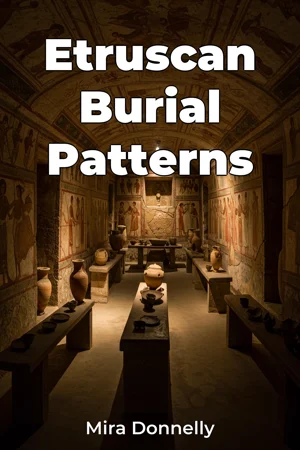
What can the silent cities of the dead tell us about the living? In "Etruscan Burial Patterns," we delve into the fascinating world of Etruscan tombs to unearth the secrets of their society, beliefs, and social structures. This book explores the rich archaeological record left by the Etruscans, focusing on burial layouts, grave goods, and the spatial logic embedded within their necropolises. These elements provide unparalleled insights into Etruscan social rank and their complex belief system regarding the afterlife. The significance of this exploration lies in understanding a civilization that profoundly influenced the Roman world yet often remains overshadowed in historical narratives. By examining their burial customs, we gain a clearer picture of Etruscan daily life, their social hierarchies, and their spiritual outlook. This comprehensive analysis is crucial for anyone interested in ancient history, archaeology, or the evolution of religious and social practices. This book argues that Etruscan tombs were not merely final resting places but meticulously constructed statements about the deceased's identity, status, and place in the cosmos. The arrangement of tombs within necropolises, the types and quantities of grave goods interred, and the architectural styles employed all served to communicate specific messages about the individual and their family. By decoding these messages, we can reconstruct a nuanced understanding of Etruscan society. The book begins by introducing the Etruscan civilization, providing essential background on their history, geography, and cultural characteristics. We then transition into a detailed examination of Etruscan burial practices, analyzing different types of tombs, from simple pit graves to elaborate painted chambers. Central to the analysis are three key areas: first, the spatial organization of necropolises and how tomb placement reflected social stratification; second, the diverse range of grave goods, including pottery, metalwork, and personal adornments, and their symbolic significance; and third, the iconography and inscriptions found within tombs, which offer direct clues to Etruscan beliefs about death and the afterlife. The book culminates in a discussion of the broader implications of these findings, exploring how Etruscan burial patterns shed light on their social and political structures, religious beliefs, and interactions with neighboring cultures. The evidence presented in this book draws upon decades of archaeological research, including detailed site reports, artifact analyses, and epigraphic studies. We also incorporate insights from art history and religious studies to provide a holistic interpretation of Etruscan burial customs. Furthermore, the book benefits from recent advances in archaeological techniques, such as spatial analysis and isotopic analysis, which offer new perspectives on the organization of necropolises and the origins of grave goods. "Etruscan Burial Patterns" connects to several interdisciplinary fields. It engages with sociology by examining how burial rituals reflect social identities and hierarchies. It overlaps with religious studies by analyzing Etruscan beliefs about death, the afterlife, and the divine. Furthermore, it intersects with art history through the study of tomb paintings, sculptures, and other artistic representations found in burial contexts. This book adopts an academic yet accessible tone, striving to make complex archaeological data understandable to a broad audience. While grounded in rigorous scholarship, the narrative aims to be engaging and informative, avoiding overly technical jargon whenever possible. The target audience includes students and scholars of ancient history, archaeology, and classical studies, as well as general readers interested in Etruscan civilization and ancient burial practices. This book is valuable because It synthesizes a wide range of research on Etruscan tombs, providing a comprehensive and up-to-date overview of the field. The scope of this book is limited to the analysis of Etruscan burial patterns, primarily focusing on archaeological evidence from major Etruscan necropolises. While we acknowledge the importance of textual sources, such as inscriptions and literary references, our primary focus is on the material remains of Etruscan tombs. The information presented in this book has real-world applications for archaeologists, museum curators, and cultural heritage professionals. Understanding Etruscan burial patterns is essential for interpreting archaeological sites, preserving cultural heritage, and educating the public about this fascinating civilization. Etruscan burial practices remain a subject of ongoing debate, particularly regarding the interpretation of tomb iconography and the social significance of specific grave goods. This book acknowledges these controversies, presenting different perspectives and offering reasoned arguments based on the available evidence.
What can the silent cities of the dead tell us about the living? In "Etruscan Burial Patterns," we delve into the fascinating world of Etruscan tombs to unearth the secrets of their society, beliefs, and social structures. This book explores the rich archaeological record left by the Etruscans, focusing on burial layouts, grave goods, and the spatial logic embedded within their necropolises. These elements provide unparalleled insights into Etruscan social rank and their complex belief system regarding the afterlife. The significance of this exploration lies in understanding a civilization that profoundly influenced the Roman world yet often remains overshadowed in historical narratives. By examining their burial customs, we gain a clearer picture of Etruscan daily life, their social hierarchies, and their spiritual outlook. This comprehensive analysis is crucial for anyone interested in ancient history, archaeology, or the evolution of religious and social practices. This book argues that Etruscan tombs were not merely final resting places but meticulously constructed statements about the deceased's identity, status, and place in the cosmos. The arrangement of tombs within necropolises, the types and quantities of grave goods interred, and the architectural styles employed all served to communicate specific messages about the individual and their family. By decoding these messages, we can reconstruct a nuanced understanding of Etruscan society. The book begins by introducing the Etruscan civilization, providing essential background on their history, geography, and cultural characteristics. We then transition into a detailed examination of Etruscan burial practices, analyzing different types of tombs, from simple pit graves to elaborate painted chambers. Central to the analysis are three key areas: first, the spatial organization of necropolises and how tomb placement reflected social stratification; second, the diverse range of grave goods, including pottery, metalwork, and personal adornments, and their symbolic significance; and third, the iconography and inscriptions found within tombs, which offer direct clues to Etruscan beliefs about death and the afterlife. The book culminates in a discussion of the broader implications of these findings, exploring how Etruscan burial patterns shed light on their social and political structures, religious beliefs, and interactions with neighboring cultures. The evidence presented in this book draws upon decades of archaeological research, including detailed site reports, artifact analyses, and epigraphic studies. We also incorporate insights from art history and religious studies to provide a holistic interpretation of Etruscan burial customs. Furthermore, the book benefits from recent advances in archaeological techniques, such as spatial analysis and isotopic analysis, which offer new perspectives on the organization of necropolises and the origins of grave goods. "Etruscan Burial Patterns" connects to several interdisciplinary fields. It engages with sociology by examining how burial rituals reflect social identities and hierarchies. It overlaps with religious studies by analyzing Etruscan beliefs about death, the afterlife, and the divine. Furthermore, it intersects with art history through the study of tomb paintings, sculptures, and other artistic representations found in burial contexts. This book adopts an academic yet accessible tone, striving to make complex archaeological data understandable to a broad audience. While grounded in rigorous scholarship, the narrative aims to be engaging and informative, avoiding overly technical jargon whenever possible. The target audience includes students and scholars of ancient history, archaeology, and classical studies, as well as general readers interested in Etruscan civilization and ancient burial practices. This book is valuable because It synthesizes a wide range of research on Etruscan tombs, providing a comprehensive and up-to-date overview of the field. The scope of this book is limited to the analysis of Etruscan burial patterns, primarily focusing on archaeological evidence from major Etruscan necropolises. While we acknowledge the importance of textual sources, such as inscriptions and literary references, our primary focus is on the material remains of Etruscan tombs. The information presented in this book has real-world applications for archaeologists, museum curators, and cultural heritage professionals. Understanding Etruscan burial patterns is essential for interpreting archaeological sites, preserving cultural heritage, and educating the public about this fascinating civilization. Etruscan burial practices remain a subject of ongoing debate, particularly regarding the interpretation of tomb iconography and the social significance of specific grave goods. This book acknowledges these controversies, presenting different perspectives and offering reasoned arguments based on the available evidence.
"Etruscan Burial Patterns" explores how the Etruscans used their elaborate tombs and necropolises to communicate profound messages about identity, status, and their beliefs about the afterlife. This book delves into the rich archaeological record, providing insights into Etruscan society and their complex social structures. For instance, the placement of tombs within necropolises directly correlated with social stratification, and grave goods, like intricate metalwork, held significant symbolic value, reflecting the deceased's position and achievements in life. Beginning with an introduction to the Etruscan civilization, the book progresses to detailed analyses of tomb types and grave goods, examining how the spatial organization of necropolises reflected social hierarchies. By decoding the iconography and inscriptions within the tombs, the book sheds light on Etruscan beliefs about death and the afterlife. It draws upon decades of archaeological research to connect burial rituals to broader social identities, religious views, and artistic representations, making it a valuable resource for anyone interested in ancient history and archaeology.
Book Details
ISBN
9788235240026
Publisher
Publifye AS
Your Licenses
You don't own any licenses for this book
Purchase a license below to unlock this book and download the EPUB.
Purchase License
Select a tier to unlock this book
Need bulk licensing?
Contact us for enterprise agreements.