
About This Book
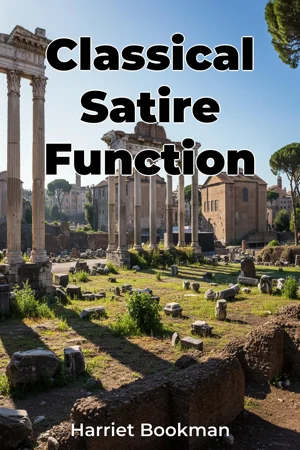
How did ancient Roman writers use humor to wield power, challenge authority, and expose societal ills? "Classical Satire Function" delves into the enduring relevance of satire as a tool for public discourse, political critique, and social commentary, focusing on the works of Juvenal and Horace. Understanding satire's historical roots provides crucial insight into its modern manifestations, allowing for a deeper appreciation of its function in contemporary society where it remains a powerful force in shaping public opinion. This book explores two key topics: the specific techniques employed by Juvenal and Horace in their satirical works, and the broader socio-political contexts that shaped their perspectives and motivated their critiques. It examines how these authors utilized devices such as irony, parody, and invective to target specific individuals, institutions, and societal norms. Analyzing these techniques in their original historical contexts offers insight into the challenges and opportunities inherent in using satire as a form of social commentary. The Roman Empire, rife with political intrigue, social stratification, and moral decay, provided fertile ground for satirists. Understanding the intricacies of Roman society – its patronage system, its evolving political structures, and its diverse cultural influences – is essential for interpreting the nuances of Juvenal's and Horace's critiques. The book assumes a basic familiarity with Roman history and literature, although it provides supplementary context where necessary to illuminate specific allusions and references within the texts. "Classical Satire Function" argues that Juvenal and Horace, despite their different approaches and social positions, both understood the power of satire to provoke thought, challenge authority, and effect social change. Their works, while rooted in the specific circumstances of ancient Rome, offer timeless lessons about the role of humor in public discourse and the enduring human impulse to question and critique the world around us. The book is structured in three parts. Part one introduces the concept of satire, tracing its development in Roman literature and outlining the key characteristics that define the genre. Part two undertakes a detailed analysis of the works of Horace, examining his more urbane and nuanced approach to social criticism. Part three focuses on Juvenal, exploring the fiery indignation and moral outrage that fueled his satirical attacks. The book culminates with a discussion of the lasting legacy of Juvenal and Horace, examining how their works have influenced subsequent generations of satirists and continue to resonate with contemporary audiences. The arguments presented within this book are supported by close readings of the original Latin texts, as well as secondary scholarship on Roman history, literature, and social thought. The book draws upon a range of sources, including critical editions of Juvenal's and Horace's satires, historical accounts of Roman society, and contemporary analyses of satire as a rhetorical and social force. This exploration of classical satire connects to the fields of political science, sociology, and media studies and sheds light on the enduring power of humor to shape public discourse and promote social change. Examining these connections allows us to understand how satire operates in different cultural and political contexts, and how it can be used to both challenge and reinforce existing power structures. "Classical Satire Function" offers a unique perspective by examining the works of Juvenal and Horace through the lens of contemporary social and political theory. This approach allows for a fresh and insightful analysis of their satirical techniques and their lasting relevance. The book adopts an academic yet accessible tone, aiming to engage both scholars and general readers with an interest in classical literature, political thought, and the power of satire. It is intended for students of classics, literature, and political science, as well as anyone interested in understanding the historical roots of satire and its enduring relevance in modern society. As a work of literary criticism and political analysis, this book adheres to the conventions of scholarly non-fiction, emphasizing rigorous research, clear argumentation, and insightful interpretation. The scope of the book is intentionally limited to the works of Juvenal and Horace, allowing for a more in-depth analysis of their satirical techniques and perspectives. While other Roman satirists are mentioned, the focus remains firmly on these two key figures. The insights presented in this book can be applied to a wide range of real-world situations, from analyzing political rhetoric to understanding the role of humor in social movements. By studying the techniques of Juvenal and Horace, readers can develop a more critical understanding of the ways in which satire is used to shape public opinion and influence social change. The study explores the ongoing debate surrounding the effectiveness and ethical implications of satire. Is satire a force for positive social change, or does it simply reinforce existing prejudices and power structures? This book acknowledges these controversies and encourages readers to engage critically with the arguments presented.
How did ancient Roman writers use humor to wield power, challenge authority, and expose societal ills? "Classical Satire Function" delves into the enduring relevance of satire as a tool for public discourse, political critique, and social commentary, focusing on the works of Juvenal and Horace. Understanding satire's historical roots provides crucial insight into its modern manifestations, allowing for a deeper appreciation of its function in contemporary society where it remains a powerful force in shaping public opinion. This book explores two key topics: the specific techniques employed by Juvenal and Horace in their satirical works, and the broader socio-political contexts that shaped their perspectives and motivated their critiques. It examines how these authors utilized devices such as irony, parody, and invective to target specific individuals, institutions, and societal norms. Analyzing these techniques in their original historical contexts offers insight into the challenges and opportunities inherent in using satire as a form of social commentary. The Roman Empire, rife with political intrigue, social stratification, and moral decay, provided fertile ground for satirists. Understanding the intricacies of Roman society – its patronage system, its evolving political structures, and its diverse cultural influences – is essential for interpreting the nuances of Juvenal's and Horace's critiques. The book assumes a basic familiarity with Roman history and literature, although it provides supplementary context where necessary to illuminate specific allusions and references within the texts. "Classical Satire Function" argues that Juvenal and Horace, despite their different approaches and social positions, both understood the power of satire to provoke thought, challenge authority, and effect social change. Their works, while rooted in the specific circumstances of ancient Rome, offer timeless lessons about the role of humor in public discourse and the enduring human impulse to question and critique the world around us. The book is structured in three parts. Part one introduces the concept of satire, tracing its development in Roman literature and outlining the key characteristics that define the genre. Part two undertakes a detailed analysis of the works of Horace, examining his more urbane and nuanced approach to social criticism. Part three focuses on Juvenal, exploring the fiery indignation and moral outrage that fueled his satirical attacks. The book culminates with a discussion of the lasting legacy of Juvenal and Horace, examining how their works have influenced subsequent generations of satirists and continue to resonate with contemporary audiences. The arguments presented within this book are supported by close readings of the original Latin texts, as well as secondary scholarship on Roman history, literature, and social thought. The book draws upon a range of sources, including critical editions of Juvenal's and Horace's satires, historical accounts of Roman society, and contemporary analyses of satire as a rhetorical and social force. This exploration of classical satire connects to the fields of political science, sociology, and media studies and sheds light on the enduring power of humor to shape public discourse and promote social change. Examining these connections allows us to understand how satire operates in different cultural and political contexts, and how it can be used to both challenge and reinforce existing power structures. "Classical Satire Function" offers a unique perspective by examining the works of Juvenal and Horace through the lens of contemporary social and political theory. This approach allows for a fresh and insightful analysis of their satirical techniques and their lasting relevance. The book adopts an academic yet accessible tone, aiming to engage both scholars and general readers with an interest in classical literature, political thought, and the power of satire. It is intended for students of classics, literature, and political science, as well as anyone interested in understanding the historical roots of satire and its enduring relevance in modern society. As a work of literary criticism and political analysis, this book adheres to the conventions of scholarly non-fiction, emphasizing rigorous research, clear argumentation, and insightful interpretation. The scope of the book is intentionally limited to the works of Juvenal and Horace, allowing for a more in-depth analysis of their satirical techniques and perspectives. While other Roman satirists are mentioned, the focus remains firmly on these two key figures. The insights presented in this book can be applied to a wide range of real-world situations, from analyzing political rhetoric to understanding the role of humor in social movements. By studying the techniques of Juvenal and Horace, readers can develop a more critical understanding of the ways in which satire is used to shape public opinion and influence social change. The study explores the ongoing debate surrounding the effectiveness and ethical implications of satire. Is satire a force for positive social change, or does it simply reinforce existing prejudices and power structures? This book acknowledges these controversies and encourages readers to engage critically with the arguments presented.
"Classical Satire Function" explores how ancient Roman satirists like Juvenal and Horace used humor as a potent tool for political critique and social commentary. These writers dissected the intricacies of Roman society, from political intrigue to moral decay, providing insights into the challenges and opportunities inherent in using satire to shape public opinion. Roman satire served as a powerful means to challenge authority and expose societal ills. This book examines key techniques such as irony and parody, revealing how satire was employed to target individuals, institutions, and societal norms. The book is structured in three parts, beginning with an introduction to satire's development in Roman literature. It then undertakes a detailed analysis of Horace's urbane approach and Juvenal's fiery indignation. By understanding the socio-political contexts that shaped these satirists, readers gain a deeper appreciation of satire's function in contemporary society. The book argues that despite their different approaches, both Juvenal and Horace understood satire's power to provoke thought and effect social change, offering timeless lessons about humor's role in public discourse.
Book Details
ISBN
9788235239808
Publisher
Publifye AS
Your Licenses
You don't own any licenses for this book
Purchase a license below to unlock this book and download the EPUB.
Purchase License
Select a tier to unlock this book
Need bulk licensing?
Contact us for enterprise agreements.