
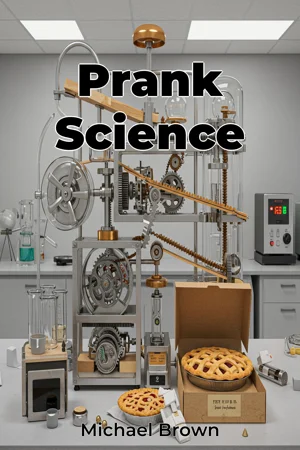
About This Book
Ever wondered why a well-executed prank elicits laughter instead of fury? "Prank Science" delves into the surprisingly complex world of harmless practical jokes, exploring the underlying science and psychology that transform a potentially offensive act into a source of amusement. This book examines why people find jokes funny and how our brains react to the unexpected twists that define a successful prank. It's important to understand these mechanisms, not only for the sake of good humor but also because they reveal fundamental aspects of human cognition, social interaction, and emotional regulation. We’ll start with a look at the historical and social context of pranks, tracing their evolution from ancient trickery to modern-day internet culture. While "Prank Science" doesn't require advanced scientific or psychological knowledge, familiarity with basic concepts of social psychology and cognitive biases will enhance the reading experience. At its heart, "Prank Science" argues that the enjoyment of pranks stems from a carefully balanced interplay of surprise, cognitive dissonance, and a sense of shared understanding. We’ll demonstrate that a well-crafted prank is not merely a random act of mischief but a carefully engineered social experiment that can tell us much about human behavior. The book is structured in three parts. First, we introduce the core concepts of surprise, humor theory, and social psychology relevant to understanding pranks. The second section explores specific types of pranks, dissecting their psychological mechanisms and examining case studies of both successful and failed pranks, drawing from fields such as experimental psychology, neuroscience, as well as examples from media and popular culture. This section elucidates how elements like timing, target selection, and the element of surprise contribute to a prank's effectiveness. The final section delves into the ethical considerations of pranking, highlighting the fine line between harmless fun and harmful transgression. This discussion considers the impact of power dynamics, cultural norms, and individual sensitivities on the perception of pranks. The evidence presented in "Prank Science" draws from a varied array of sources, including experimental studies on humor and surprise, analyses of social media trends related to pranking, and neurological research on the brain's response to unexpected stimuli. Unique data includes analysis of online prank videos, cataloging elements like target demographics, set-up, and reactions, to identify patterns that contribute to comedic success. "Prank Science" connects to other fields, such as sociology (examining pranks as social rituals), communication studies (analyzing the role of pranks in shaping social narratives), and even engineering (considering the design and execution of elaborate pranks as problem-solving exercises). This interdisciplinary approach enriches the book's argument, providing a holistic understanding of pranking. This book takes a novel approach by applying scientific rigor to a subject often dismissed as frivolous. Rather than simply cataloging pranks, "Prank Science" seeks to understand their underlying mechanisms and their impact on human behavior. Written in an accessible and engaging style, "Prank Science" targets a broad audience, including students of psychology, sociology, and communication, as well as anyone curious about the science behind humor and social interaction. It’s valuable for those seeking to understand the dynamics of humor and to appreciate the psychology behind why we laugh. As a work of non-fiction, this book adheres to principles of accuracy, objectivity, and responsible reporting. While the subject matter is lighthearted, the analysis is grounded in established scientific and psychological theories. The scope deliberately focuses on harmless pranks, excluding those that cause physical or emotional harm. The insights of "Prank Science" can be practically applied in various settings, from improving communication in the workplace to designing engaging educational experiences. While debates exist about the ethical boundaries of pranking, "Prank Science" contributes by providing a scientific and psychological framework for navigating these complex issues and understanding the potential impact of our actions on others.
Ever wondered why a well-executed prank elicits laughter instead of fury? "Prank Science" delves into the surprisingly complex world of harmless practical jokes, exploring the underlying science and psychology that transform a potentially offensive act into a source of amusement. This book examines why people find jokes funny and how our brains react to the unexpected twists that define a successful prank. It's important to understand these mechanisms, not only for the sake of good humor but also because they reveal fundamental aspects of human cognition, social interaction, and emotional regulation. We’ll start with a look at the historical and social context of pranks, tracing their evolution from ancient trickery to modern-day internet culture. While "Prank Science" doesn't require advanced scientific or psychological knowledge, familiarity with basic concepts of social psychology and cognitive biases will enhance the reading experience. At its heart, "Prank Science" argues that the enjoyment of pranks stems from a carefully balanced interplay of surprise, cognitive dissonance, and a sense of shared understanding. We’ll demonstrate that a well-crafted prank is not merely a random act of mischief but a carefully engineered social experiment that can tell us much about human behavior. The book is structured in three parts. First, we introduce the core concepts of surprise, humor theory, and social psychology relevant to understanding pranks. The second section explores specific types of pranks, dissecting their psychological mechanisms and examining case studies of both successful and failed pranks, drawing from fields such as experimental psychology, neuroscience, as well as examples from media and popular culture. This section elucidates how elements like timing, target selection, and the element of surprise contribute to a prank's effectiveness. The final section delves into the ethical considerations of pranking, highlighting the fine line between harmless fun and harmful transgression. This discussion considers the impact of power dynamics, cultural norms, and individual sensitivities on the perception of pranks. The evidence presented in "Prank Science" draws from a varied array of sources, including experimental studies on humor and surprise, analyses of social media trends related to pranking, and neurological research on the brain's response to unexpected stimuli. Unique data includes analysis of online prank videos, cataloging elements like target demographics, set-up, and reactions, to identify patterns that contribute to comedic success. "Prank Science" connects to other fields, such as sociology (examining pranks as social rituals), communication studies (analyzing the role of pranks in shaping social narratives), and even engineering (considering the design and execution of elaborate pranks as problem-solving exercises). This interdisciplinary approach enriches the book's argument, providing a holistic understanding of pranking. This book takes a novel approach by applying scientific rigor to a subject often dismissed as frivolous. Rather than simply cataloging pranks, "Prank Science" seeks to understand their underlying mechanisms and their impact on human behavior. Written in an accessible and engaging style, "Prank Science" targets a broad audience, including students of psychology, sociology, and communication, as well as anyone curious about the science behind humor and social interaction. It’s valuable for those seeking to understand the dynamics of humor and to appreciate the psychology behind why we laugh. As a work of non-fiction, this book adheres to principles of accuracy, objectivity, and responsible reporting. While the subject matter is lighthearted, the analysis is grounded in established scientific and psychological theories. The scope deliberately focuses on harmless pranks, excluding those that cause physical or emotional harm. The insights of "Prank Science" can be practically applied in various settings, from improving communication in the workplace to designing engaging educational experiences. While debates exist about the ethical boundaries of pranking, "Prank Science" contributes by providing a scientific and psychological framework for navigating these complex issues and understanding the potential impact of our actions on others.
"Prank Science" explores the surprising science and psychology behind harmless practical jokes, arguing that their success stems from a careful balance of surprise, cognitive dissonance, and shared understanding. The book reveals how pranks, often dismissed as mere mischief, are actually carefully engineered social experiments that offer insights into human behavior. For example, the element of surprise in a prank triggers specific neurological responses, while successful pranks often exploit cognitive biases to create humor. The book begins by establishing the historical and social context of pranks, then moves to dissecting the psychological mechanisms behind different types of pranks using case studies and experimental psychology. It examines how timing, target selection, and the element of surprise contribute to a prank's effectiveness. Finally, the book considers the ethical dimensions of pranking, navigating the line between harmless fun and potentially harmful actions.
Book Details
ISBN
9788235238719
Publisher
Publifye AS
Your Licenses
You don't own any licenses for this book
Purchase a license below to unlock this book and download the EPUB.
Purchase License
Select a tier to unlock this book
Need bulk licensing?
Contact us for enterprise agreements.