
About This Book
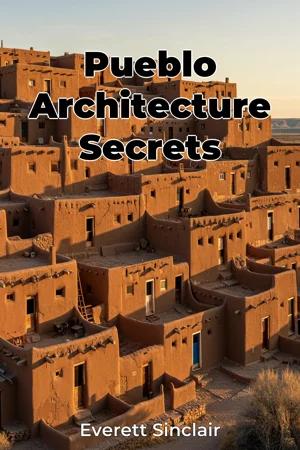
Could the ancient secrets of adobe architecture hold the key to sustainable and climate-resilient housing of the future? This book, "Pueblo Architecture Secrets," delves into the intricate engineering, material science, and cultural wisdom embedded within indigenous adobe dwellings, particularly those of the Pueblo people of the Southwestern United States. It explores how these age-old construction techniques provide superior insulation and resilience in regions characterized by extreme temperature variations and arid conditions. These topics are critically important because understanding and adapting these principles can inspire innovative solutions for contemporary building challenges, particularly in the face of climate change and the growing need for sustainable construction practices. To fully appreciate the ingenuity of Pueblo architecture, this book provides essential historical and environmental context. Readers will learn about the cultural practices, resource management strategies, and deep understanding of local climate that shaped the development of these unique structures. Familiarity with basic architectural and engineering concepts is helpful, but not required, as the book offers clear explanations of relevant principles. The central argument of "Pueblo Architecture Secrets" is that indigenous adobe architecture represents a sophisticated and sustainable building system developed over centuries through careful observation, experimentation, and adaptation to specific environmental conditions. This living tradition offers valuable lessons for modern architects, engineers, and builders seeking to create energy-efficient, durable, and culturally sensitive structures. The book is structured to systematically unpack the secrets of Pueblo architecture. We begin by introducing the fundamental properties of adobe as a building material, examining its thermal mass, moisture regulation, and structural behavior. The book then explores key design elements, such as wall construction techniques, roof systems, and passive solar strategies, detailing how each component contributes to the overall performance of the dwelling. Subsequently, we delve into the specific adaptations found in different Pueblo communities, illustrating how local resources and environmental conditions influenced architectural variations. The concluding sections synthesize these lessons, presenting practical guidelines for incorporating traditional adobe principles into contemporary designs. The analysis presented is grounded in a combination of architectural surveys, engineering analyses, environmental data, and ethnographic research. This book brings together findings from scientific studies on adobe properties alongside insights gleaned from interviews with Pueblo elders and artisans. The book has strong interdisciplinary connections with environmental science, materials engineering, and anthropology. Understanding the environmental impact of building materials is crucial for sustainability. Exploring the material science of adobe helps us understand how it behaves over time. Studying Pueblo culture provides insight into the social and cultural values embedded in their architectural traditions. "Pueblo Architecture Secrets" stands apart by offering a holistic perspective on adobe architecture, integrating engineering principles with cultural context. It is not simply a technical manual, but rather a comprehensive exploration of a living architectural tradition. The book adopts a clear and engaging writing style, making complex concepts accessible to a broad audience. It is aimed at architects, engineers, builders, sustainability professionals, students, and anyone interested in learning about sustainable building practices and indigenous architectural traditions. The book will be useful to understand how traditional methods can inform modern architectural challenges. As a work of non-fiction focused on architecture, this book emphasizes accuracy, clarity, and evidence-based analysis. While celebrating the beauty and ingenuity of Pueblo architecture, it maintains a rigorous and objective approach. The scope of the book is limited to the adobe architecture of the Pueblo people of the Southwestern United States. While other adobe traditions exist around the world, this book focuses on the unique adaptations and innovations found in this specific region. The information presented can be applied to a wide range of practical applications, including the design of energy-efficient homes, the restoration of historic adobe structures, and the development of sustainable building materials. While adobe construction is widely recognized for its sustainability and energy efficiency, debates persist regarding its suitability for seismic regions and areas with high rainfall. This book addresses these concerns, exploring strategies for mitigating risk and enhancing the durability of adobe structures in challenging environments.
Could the ancient secrets of adobe architecture hold the key to sustainable and climate-resilient housing of the future? This book, "Pueblo Architecture Secrets," delves into the intricate engineering, material science, and cultural wisdom embedded within indigenous adobe dwellings, particularly those of the Pueblo people of the Southwestern United States. It explores how these age-old construction techniques provide superior insulation and resilience in regions characterized by extreme temperature variations and arid conditions. These topics are critically important because understanding and adapting these principles can inspire innovative solutions for contemporary building challenges, particularly in the face of climate change and the growing need for sustainable construction practices. To fully appreciate the ingenuity of Pueblo architecture, this book provides essential historical and environmental context. Readers will learn about the cultural practices, resource management strategies, and deep understanding of local climate that shaped the development of these unique structures. Familiarity with basic architectural and engineering concepts is helpful, but not required, as the book offers clear explanations of relevant principles. The central argument of "Pueblo Architecture Secrets" is that indigenous adobe architecture represents a sophisticated and sustainable building system developed over centuries through careful observation, experimentation, and adaptation to specific environmental conditions. This living tradition offers valuable lessons for modern architects, engineers, and builders seeking to create energy-efficient, durable, and culturally sensitive structures. The book is structured to systematically unpack the secrets of Pueblo architecture. We begin by introducing the fundamental properties of adobe as a building material, examining its thermal mass, moisture regulation, and structural behavior. The book then explores key design elements, such as wall construction techniques, roof systems, and passive solar strategies, detailing how each component contributes to the overall performance of the dwelling. Subsequently, we delve into the specific adaptations found in different Pueblo communities, illustrating how local resources and environmental conditions influenced architectural variations. The concluding sections synthesize these lessons, presenting practical guidelines for incorporating traditional adobe principles into contemporary designs. The analysis presented is grounded in a combination of architectural surveys, engineering analyses, environmental data, and ethnographic research. This book brings together findings from scientific studies on adobe properties alongside insights gleaned from interviews with Pueblo elders and artisans. The book has strong interdisciplinary connections with environmental science, materials engineering, and anthropology. Understanding the environmental impact of building materials is crucial for sustainability. Exploring the material science of adobe helps us understand how it behaves over time. Studying Pueblo culture provides insight into the social and cultural values embedded in their architectural traditions. "Pueblo Architecture Secrets" stands apart by offering a holistic perspective on adobe architecture, integrating engineering principles with cultural context. It is not simply a technical manual, but rather a comprehensive exploration of a living architectural tradition. The book adopts a clear and engaging writing style, making complex concepts accessible to a broad audience. It is aimed at architects, engineers, builders, sustainability professionals, students, and anyone interested in learning about sustainable building practices and indigenous architectural traditions. The book will be useful to understand how traditional methods can inform modern architectural challenges. As a work of non-fiction focused on architecture, this book emphasizes accuracy, clarity, and evidence-based analysis. While celebrating the beauty and ingenuity of Pueblo architecture, it maintains a rigorous and objective approach. The scope of the book is limited to the adobe architecture of the Pueblo people of the Southwestern United States. While other adobe traditions exist around the world, this book focuses on the unique adaptations and innovations found in this specific region. The information presented can be applied to a wide range of practical applications, including the design of energy-efficient homes, the restoration of historic adobe structures, and the development of sustainable building materials. While adobe construction is widely recognized for its sustainability and energy efficiency, debates persist regarding its suitability for seismic regions and areas with high rainfall. This book addresses these concerns, exploring strategies for mitigating risk and enhancing the durability of adobe structures in challenging environments.
"Pueblo Architecture Secrets" reveals the sustainable and climate-resilient design principles embedded in the adobe architecture of the Pueblo people in the Southwestern United States. This architectural design offers valuable lessons for contemporary building practices. One intriguing aspect is how the thermal mass of adobe naturally regulates indoor temperatures, keeping homes cool in the summer and warm in the winter, reducing the need for energy-intensive heating and cooling systems. The book also explores the ingenious methods used to manage water and prevent erosion in arid climates, showcasing the deep understanding of environmental design. The book delves into the properties of adobe, detailing wall construction, roof systems, and passive solar strategies, demonstrating how they contribute to a dwelling's overall performance. It presents architectural surveys, engineering analyses, environmental data, and ethnographic research. By integrating engineering principles with cultural context, "Pueblo Architecture Secrets" provides a holistic perspective, making it a valuable resource for architects, engineers, and anyone interested in sustainable building and indigenous architectural traditions.
Book Details
ISBN
9788235238047
Publisher
Publifye AS
Your Licenses
You don't own any licenses for this book
Purchase a license below to unlock this book and download the EPUB.
Purchase License
Select a tier to unlock this book
Need bulk licensing?
Contact us for enterprise agreements.