
About This Book
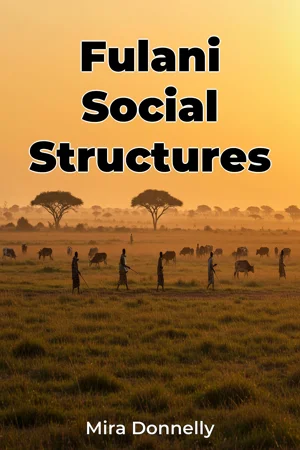
How did the Fulani, a widely dispersed people, maintain their unique identity and influence across diverse landscapes and political systems for centuries? "Fulani Social Structures" explores the intricate sociopolitical systems that enabled Fulani communities to preserve authority, ensure mobility, and maintain religious continuity across vast regions of West Africa and beyond. This book addresses the essential question of how a decentralized population sustained a shared cultural and religious identity while adapting to varying local contexts. This book argues that Fulani success in maintaining a distinct identity stemmed from a flexible yet resilient social structure characterized by adaptable leadership models, emphasis on pastoral nomadism, and a shared commitment to Islamic scholarship and practice. These three factors – leadership, mobility, and religion – are the central pillars upon which Fulani social structures were built and are examined in detail. Understanding these aspects is crucial for anyone seeking a comprehensive view of West African history, the dynamics of nomadic societies, or the impact of Islam on social organization. The historical context is essential: The Fulani diaspora emerged from the Senegal River valley, spreading eastward through both peaceful migration and the establishment of Islamic states during the 18th and 19th centuries. Their interaction with settled agricultural populations and pre-existing political structures shaped the evolution of their social institutions. To fully appreciate the book, a basic understanding of West African geography, pre-colonial political systems, and the spread of Islam is beneficial but not required. The core of "Fulani Social Structures" analyzes various leadership models employed by Fulani communities, ranging from clan-based systems to theocratic states founded during the jihad movements. It examines how these leadership structures adapted to different environments and challenges, ensuring both internal cohesion and external influence. The book details how the Fulani emphasis on pastoralism, and associated transhumance, facilitated their mobility and interaction with diverse populations, creating economic and social networks that spanned vast distances. A critical component was the role of Islam, primarily its Maliki school, as a unifying force. The book investigates how Islamic scholarship reinforced cultural values and provided a framework for legal and social norms, fostering a sense of shared identity even among geographically dispersed communities. The book is structured to first introduce fundamental concepts of Fulani social organization, including lineage systems, age grades, and social stratification. It then moves to examine how Fulani communities developed and maintained authority in different contexts, from nomadic pastoral groups to settled, ruling elites. A dedicated section explores the dynamics of mobility, analyzing the economic and social implications of transhumance and trade networks. Finally, the book examines the role of Islam in shaping Fulani identity and social norms, investigating the influence of Islamic scholars and institutions. The book culminates by exploring the implications of these historical social structures on contemporary Fulani communities and their ongoing engagement with modern nation-states. The evidence presented in this book draws from a variety of sources, including historical chronicles, oral traditions, ethnographic studies, and colonial administrative records. Particular attention is given to analyzing primary source materials in Fulfulde, Arabic, and European languages to provide a nuanced and culturally sensitive account. "Fulani Social Structures" also connects to broader academic fields, especially anthropology, political science, and religious studies. By examining the intricacies of Fulani social organization, the book contributes to anthropological discussions on social complexity and cultural adaptation. Its analysis of Fulani political systems offers insights into the dynamics of power and authority in decentralized societies, relevant to political science. Furthermore, the study of Islam's role in shaping Fulani identity contributes to the broader field of religious studies. This book offers a unique perspective by focusing on the interplay between social structures, mobility, and religious identity in shaping Fulani history. It moves beyond simplistic narratives of conquest and resistance to provide a comprehensive analysis of the factors that enabled Fulani communities to thrive across diverse environments. The book is written in an accessible and engaging style, making it suitable for students, researchers, and general readers interested in African history, Islamic studies, and social anthropology. It will particularly appeal to those seeking a nuanced understanding of the Fulani people and their enduring legacy. The book’s scope is West Africa with some consideration of Fulani communities further east. While it provides a broad overview of Fulani social structures across various regions and historical periods, it acknowledges that specific communities exhibit unique characteristics that warrant further localized studies. Understanding the historical context of Fulani social structures allows for a greater understanding of contemporary issues such as land rights, political marginalization, and cultural preservation. Contemporary debates about the role of pastoralism in sustainable development and the relationship between religious identity and political participation are touched upon where directly related to the book’s focused content but are not the primary focus.
How did the Fulani, a widely dispersed people, maintain their unique identity and influence across diverse landscapes and political systems for centuries? "Fulani Social Structures" explores the intricate sociopolitical systems that enabled Fulani communities to preserve authority, ensure mobility, and maintain religious continuity across vast regions of West Africa and beyond. This book addresses the essential question of how a decentralized population sustained a shared cultural and religious identity while adapting to varying local contexts. This book argues that Fulani success in maintaining a distinct identity stemmed from a flexible yet resilient social structure characterized by adaptable leadership models, emphasis on pastoral nomadism, and a shared commitment to Islamic scholarship and practice. These three factors – leadership, mobility, and religion – are the central pillars upon which Fulani social structures were built and are examined in detail. Understanding these aspects is crucial for anyone seeking a comprehensive view of West African history, the dynamics of nomadic societies, or the impact of Islam on social organization. The historical context is essential: The Fulani diaspora emerged from the Senegal River valley, spreading eastward through both peaceful migration and the establishment of Islamic states during the 18th and 19th centuries. Their interaction with settled agricultural populations and pre-existing political structures shaped the evolution of their social institutions. To fully appreciate the book, a basic understanding of West African geography, pre-colonial political systems, and the spread of Islam is beneficial but not required. The core of "Fulani Social Structures" analyzes various leadership models employed by Fulani communities, ranging from clan-based systems to theocratic states founded during the jihad movements. It examines how these leadership structures adapted to different environments and challenges, ensuring both internal cohesion and external influence. The book details how the Fulani emphasis on pastoralism, and associated transhumance, facilitated their mobility and interaction with diverse populations, creating economic and social networks that spanned vast distances. A critical component was the role of Islam, primarily its Maliki school, as a unifying force. The book investigates how Islamic scholarship reinforced cultural values and provided a framework for legal and social norms, fostering a sense of shared identity even among geographically dispersed communities. The book is structured to first introduce fundamental concepts of Fulani social organization, including lineage systems, age grades, and social stratification. It then moves to examine how Fulani communities developed and maintained authority in different contexts, from nomadic pastoral groups to settled, ruling elites. A dedicated section explores the dynamics of mobility, analyzing the economic and social implications of transhumance and trade networks. Finally, the book examines the role of Islam in shaping Fulani identity and social norms, investigating the influence of Islamic scholars and institutions. The book culminates by exploring the implications of these historical social structures on contemporary Fulani communities and their ongoing engagement with modern nation-states. The evidence presented in this book draws from a variety of sources, including historical chronicles, oral traditions, ethnographic studies, and colonial administrative records. Particular attention is given to analyzing primary source materials in Fulfulde, Arabic, and European languages to provide a nuanced and culturally sensitive account. "Fulani Social Structures" also connects to broader academic fields, especially anthropology, political science, and religious studies. By examining the intricacies of Fulani social organization, the book contributes to anthropological discussions on social complexity and cultural adaptation. Its analysis of Fulani political systems offers insights into the dynamics of power and authority in decentralized societies, relevant to political science. Furthermore, the study of Islam's role in shaping Fulani identity contributes to the broader field of religious studies. This book offers a unique perspective by focusing on the interplay between social structures, mobility, and religious identity in shaping Fulani history. It moves beyond simplistic narratives of conquest and resistance to provide a comprehensive analysis of the factors that enabled Fulani communities to thrive across diverse environments. The book is written in an accessible and engaging style, making it suitable for students, researchers, and general readers interested in African history, Islamic studies, and social anthropology. It will particularly appeal to those seeking a nuanced understanding of the Fulani people and their enduring legacy. The book’s scope is West Africa with some consideration of Fulani communities further east. While it provides a broad overview of Fulani social structures across various regions and historical periods, it acknowledges that specific communities exhibit unique characteristics that warrant further localized studies. Understanding the historical context of Fulani social structures allows for a greater understanding of contemporary issues such as land rights, political marginalization, and cultural preservation. Contemporary debates about the role of pastoralism in sustainable development and the relationship between religious identity and political participation are touched upon where directly related to the book’s focused content but are not the primary focus.
"Fulani Social Structures" delves into the fascinating ways the Fulani people, despite their widespread presence across West Africa, have maintained a distinct cultural and religious identity for centuries. The book argues that their success lies in a resilient social structure built upon adaptable leadership, a commitment to pastoral nomadism, and a shared dedication to Islamic scholarship. One intriguing aspect is how Fulani communities adapted their leadership models, ranging from clan-based systems to theocratic states, to suit different environments. The book progresses by first introducing core concepts of Fulani social organization, such as lineage systems, before exploring how authority was maintained in various contexts. It then examines the economic and social implications of their mobile lifestyle and the unifying role of Islam in shaping their identity. By examining historical chronicles, oral traditions, and ethnographic studies, "Fulani Social Structures" offers a nuanced perspective on the interplay between social structures, mobility, and religious identity, making it a valuable resource for those interested in African history, Islamic studies, and social anthropology. This approach moves beyond simple narratives to provide a comprehensive analysis.
Book Details
ISBN
9788235237743
Publisher
Publifye AS
Your Licenses
You don't own any licenses for this book
Purchase a license below to unlock this book and download the EPUB.
Purchase License
Select a tier to unlock this book
Need bulk licensing?
Contact us for enterprise agreements.