
About This Book
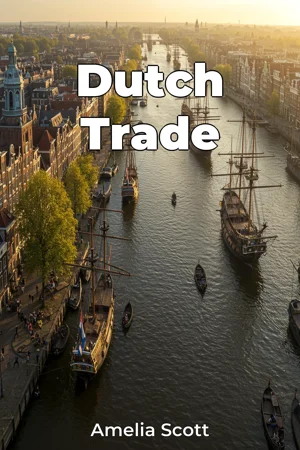
How did a small nation, recently liberated from imperial rule, become a global economic powerhouse in the 17th century? "Dutch Trade" delves into the intricacies of the Dutch Golden Age, exploring the economic prosperity that propelled the Netherlands into a dominant position in European and global trade. This book examines the confluence of factors that enabled Dutch merchants, financiers, and innovators to establish a commercial empire that spanned continents. The primary focus of this book rests on three key areas: the innovative financial instruments developed in the Netherlands, the expansive trade networks established by Dutch merchants, and the impact of these economic activities on Dutch society and its global standing. These topics are significant because they reveal how a nation lacking vast natural resources could leverage ingenuity and strategic partnerships to achieve unprecedented economic success. Understanding the Dutch model provides valuable insights into the dynamics of global trade and economic development, relevant even today. To appreciate the full scope of Dutch commercial achievements, it is essential to understand the historical context of the 16th and 17th centuries. The Dutch Republic emerged from a protracted struggle for independence from Spain, which spurred a need for economic self-sufficiency and global outreach. Readers will benefit from a basic understanding of European history, particularly the Reformation, the rise of mercantilism, and early colonial endeavors. The central argument of "Dutch Trade" is that the Netherlands’ Golden Age was not merely a period of economic growth, but a deliberate and innovative construction driven by a combination of factors: a pragmatic approach to trade, sophisticated financial systems, and a relatively tolerant social environment. This argument challenges purely resource-based explanations of economic success, emphasizing the crucial role of institutions and policies. This book unfolds in a structured manner. First, it sets the stage by introducing the political and social landscape of the 17th-century Netherlands and describes the key innovations in finance and shipping. It then dedicates chapters to examining the Dutch East India Company (VOC) and the Dutch West India Company (GWC), analyzing their operations, impact, and global reach. This includes detailing the goods traded, the routes traversed, and the relationships established (or exploited) with other nations and peoples. The book culminates by assessing the long-term consequences of Dutch trade, both positive and negative, on the Netherlands and the world, including the legacy of colonialism and the evolution of global financial markets. The analysis presented here is supported by a wide range of primary and secondary sources, including archival documents from the VOC and GWC, contemporary travelogues, financial records, and scholarly analyses. Unique data sources include detailed shipping manifests and price lists, providing granular insights into the flow of goods and capital. "Dutch Trade" connects to several other fields of study. It intersects with political science by examining the relationship between state power and economic activity. It touches on sociology and anthropology by considering the social and cultural impact of trade on both Dutch society and the societies with which the Dutch interacted. The book also interfaces with environmental history by examining the ecological consequences of resource extraction and global commodity flows. This book offers a fresh perspective by emphasizing the systemic nature of Dutch trade, highlighting how various components—finance, shipping, governance, and social attitudes—worked together to create a globally dominant trading power. Written in a clear and accessible style, this book is aimed at students, researchers, and anyone with an interest in economic history, world history, and the history of trade. It will be valuable to readers seeking to understand the historical roots of globalization and the enduring impact of early modern trade networks. This book aligns with the conventions of historical and economic non-fiction, providing rigorous analysis, empirical evidence, and clear explanations of complex concepts. The scope of "Dutch Trade" is limited to the Dutch Golden Age, primarily focusing on the 17th century. While it acknowledges earlier and later periods, the book's primary aim is to provide an in-depth examination of the Dutch Republic's commercial activities during its peak. The lessons gleaned from this book can be applied to understanding contemporary debates about globalization, trade policy, and the role of finance in economic development. Finally, this book also addresses some of the controversies surrounding Dutch trade, including the ethical implications of the slave trade and the impact of Dutch colonialism on indigenous populations. By acknowledging these complexities, "Dutch Trade" offers a nuanced and balanced account of this pivotal era in world history.
How did a small nation, recently liberated from imperial rule, become a global economic powerhouse in the 17th century? "Dutch Trade" delves into the intricacies of the Dutch Golden Age, exploring the economic prosperity that propelled the Netherlands into a dominant position in European and global trade. This book examines the confluence of factors that enabled Dutch merchants, financiers, and innovators to establish a commercial empire that spanned continents. The primary focus of this book rests on three key areas: the innovative financial instruments developed in the Netherlands, the expansive trade networks established by Dutch merchants, and the impact of these economic activities on Dutch society and its global standing. These topics are significant because they reveal how a nation lacking vast natural resources could leverage ingenuity and strategic partnerships to achieve unprecedented economic success. Understanding the Dutch model provides valuable insights into the dynamics of global trade and economic development, relevant even today. To appreciate the full scope of Dutch commercial achievements, it is essential to understand the historical context of the 16th and 17th centuries. The Dutch Republic emerged from a protracted struggle for independence from Spain, which spurred a need for economic self-sufficiency and global outreach. Readers will benefit from a basic understanding of European history, particularly the Reformation, the rise of mercantilism, and early colonial endeavors. The central argument of "Dutch Trade" is that the Netherlands’ Golden Age was not merely a period of economic growth, but a deliberate and innovative construction driven by a combination of factors: a pragmatic approach to trade, sophisticated financial systems, and a relatively tolerant social environment. This argument challenges purely resource-based explanations of economic success, emphasizing the crucial role of institutions and policies. This book unfolds in a structured manner. First, it sets the stage by introducing the political and social landscape of the 17th-century Netherlands and describes the key innovations in finance and shipping. It then dedicates chapters to examining the Dutch East India Company (VOC) and the Dutch West India Company (GWC), analyzing their operations, impact, and global reach. This includes detailing the goods traded, the routes traversed, and the relationships established (or exploited) with other nations and peoples. The book culminates by assessing the long-term consequences of Dutch trade, both positive and negative, on the Netherlands and the world, including the legacy of colonialism and the evolution of global financial markets. The analysis presented here is supported by a wide range of primary and secondary sources, including archival documents from the VOC and GWC, contemporary travelogues, financial records, and scholarly analyses. Unique data sources include detailed shipping manifests and price lists, providing granular insights into the flow of goods and capital. "Dutch Trade" connects to several other fields of study. It intersects with political science by examining the relationship between state power and economic activity. It touches on sociology and anthropology by considering the social and cultural impact of trade on both Dutch society and the societies with which the Dutch interacted. The book also interfaces with environmental history by examining the ecological consequences of resource extraction and global commodity flows. This book offers a fresh perspective by emphasizing the systemic nature of Dutch trade, highlighting how various components—finance, shipping, governance, and social attitudes—worked together to create a globally dominant trading power. Written in a clear and accessible style, this book is aimed at students, researchers, and anyone with an interest in economic history, world history, and the history of trade. It will be valuable to readers seeking to understand the historical roots of globalization and the enduring impact of early modern trade networks. This book aligns with the conventions of historical and economic non-fiction, providing rigorous analysis, empirical evidence, and clear explanations of complex concepts. The scope of "Dutch Trade" is limited to the Dutch Golden Age, primarily focusing on the 17th century. While it acknowledges earlier and later periods, the book's primary aim is to provide an in-depth examination of the Dutch Republic's commercial activities during its peak. The lessons gleaned from this book can be applied to understanding contemporary debates about globalization, trade policy, and the role of finance in economic development. Finally, this book also addresses some of the controversies surrounding Dutch trade, including the ethical implications of the slave trade and the impact of Dutch colonialism on indigenous populations. By acknowledging these complexities, "Dutch Trade" offers a nuanced and balanced account of this pivotal era in world history.
"Dutch Trade" investigates how the Netherlands, a small nation, rose to become a global economic power during the Dutch Golden Age. This book explores the innovative financial instruments, such as early forms of stocks and bonds, and the expansive trade networks established by the Dutch East India Company (VOC) and the Dutch West India Company (GWC). These companies facilitated global trade, with the VOC becoming the first multinational corporation. At its peak, the Dutch merchant fleet was larger than all other European nations combined, highlighting their dominance in maritime trade. The book argues that the Dutch Golden Age was a result of pragmatic trade policies, sophisticated financial systems, and a tolerant social environment. It begins by setting the scene of the 17th-century Netherlands, moves through the operations and impact of the VOC and GWC, and concludes by assessing the long-term global consequences of Dutch trade. This includes acknowledging the controversies of colonialism and the slave trade, providing a balanced view of this influential period in world history and economic development. "Dutch Trade" offers a fresh perspective on the systemic nature of Dutch trade and its lasting impact. By connecting economic activity with political science, sociology, anthropology, and even environmental history, the book offers a comprehensive understanding of the Dutch Republic's commercial activities and their influence on globalization.
Book Details
ISBN
9788235236661
Publisher
Publifye AS
Your Licenses
You don't own any licenses for this book
Purchase a license below to unlock this book and download the EPUB.
Purchase License
Select a tier to unlock this book
Need bulk licensing?
Contact us for enterprise agreements.