
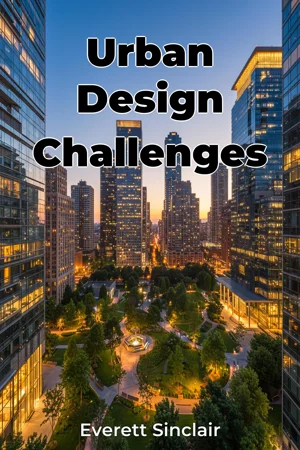
About This Book
How can cities simultaneously foster economic growth, environmental sustainability, and social equity? "Urban Design Challenges" delves into the multifaceted issues facing urban planners and policymakers today, examining the complex interplay between design, politics, and societal needs. This book tackles the critical challenges of creating livable, resilient, and just urban environments in the 21st century. The book focuses primarily on three crucial themes: sustainable urban development, effective traffic and infrastructure management, and social equity within metropolitan areas. Sustainable urban development explores innovative strategies for reducing carbon footprints, promoting green spaces, and conserving resources while accommodating growing populations. Effective traffic and infrastructure management examines the challenges of providing safe, efficient, and accessible transportation systems for all residents while minimizing congestion and pollution. Social equity explores how urban design can address disparities in access to housing, employment, education, and other essential services, promoting inclusive and equitable communities. These themes are important because cities are increasingly becoming centers of global population and economic activity, making their design and management crucial for long-term sustainability and social well-being. "Urban Design Challenges" provides the necessary historical and social context to understand how contemporary urban planning practices have evolved. It analyzes the impact of past planning decisions on present-day challenges, such as urban sprawl, segregation, and environmental degradation. The central argument posits that effective urban design requires a holistic approach that integrates environmental, economic, and social considerations. It challenges the traditional siloed approach to urban planning, advocating for interdisciplinary collaboration and community engagement. The book stresses that successful urban design must prioritize the needs of all residents, particularly marginalized communities, while promoting environmental stewardship and economic vitality. The book's structure systematically introduces the core concepts of urban planning and design. First, it examines the historical context and theoretical frameworks that shape contemporary practices. Second, it devotes individual chapters to the in-depth discussion of sustainability, traffic management, and social equity. Each of these sections explores specific case studies, policy recommendations, and design strategies. Finally, the book culminates with a discussion of the future of urban design, exploring the potential of emerging technologies and participatory planning processes to create more resilient and equitable cities. Evidence and research presented in the book include a variety of sources: statistical data on urban demographics and environmental indicators, case studies of successful and unsuccessful urban development projects, policy analysis of urban planning regulations, and interviews with urban planners, policymakers, and community stakeholders. Furthermore, the book draws upon diverse methodologies, including spatial analysis, economic modeling, and qualitative research. This book recognizes the interdisciplinary nature of urban design, connecting it to fields such as environmental science, sociology, and economics. The connections to environmental science underscore the ecological impact of urban development and the importance of sustainable design practices. The connections to sociology highlight the social and cultural dimensions of urban life and the need for equitable planning policies. The connections to economics reveal the economic forces that shape urban development and the importance of creating economically vibrant and inclusive cities. "Urban Design Challenges" stands out due to its comprehensive and integrated approach to urban planning. It moves beyond simplistic solutions, advocating for nuanced and context-specific strategies that address the complex challenges facing cities today. The book is written in an accessible and engaging style, making it suitable for a broad audience, including students, policymakers, urban planners, community activists, and anyone interested in the future of cities. It provides practical insights and actionable recommendations that can be applied in a variety of contexts. Its scope is broad, covering a wide range of urban design issues, but it also acknowledges the limitations of any single approach, emphasizing the importance of ongoing learning and adaptation. The information presented in "Urban Design Challenges" can be applied practically to inform urban planning policies, design guidelines, and community development initiatives. By exploring ongoing debates and controversies in the field, such as gentrification, displacement, and the impact of technology on urban life, the book provides a critical perspective on the challenges and opportunities facing cities today.
How can cities simultaneously foster economic growth, environmental sustainability, and social equity? "Urban Design Challenges" delves into the multifaceted issues facing urban planners and policymakers today, examining the complex interplay between design, politics, and societal needs. This book tackles the critical challenges of creating livable, resilient, and just urban environments in the 21st century. The book focuses primarily on three crucial themes: sustainable urban development, effective traffic and infrastructure management, and social equity within metropolitan areas. Sustainable urban development explores innovative strategies for reducing carbon footprints, promoting green spaces, and conserving resources while accommodating growing populations. Effective traffic and infrastructure management examines the challenges of providing safe, efficient, and accessible transportation systems for all residents while minimizing congestion and pollution. Social equity explores how urban design can address disparities in access to housing, employment, education, and other essential services, promoting inclusive and equitable communities. These themes are important because cities are increasingly becoming centers of global population and economic activity, making their design and management crucial for long-term sustainability and social well-being. "Urban Design Challenges" provides the necessary historical and social context to understand how contemporary urban planning practices have evolved. It analyzes the impact of past planning decisions on present-day challenges, such as urban sprawl, segregation, and environmental degradation. The central argument posits that effective urban design requires a holistic approach that integrates environmental, economic, and social considerations. It challenges the traditional siloed approach to urban planning, advocating for interdisciplinary collaboration and community engagement. The book stresses that successful urban design must prioritize the needs of all residents, particularly marginalized communities, while promoting environmental stewardship and economic vitality. The book's structure systematically introduces the core concepts of urban planning and design. First, it examines the historical context and theoretical frameworks that shape contemporary practices. Second, it devotes individual chapters to the in-depth discussion of sustainability, traffic management, and social equity. Each of these sections explores specific case studies, policy recommendations, and design strategies. Finally, the book culminates with a discussion of the future of urban design, exploring the potential of emerging technologies and participatory planning processes to create more resilient and equitable cities. Evidence and research presented in the book include a variety of sources: statistical data on urban demographics and environmental indicators, case studies of successful and unsuccessful urban development projects, policy analysis of urban planning regulations, and interviews with urban planners, policymakers, and community stakeholders. Furthermore, the book draws upon diverse methodologies, including spatial analysis, economic modeling, and qualitative research. This book recognizes the interdisciplinary nature of urban design, connecting it to fields such as environmental science, sociology, and economics. The connections to environmental science underscore the ecological impact of urban development and the importance of sustainable design practices. The connections to sociology highlight the social and cultural dimensions of urban life and the need for equitable planning policies. The connections to economics reveal the economic forces that shape urban development and the importance of creating economically vibrant and inclusive cities. "Urban Design Challenges" stands out due to its comprehensive and integrated approach to urban planning. It moves beyond simplistic solutions, advocating for nuanced and context-specific strategies that address the complex challenges facing cities today. The book is written in an accessible and engaging style, making it suitable for a broad audience, including students, policymakers, urban planners, community activists, and anyone interested in the future of cities. It provides practical insights and actionable recommendations that can be applied in a variety of contexts. Its scope is broad, covering a wide range of urban design issues, but it also acknowledges the limitations of any single approach, emphasizing the importance of ongoing learning and adaptation. The information presented in "Urban Design Challenges" can be applied practically to inform urban planning policies, design guidelines, and community development initiatives. By exploring ongoing debates and controversies in the field, such as gentrification, displacement, and the impact of technology on urban life, the book provides a critical perspective on the challenges and opportunities facing cities today.
"Urban Design Challenges" explores the intricate relationship between politics, architecture, and societal needs in shaping modern urban environments. It tackles the challenges of creating livable, resilient, and equitable cities by focusing on sustainable urban development, effective traffic and infrastructure management, and social equity. The book reveals that cities are becoming global hubs, highlighting the importance of design and management for long-term sustainability. Did you know that effective urban design requires integrating environmental, economic, and social considerations, moving beyond traditional planning approaches? The book provides historical and social context to understand the evolution of urban planning. It analyzes past decisions' impact on contemporary challenges like urban sprawl and environmental degradation. Each section explores case studies and policy recommendations, systematically introducing core concepts and culminating in a discussion about the future of urban design. The book emphasizes the need to prioritize marginalized communities and promote environmental stewardship.
Book Details
ISBN
9788235236531
Publisher
Publifye AS
Your Licenses
You don't own any licenses for this book
Purchase a license below to unlock this book and download the EPUB.
Purchase License
Select a tier to unlock this book
Need bulk licensing?
Contact us for enterprise agreements.