
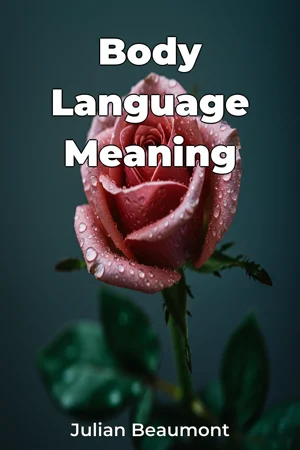
About This Book
Have you ever wondered what your body is saying when your words don't? This book, *Body Language Meaning*, delves into the fascinating world of nonverbal communication, exploring the subtle cues that reveal our deepest emotions and desires, particularly within the context of erotic and emotional signals. Understanding body language is vital for fostering better relationships, improving communication skills, and gaining a deeper understanding of human psychology. This book examines the nuances of nonverbal cues, moving beyond simple interpretations to reveal the complex interplay of signals that influence our interactions. We will examine not only what these signals are, but also the 'why' behind them, shedding light on their evolutionary and social roots. We begin by establishing a foundation in the science of nonverbal communication, tracing its origins from Darwin's early work on emotional expression to modern neurological studies. This background provides a necessary framework for understanding the biological and psychological underpinnings of body language. No prior knowledge of psychology is required, as we will explain key concepts in an accessible manner. The central argument of this book is that nonverbal communication is a critical, often overlooked, component of human interaction, particularly in the realms of romantic attraction and emotional intimacy. Accurately interpreting these cues can significantly enhance our ability to connect with others on a deeper level, while misinterpreting them can lead to misunderstandings and damaged relationships. The book is structured in three parts. Part one introduces the fundamental elements of body language, defining key terms and exploring the basic building blocks of nonverbal communication. Part two focuses specifically on erotic signals, analyzing how posture, eye contact, touch, and other cues signal attraction and desire, and how gender, culture and situation all play a role in how these signals are sent and received. Part three explores how emotional signals are displayed; how to recognize these cues and how to respond appropriately and empathetically. Finally, the book culminates with practical strategies for improving your own nonverbal communication skills and decoding the body language of others. Throughout the book, arguments are supported by a wide range of evidence, including observational studies, experimental research, and case studies. The book draws on data from diverse sources, including academic journals, clinical research, and cross-cultural studies. The approach integrates findings from psychology, anthropology, and communication studies. The study of body language naturally connects to several related fields. For instance, it has clear links to sociology, where understanding group dynamics and social interactions is paramount. It also connects to the field of marketing, where nonverbal cues can influence consumer behavior. Furthermore, the book touches upon the legal field, examining how body language can play a role in assessing credibility and deception. This book stands out due to its focus on the integration of both erotic and emotional signals within the framework of family relationships and relationship psychology. It moves beyond a simple catalog of gestures to offer a comprehensive understanding of the subtle and complex ways in which we communicate nonverbally. The book is written in a clear, accessible style, avoiding technical jargon whenever possible. While grounded in scientific research, the presentation is designed to be engaging and relatable for a broad audience. The target audience includes anyone interested in improving their communication skills, deepening their relationships, or gaining a better understanding of human behavior. This book will be particularly valuable for individuals in fields such as counseling, therapy, education, and sales. As a work of non-fiction, the book adheres to principles of accuracy, objectivity, and transparency. All sources are carefully cited, and any limitations in the research are clearly acknowledged. While the book covers a wide range of nonverbal cues, it does not delve into specific medical or psychiatric conditions that can affect body language. The focus remains on typical communication patterns within the general population. The information provided can be applied in numerous real-world settings, from improving communication with loved ones to enhancing professional relationships. By understanding the nuances of body language, readers can become more effective communicators and build stronger, more fulfilling connections with others. While the interpretation of body language is generally consistent, ongoing debates exist regarding the influence of culture and individual differences. The book addresses these controversies by presenting multiple perspectives and encouraging readers to consider the context in which nonverbal cues are displayed.
Have you ever wondered what your body is saying when your words don't? This book, *Body Language Meaning*, delves into the fascinating world of nonverbal communication, exploring the subtle cues that reveal our deepest emotions and desires, particularly within the context of erotic and emotional signals. Understanding body language is vital for fostering better relationships, improving communication skills, and gaining a deeper understanding of human psychology. This book examines the nuances of nonverbal cues, moving beyond simple interpretations to reveal the complex interplay of signals that influence our interactions. We will examine not only what these signals are, but also the 'why' behind them, shedding light on their evolutionary and social roots. We begin by establishing a foundation in the science of nonverbal communication, tracing its origins from Darwin's early work on emotional expression to modern neurological studies. This background provides a necessary framework for understanding the biological and psychological underpinnings of body language. No prior knowledge of psychology is required, as we will explain key concepts in an accessible manner. The central argument of this book is that nonverbal communication is a critical, often overlooked, component of human interaction, particularly in the realms of romantic attraction and emotional intimacy. Accurately interpreting these cues can significantly enhance our ability to connect with others on a deeper level, while misinterpreting them can lead to misunderstandings and damaged relationships. The book is structured in three parts. Part one introduces the fundamental elements of body language, defining key terms and exploring the basic building blocks of nonverbal communication. Part two focuses specifically on erotic signals, analyzing how posture, eye contact, touch, and other cues signal attraction and desire, and how gender, culture and situation all play a role in how these signals are sent and received. Part three explores how emotional signals are displayed; how to recognize these cues and how to respond appropriately and empathetically. Finally, the book culminates with practical strategies for improving your own nonverbal communication skills and decoding the body language of others. Throughout the book, arguments are supported by a wide range of evidence, including observational studies, experimental research, and case studies. The book draws on data from diverse sources, including academic journals, clinical research, and cross-cultural studies. The approach integrates findings from psychology, anthropology, and communication studies. The study of body language naturally connects to several related fields. For instance, it has clear links to sociology, where understanding group dynamics and social interactions is paramount. It also connects to the field of marketing, where nonverbal cues can influence consumer behavior. Furthermore, the book touches upon the legal field, examining how body language can play a role in assessing credibility and deception. This book stands out due to its focus on the integration of both erotic and emotional signals within the framework of family relationships and relationship psychology. It moves beyond a simple catalog of gestures to offer a comprehensive understanding of the subtle and complex ways in which we communicate nonverbally. The book is written in a clear, accessible style, avoiding technical jargon whenever possible. While grounded in scientific research, the presentation is designed to be engaging and relatable for a broad audience. The target audience includes anyone interested in improving their communication skills, deepening their relationships, or gaining a better understanding of human behavior. This book will be particularly valuable for individuals in fields such as counseling, therapy, education, and sales. As a work of non-fiction, the book adheres to principles of accuracy, objectivity, and transparency. All sources are carefully cited, and any limitations in the research are clearly acknowledged. While the book covers a wide range of nonverbal cues, it does not delve into specific medical or psychiatric conditions that can affect body language. The focus remains on typical communication patterns within the general population. The information provided can be applied in numerous real-world settings, from improving communication with loved ones to enhancing professional relationships. By understanding the nuances of body language, readers can become more effective communicators and build stronger, more fulfilling connections with others. While the interpretation of body language is generally consistent, ongoing debates exist regarding the influence of culture and individual differences. The book addresses these controversies by presenting multiple perspectives and encouraging readers to consider the context in which nonverbal cues are displayed.
*Body Language Meaning* explores the world of nonverbal communication and its profound impact on our relationships. It delves into how we reveal emotions and desires through subtle cues, often without realizing it. Did you know that our posture and eye contact can signal attraction, and that misinterpreting these signals can damage relationships? This book helps readers understand the "why" behind these signals, tracing their evolutionary and social roots to improve communication skills. The book uniquely integrates both erotic and emotional signals within the context of family relationships and relationship psychology. Beginning with the science of nonverbal communication, it progresses into the specifics of erotic signals, emotional cues, and finally, practical strategies for enhancing one's own nonverbal communication. Through observational studies, experimental research, and case studies, the book provides a comprehensive understanding of decoding body language. This book offers valuable insights into human behavior, explaining how to recognize and respond to nonverbal cues appropriately. By understanding the complexities of nonverbal communication, readers can foster deeper connections and improve interactions in both personal and professional settings.
Book Details
ISBN
9788235235657
Publisher
Publifye AS
Your Licenses
You don't own any licenses for this book
Purchase a license below to unlock this book and download the EPUB.
Purchase License
Select a tier to unlock this book
Need bulk licensing?
Contact us for enterprise agreements.